
Related videos:
The Cuban regime used the figure of Raúl Castro this Wednesday to legitimize a package of economic reforms, announcing during the Extraordinary Plenary of the Central Committee of the Communist Party that the 94-year-old former leader signed the document of transformations and participated in the session via videoconference.
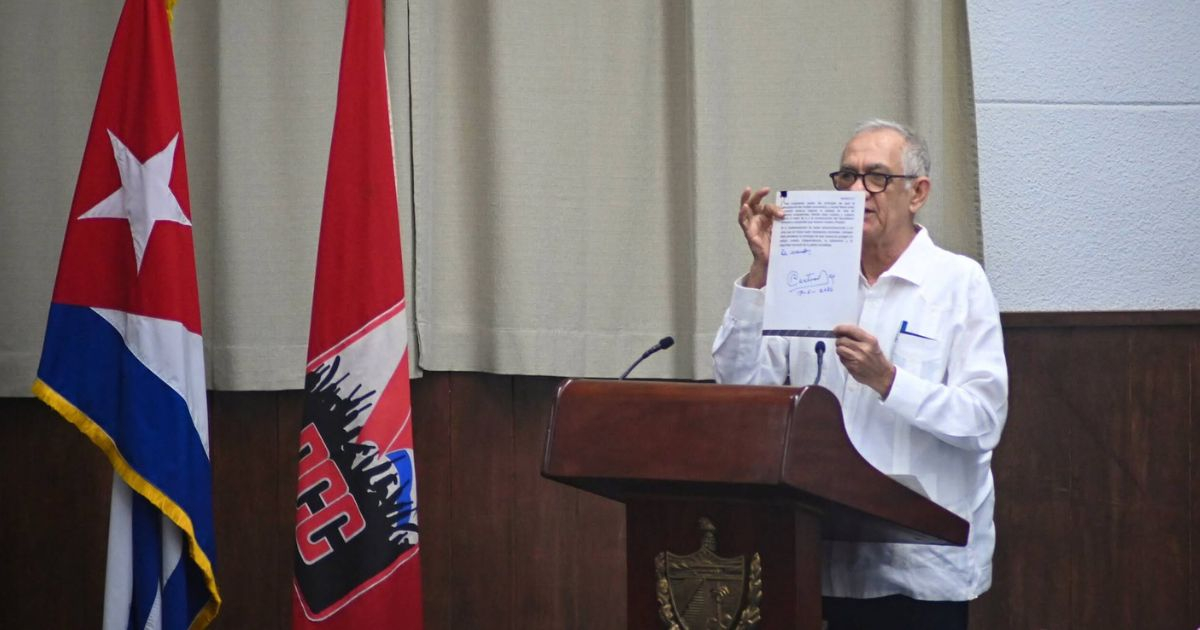
The division general José Amado Ricardo Guerra, a member of the Political Bureau and Secretary of the Council of Ministers, informed the delegates at the plenary that Castro was consulted and expressed "full agreement" with the proposals presented by Prime Minister Manuel Marrero Cruz.
Ricardo physically displayed the signature of the former ruler on the analyzed document, describing it as "unequivocal evidence of his approval and support," while also showing that the nonagenarian is still pulling the strings from the shadows.
According to the official, Castro transmitted a message calling for participation in the meeting to "build the necessary consensus at this crucial moment" and stated that undertaking the proposed transformations "is what is most beneficial for the Revolution today."
The regime also attributed to Castro the warning that "as important as the approval of these transformations is their proper and timely implementation," with defined priorities and what he described as the participation of the people, acting with "their feet and ears firmly on the ground."
The assembly, led by Miguel Díaz-Canel, was convened to endorse a package of over 20 economic reforms that Díaz-Canel himself announced on June 12.
The measures include a reduction in the number of ministries from 27 to 21, greater salary and commercial autonomy for state-owned enterprises, elimination of the requirement to channel imports and exports through the government, expansion of small and medium-sized enterprises (mipymes), and mechanisms to facilitate investment by Cubans abroad.
Raúl Castro's participation via videoconference, rather than in person, highlights the former leader's health condition. In April 2026, Díaz-Canel himself acknowledged that Castro is "retired for health reasons" and that he is "fragile."
On May 1, 2026, when he chaired the event at the Anti-Imperialist Tribune, independent media described him as visibly diminished.
The exhibition of his signature was, in that context, a deliberate gesture of political legitimization amid the worst economic crisis Cuba has faced in decades, characterized by rampant inflation, prolonged blackouts, and widespread shortages.
Skepticism regarding the reforms quickly became evident. Economist Pedro Monreal described them as “late pragmatism” and “an obsolete ruse”, questioning that the reduction in ministries carries “more symbolic weight than transformative impact” and that the package does not address the structural problems of the centralized planning model.
In parallel to the session, there were protests in Santa Clara and demonstrations in Havana, highlighting the social discontent surrounding the process.
For this Thursday, an extraordinary session of the National Assembly has been called to assess and formalize the reforms approved in the plenary.
Filed under: