
Related videos:
Residents of Real Campiña, a rural community in the municipality of Aguada de Pasajeros in the province of Cienfuegos, reported on social media this Saturday a situation they deem unsustainable, as they have been without drinking water for 27 days and experiencing power outages of up to three consecutive days, with no solution offered by the authorities.
"The population asserts that living conditions are extremely difficult and that, despite the constant complaints, they receive no responses or effective solutions from the authorities," explained through her Facebook profile, activist Idelisa Diasniurka Salcedo Verdecia.
A resident in the town confirmed in the comments that the direct cause of the shortage is the breakdown of the turbine that supplied water to the community, a piece of equipment that had already been failing since the previous year.
"27 days have passed since the turbine that supplied the town broke down, but the issue had been ongoing for some time as it was known to have been experiencing various problems since last year, during which we went without water for two three-month periods," he emphasized.
In the absence of any service, families have been forced to turn to the informal market for supplies, Salcedo stated.
He added that a water tank costs between 1,000 and 1,500 Cuban pesos, while a truckload can reach 12,000 pesos, amounts that are unaffordable for most households.
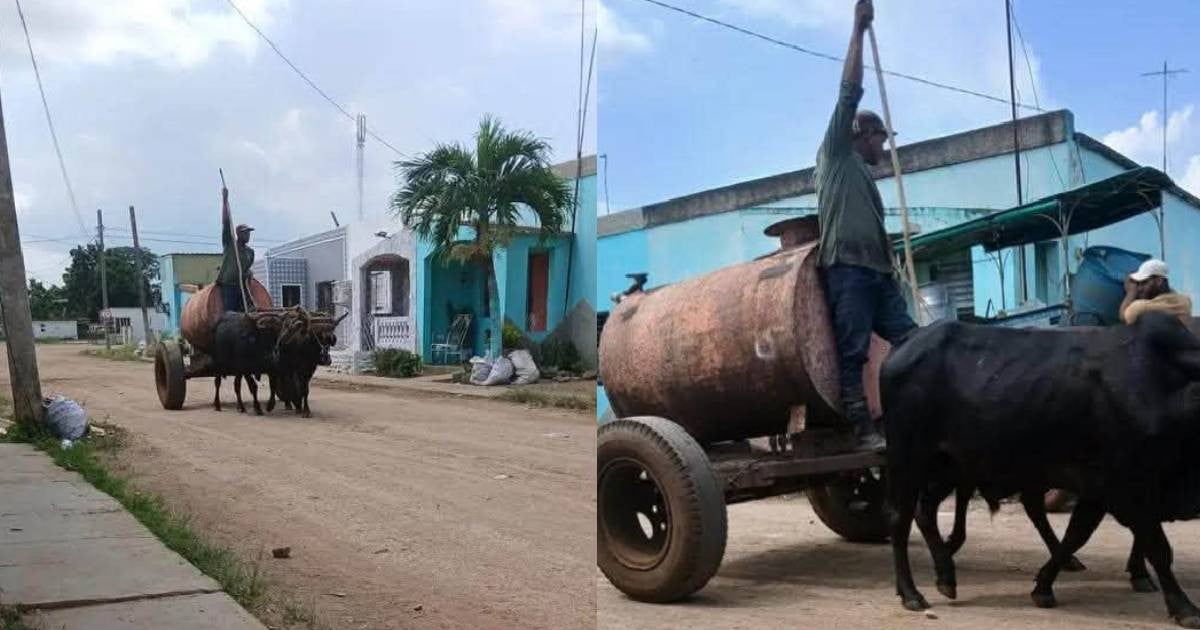
The images accompanying the complaint show an ox-drawn cart transporting a cylindrical tank along dirt roads, a scene that reflects the decline in the living conditions of the town.
Comments from neighbors and Cubans from other provinces reveal that the crisis extends far beyond Real Campiña.
A resident of San Antonio de Río Blanco, in the municipality of Jaruco, in the province of Mayabeque, described her situation harshly: "We have gone 19 days without water and without accurate information. The taps are dry, plus we have power outages lasting over 24 hours. They ask us to be resilient. It’s a slow death."
Another neighbor, from Holguín, mentioned having paid 6,000 pesos for two tanks of 1,200 liters and summarized the situation like this: "We are living in a concentration camp. There is no salary or checkbook that can cover the expenses."
Desperation is also expressed in shorter but equally impactful phrases: "This is a horror movie," wrote one person; "Between the current, the water, and the bad nights, it's enough to drive you crazy," noted another.
"We are living a very sad situation, without food, without water, without the basic and necessary resources to survive. We are losing the best years of our lives, and the future of our children, what will happen?" wrote a resident of Real Campiña, summarizing the sentiments of a community that has been waiting for almost a month for someone to provide a solution.
The case of Real Campiña is situated within a national water and energy crisis that, in June, affects millions of Cubans.
Eighty-seven percent of the country's aqueducts depend on the National Electric System to pump water, making each power outage a simultaneous water cut.
According to official data, around 2.7 million people lack regular access to drinking water, and millions suffer from intermittent supply, while the hydraulic system operates with only 37% of the necessary fuel.
In Cienfuegos, the crisis has documented backgrounds: water arrives with mud and a foul smell in several areas of the province, with possible cross-contamination between drinking water pipes and storm drainage, without an effective response from the authorities.
The blackouts that worsen the water situation show no mercy with outages of over 40 hours this week in various parts of the country, while in Matanzas, residents experienced a total of 85 consecutive hours without electricity between June 14 and June 17.
Filed under: