
Related videos:
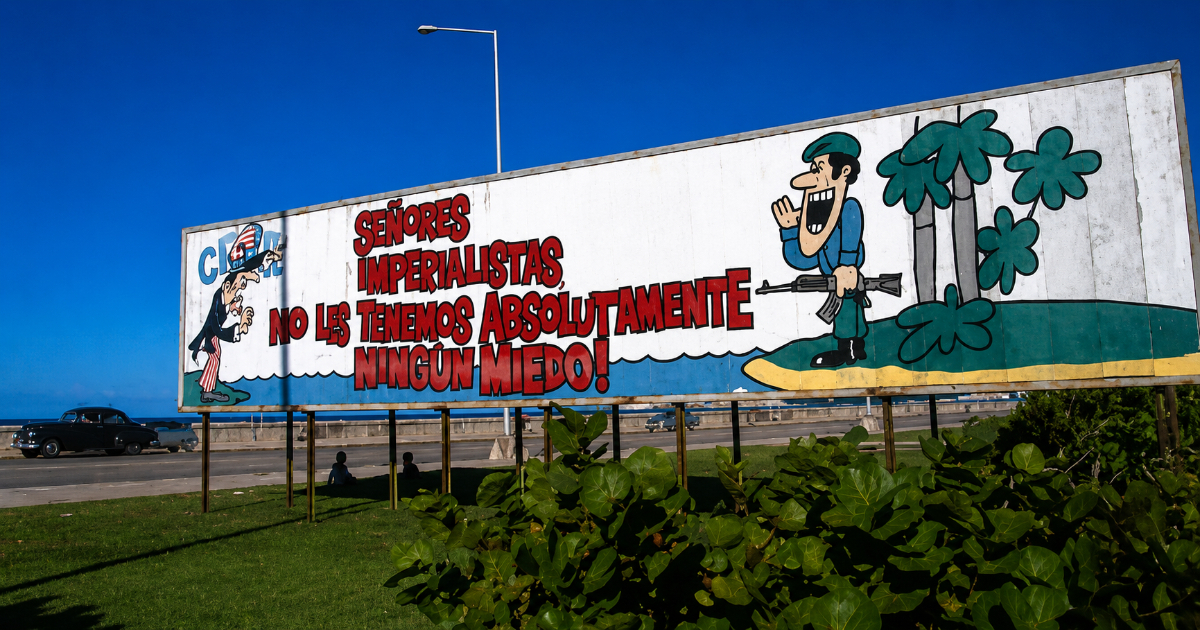
For decades, anti-imperialism was much more than a political slogan in Cuba. It was one of the central ideas on which the regime built its legitimacy.
It served to explain Cuban foreign policy, to justify internal sacrifices, to unify the country against a common enemy, and to project the so-called "Cuban revolution" internationally as a symbol of resistance against the United States.
Anti-imperialism was everywhere. In the speeches of the dictator Fidel Castro. In the documents of the Communist Party. In school textbooks. In youth organizations. In the official press. In "revolutionary diplomacy." In international forums. In the Non-Aligned Movement. In solidarity campaigns with Latin America, Africa, and Asia.
For over half a century, the revolution portrayed much of its history as a continuous struggle against the dominating pretensions of "Yankee imperialism."
It is striking, therefore, that in the recent speeches and statements of figures connected to the center of power, that language seems to have disappeared.
An absent word
In his first public interview, Raúl Guillermo Rodríguez Castro, known as El Cangrejo, discussed dialogue, mutual respect, civilized relations, investments, business, and cooperation.
He didn't talk about imperialism. He didn't talk about anti-imperialist struggle, imperial aggressions, or resistance against the empire.
The same is true for much of the recent rhetoric of the regime. Concepts that for decades occupied the center of political discourse have lost prominence or are increasingly relegated.
It doesn’t seem coincidental. The context in which the Cuban leadership operates today is radically different from the one that allowed for the construction of that narrative.
The usefulness of anti-imperialism
For much of the Cold War and even afterward, anti-imperialism proved to be extraordinarily useful for the regime.
It allowed for the explanation of international conflicts. It permitted the denunciation of U.S. sanctions. It justified the political exceptionalism of the Cuban system. It allowed for presenting economic difficulties as a result of a permanent external aggression.
And, above all, it allowed to build a legitimacy based on resistance.
The Revolution did not merely present itself as a political project. It was a trench. Power did not only govern; it resisted.
This narrative granted the regime a moral authority that was difficult to challenge within its own ideological frameworks. Anyone who criticized the system could be portrayed as someone who weakened national resistance. Those who defended the regime also defended sovereignty against the external enemy.
Anti-imperialism was, at the same time, a political doctrine, a tool for mobilization, and a source of legitimacy.
When reality changes
But the circumstances that made that discourse functional are no longer the same.
The Cuban economy is experiencing a deep crisis, exacerbated by the capture of Nicolás Maduro and U.S. pressure. The regime needs investments to survive. It requires funding, access to markets, and stabilization of the National Electric System.
It also needs to rebuild international economic relations. Above all, it needs to find a way out of a situation that threatens the very survival of the system.
This economic pressure is compounded by another reality.
Havana is increasingly positioned to negotiate with the same country that for decades played the role of "historical enemy." The possibility of agreements with Washington is no longer a secondary issue; it has become a strategic necessity.
And those possible understandings are not solely centered around economic issues. They also involve demands for openness, institutional reforms, regulatory changes, and transformations that directly impact the model established by the totalitarian communist regime.
In this context, the old anti-imperialist discourse ceases to be a useful tool. It begins to become an obstacle.
The white elephant of the Revolution
That is the dilemma facing the ruling elite today.
It cannot claim anti-imperialism with the same intensity as in previous decades. It needs to engage in dialogue, negotiate, and project an image of pragmatism. It must convince potential capitalist economic partners that Cuba is a stable and predictable place.
But neither can it openly repudiate anti-imperialism. To do so would be to question a fundamental part of the historical narrative upon which it built its political authority. It would be to admit that one of the great ideological pillars of the "Cuban revolution" has ceased to serve the purpose for which it was conceived.
Therefore, the result seems to be silence. There is no explicit review taking place. No doctrinal change is acknowledged. Simply, the subject is no longer discussed. As if the problem could vanish through omission.
An uncomfortable inheritance
The paradox is evident.
For decades, the regime taught several generations of Cubans that anti-imperialism was a moral and political obligation. It presented it as a hallmark of national identity and made it an inseparable element of revolutionary political culture.
Today, however, the heirs of that same system seem to feel much more at ease discussing investments, business, international cooperation, and dialogue with the United States than reclaiming those old slogans.
The transformation is significant. Because anti-imperialism was not a marginal idea within the revolution. It was one of the foundations upon which policies, sacrifices, and historic decisions have been justified for more than sixty years.
What no longer fits
Perhaps the problem for the regime is not that anti-imperialism has ceased to exist. Perhaps the problem is that it no longer aligns with the reality it needs to manage.
Current Cuba seeks to attract foreign investment. It needs to rebuild diplomatic bridges. It aims to alleviate the economic pressures that threaten its stability.
And it does so while trying to maintain the historical legitimacy of a system that built much of its identity precisely on the confrontation with the United States.
That is why anti-imperialism has become an uncomfortable legacy. A constant reminder of a narrative that for decades was essential for the political survival of the regime, but today hampers some of its most urgent goals.
The question is no longer what anti-imperialism meant for the "Cuban revolution." The question is what a political elite does when one of the banners that most contributed to legitimizing its power becomes an obstacle to ensuring its "continuity".
And that is a question for which, so far, the regime seems to have not found a convincing answer.
Filed under: