
Related videos:
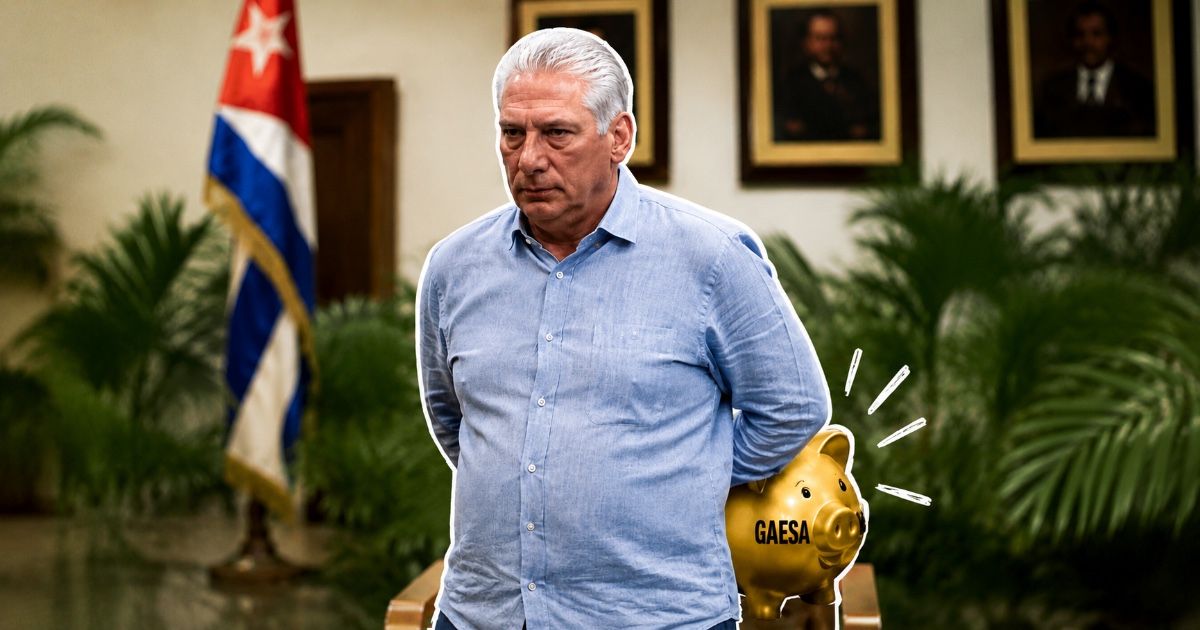
The Cuban economist Mauricio de Miranda, a member of the Cuba Transformación group, pointed out this Wednesday that the package of 176 economic measures announced by the regime of Miguel Díaz-Canel completely omits any reference to GAESA, the military-financial conglomerate that controls a significant portion of the island's economy.
De Miranda stated bluntly in an interview with Tania Costa: "It doesn't appear in the 176 measures even remotely. Not even remotely is there anything related to the transformation of GAESA, or the dismantling of GAESA, or the elimination of GAESA, which ultimately is what I think should happen."
The economist was unequivocal about the very nature of the conglomerate: "That shouldn't exist. GAESA is a military and financial entity. What are the military doing in business? What are the military doing buying and selling? What are the military and state security doing engaging in financial operations of dubious... with dubious mechanisms?"
According to Mauricio De Miranda, the mission of the Armed Forces and state security has a clear limit. “I believe that the responsibility of the Armed Forces and State Security is to defend the country and ensure the safety of the nation, of the state, not of the government. They are institutions that respond to society, to the country, to the state, not to the government.”
The economist's argument points directly to market logic. "Businesses should be in the hands of those who are dedicated to business. The Armed Forces should not be engaging in business."
What worries De Miranda the most is not only the commercial activity of the military but also its lack of transparency. "It makes no sense whatsoever for there to be a military and financial empire controlling a considerable part of the country's economy that cannot be audited by the state's regulatory entities. That cannot happen."
This criticism is supported by the regime's own legal mechanisms. The Law 158 of 2022 shielded GAESA by explicitly eliminating the possibility for the General Comptroller to audit military institutions, leaving that control solely in the hands of Díaz-Canel. In 2024, then Comptroller Gladys Bejerano publicly admitted that GAESA was not under her supervision.
The 176 measures were approved on June 19 during an extraordinary session of the National Assembly, presented by Prime Minister Manuel Marrero Cruz. The package includes the transformation of state-owned enterprises into joint-stock companies, the creation of private banking, the removal of the 100-employee cap for micro, small, and medium enterprises (Mipymes), and greater openness to foreign investment, including Cubans abroad.
However, the Cuba Transformación group has warned that without addressing the power of GAESA —which controls between 40% and 70% of Cuba's formal economy, according to estimates by economist Pedro Monreal— the reforms risk leading to an oligarchic capture of the state in a Russian style, benefiting elites connected to military and political power.
Other analysts share this concern. Economist Miguel Alejandro Hayes warned that the measures do not aim for real development but rather to reconstruct the political pact that sustains the regime, and the organization Food Monitor Program warned this Wednesday about the risk that the reforms could lead to a "crony capitalism".
Cuba Transformación, the group of five Cuban economists that includes De Miranda alongside Pedro Monreal González, Pavel Vidal Alejandro, Omar Everleny Pérez Villanueva, and Ricardo Torres Pérez, estimates that the Cuban economy could contract by at least 15% of GDP in 2026 due to the energy crisis, inflation, and the shortage of foreign currency.
Filed under: