
Related videos:
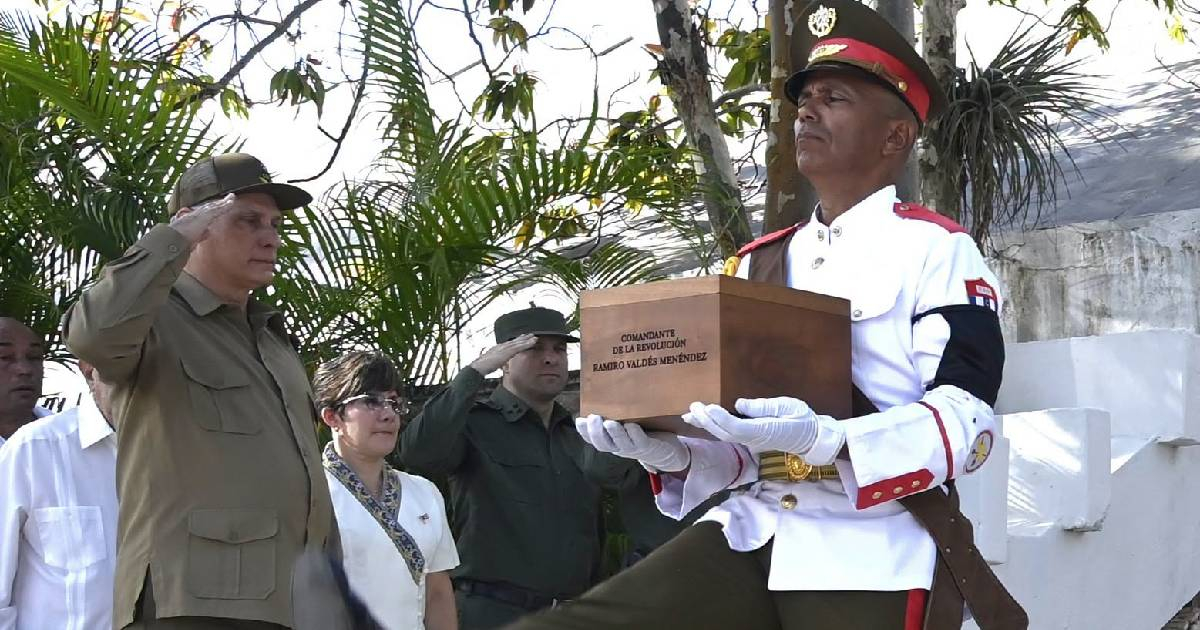
The remains of Ramiro Valdés Menéndez were interred this Thursday at the Ernesto Che Guevara Sculptural Complex in Santa Clara, during a military honors ceremony presided over by Miguel Díaz-Canel and attended by the leadership of the Cuban regime.
The ashes of the former founder of the Ministry of the Interior were placed in the first niche to the right of the eternal flame of the Mausoleum of the Front of Las Villas, which Valdés inaugurated on October 8, 2009, by lighting that flame with his own hands.
Díaz-Canel delivered the farewell remarks before an audience that included members of the Political Bureau: Esteban Lazo Hernández, President of the National Assembly; Bruno Rodríguez Parrilla, Minister of Foreign Affairs; Gladys Martínez Verdecia, First Secretary of the Party in Artemisa; and Commander José Ramón Machado Ventura.
Combatants from the Revolutionary Armed Forces and the Ministry of the Interior also attended, alongside around two thousand people convened to represent the people of Villa Clara.
In the Mausoleum of the Las Villas Front rest another 140 combatants from the 8th Column Ciro Redondo —of which Valdés was second in command under the orders of Che Guevara—, the July 26 Movement, the Revolutionary Directorate 13 of March, and the Popular Socialist Party, grouped by the historic Pedrero Pact.
The choice of location was a direct expression of Valdés's wish to rest alongside his fellow comrades and close to Che Guevara, with whom he fought during the Battle of Santa Clara in December 1958.
To prepare for the burial, the regime mobilized companies and agencies in Villa Clara to rapidly restore the Sculptural Complex: cleaning of marble and granite, improvements in landscaping and lighting, painting, waterproofing of the museum, and replacement of carpentry, all amidst one of the worst economic crises the Island is experiencing, with hospitals lacking medications and extended blackouts.
Valdés passed away on Sunday, June 21, at the age of 94. Born in Artemisa in 1932, he participated in the assault on the Moncada Barracks, the Granma expedition, and the guerrilla campaign up to Santa Clara. He was a founding member of the MININT in 1961 and instrumental in the repressive apparatus of the Cuban state, including the forced labor camps known as UMAP, where homosexuals, religious individuals, and dissidents were interned. His detractors referred to him as "the Butcher of Artemisa."
On Sunday, June 22, the regime declared an official mourning period through Presidential Decree 1247. Raúl Castro, 95 years old, reappeared on Monday at the headquarters of the Ministry of the Armed Forces in Havana to lead the first honor guard alongside Díaz-Canel.
With the death of Valdés, the so-called historical generation of the Revolution is reduced to two figures: Raúl Castro and Guillermo García Frías.
While the regime was bidding farewell to one of the pillars of its control apparatus, Cuban-American Congress members María Elvira Salazar and Carlos A. Giménez lamented that Valdés died without being held accountable for crimes against humanity, summarizing their position in one phrase: "He dies without being able to pay on earth."
Filed under: