
Related videos:
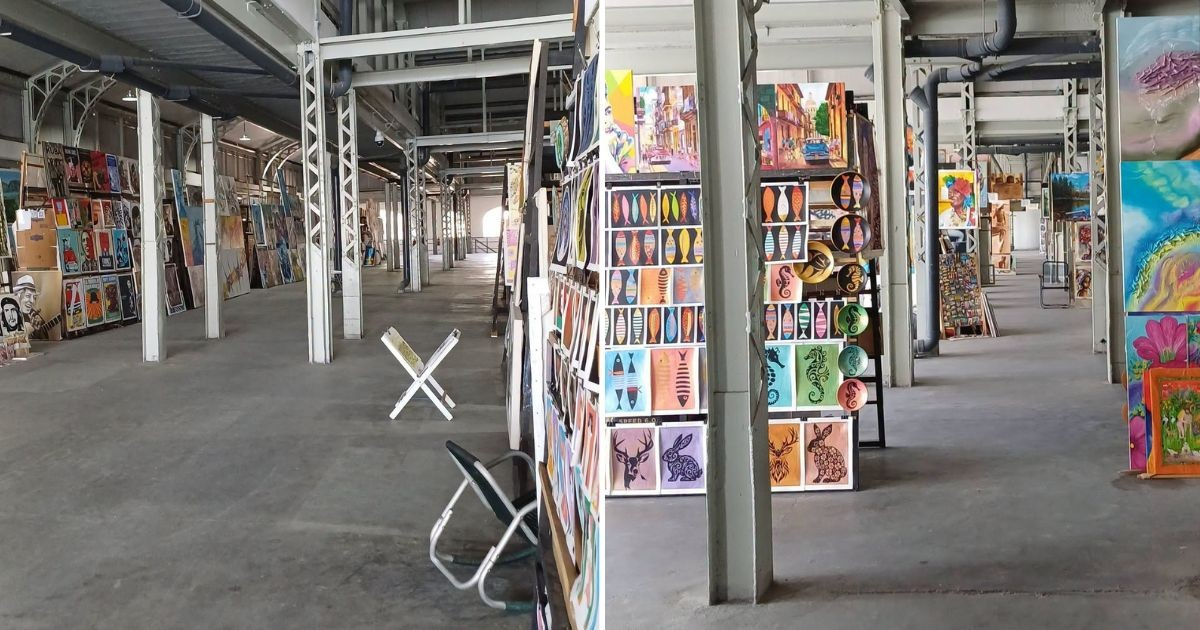
A Cuban painter with more than three decades of experience at the Almacenes San José in Old Havana warned that the closure of the iconic art and craft market could be imminent, after observing weeks without foreign visitors and a ground floor with dozens of closed stalls.
Jorge Delgado shared his testimony on Facebook with a tone of resignation that was hard to conceal: "Today I was at the fair, and the reflection and impression I got is that the days until the San José warehouses close are numbered. In the upper part, where our painters display their paintings, no tourists have been seen for several weeks."
Delgado has spent 35 years showcasing his paintings in that venue, which makes his reflection more than just a complaint: it is the anticipatory mourning of someone witnessing the disappearance of the space that defined his professional life.
"If there are no tourists in Cuba, it doesn’t make sense for us to be paying; one does it because the last thing to lose is hope," wrote the artist, before acknowledging that "an immediate solution is not in sight."
The situation you describe is not exclusive to Almacenes San José.
Other users who responded to his post confirmed that the crisis extends throughout the city and beyond. Roberto Segundo Rodriguez Hernandez noted that "the Obispo fair is also empty," while Carlos Manuel Deus Marcote pointed out that the same thing happens in Varadero: "Continuing to pay taxes without having anyone to sell to and spending a good amount of money on transportation. There's no way to understand that."
The visual artist Jorge Luis Betancourt was even more emphatic: "It is really absurd to pay for something without benefits. Everything here has collapsed, and tourists, I doubt it. We have hit rock bottom irreparably. We need to reinvent ourselves, and I don't think it will be in art. As a visual artist, I hung up my paintbrushes since the pandemic."
The desolation described by Delgado is backed by brutal statistics.
Cuba received only 328,608 tourists between January and April 2026, a drop of 55.8% compared to the same period the previous year. In March, the monthly figure plummeted to 35,561 visitors, a year-on-year decline of 79%.
In the peak of 2019, the island welcomed 4.6 million tourists. If the current pace continues, 2026 could end with fewer than one million visitors, the worst record since the pandemic.
The causes are multiple and structural: a shortage of aviation fuel that led to massive flight cancellations, U.S. sanctions against hotel chains, prolonged blackouts, and widespread deterioration of the tourism infrastructure.
Hotel occupancy in Cuba fell below 10% in the first quarter of the year.
The San José Warehouses, located on Avenida del Puerto facing the Havana harbor, were inaugurated as a crafts fair on November 1, 2009, following a restoration supported by the Office of the Historian of Havana.
The building has roots that date back to 1847 and houses over 100 stalls where Cuban artisans and creators sell paintings, textiles, ceramics, jewelry, and leather goods.
Ange Rivero summarized in a few words what many feel while walking through Old Havana: "I was in Old Havana and came out feeling shattered by seeing everything empty." Willy Santiesteban concluded with a phrase that seems like an epitaph: "It was beautiful... while it lasted."
Filed under: