
Related videos:
Miguel Díaz-Canel acknowledged this Tuesday that the implementation of the 176 economic and social measures approved by the regime will require a way of acting different from what was outlined in the Economic Plan 2026 itself, the main planning instrument approved just a few weeks ago by the National Assembly.
"The economic actors need to work in a different dynamic, one that cannot be the one reflected in the report of the Economic Plan," stated the leader during the Council of Ministers meeting, as published by the official site of the Presidency of Cuba.
The statement represents an acknowledgment that the new measures will have to diverge from the document that the Government itself presented as a guide to economic policy for this year.
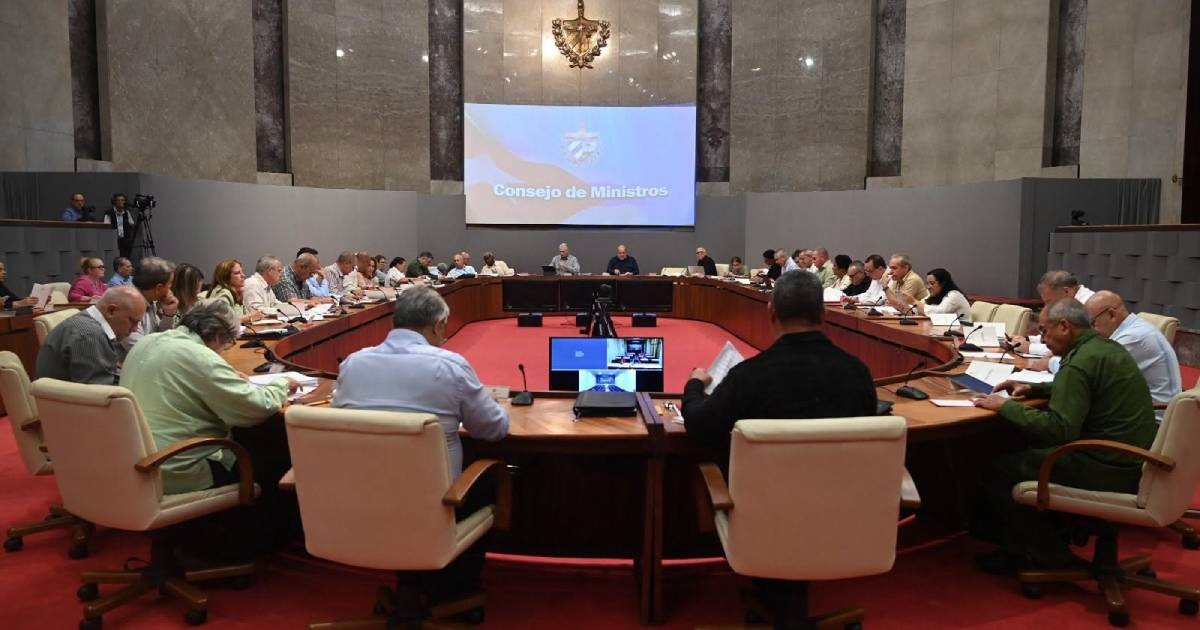
The session, led by Prime Minister Manuel Marrero Cruz, was dedicated to defining the roadmap for implementing the package of 176 transformations grouped into 23 pillars, approved by the National Assembly on June 19th.
Díaz-Canel's words come at an especially complex moment for the Cuban economy. The Economic Commission for Latin America and the Caribbean (ECLAC) predicts a contraction of 6.5% of GDP in 2026, the worst in Latin America for the second consecutive year, while the Island's economy has accumulated a decline of nearly 26% since 2020. Furthermore, in the first half of the year, exports of goods barely reached 62% of what was planned.
The authorities themselves had previously acknowledged the limitations of the Economic Plan. The Minister of Economy and Planning, Joaquín Alonso Vázquez, described it as "the bare minimum," while the Parliament's Economic Affairs Commission warned that the projected growth of 1% "does nothing to improve the current situation."
During his speech, Díaz-Canel once again attributed the crisis to the U.S. embargo.
"We are facing a complex dilemma that we can solve: how to maintain the continuity of the socialist construction process on a small Caribbean island that has endured the longest blockade in the history of humanity by the most powerful nation in the world," he stated.
The leader also stated that the reforms will depend on the support of the citizens.
"We will not succeed in properly implementing the transformations if the population does not participate," he stated.
For his part, Manuel Marrero stated that "the greatest transformation must be in our way of thinking" and explained that the document was modified after receiving 673 proposals, of which the Government incorporated 79%.
Among the first measures to be implemented are the decentralization of the approval of wholesale and retail prices, the ability for provincial governments to create or dissolve local state-owned enterprises, the authorization for an individual to own more than one private company, and the removal of the limit of 100 workers for micro, small, and medium-sized enterprises (mipymes).
The Cuban economist Pedro Monreal questioned the scope of the reforms and described the package as a "deformed hybrid." He noted that the verb "permit" appears 29 times in the document, which, in his view, reflects a logic of administrative concessions rather than the acknowledgment of permanent economic rights.
It is not the first time that the Government has acknowledged the failure of its economic strategies. In December 2024, Díaz-Canel admitted that the economic revitalization plan launched a year earlier had not yielded the expected results and stated at that time that "we are not programmed robots." In that same meeting, Vice Prime Minister José Luis Tapia Fonseca summarized the official diagnosis with another phrase: "We think we are doing well, but we are very far from meeting the needs of the population."
Filed under: