
Related videos:
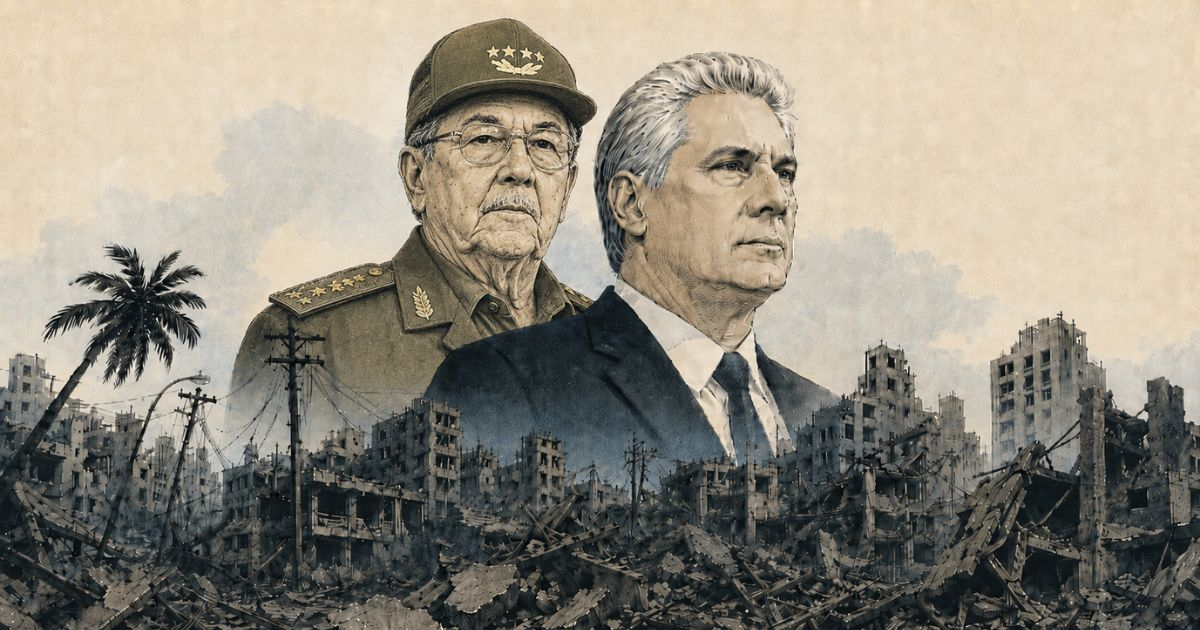
The Cuban leadership calculated a long time ago. They decided that they prefer to rule over ruins rather than risk power in a transition.
That is the key to understanding why the dictatorship does not yield. It does not cling to revolutionary rhetoric because it believes in it, but because the narrative of a besieged plaza is the excuse that transforms its downfall into epic. Without that story, the collapse would be what it is: the responsibility of those in power. With it, it disguises itself as a heroic sacrifice against an external enemy.
The regime not only tolerates the catastrophe: it has turned it into a method. The decline depopulates the country, exhausts civil society, and fuels the perpetual excuse of the embargo. And every plane that takes off releases, through migration, the pressure that would, in another context, turn against the power. The one who becomes desperate —or the one who is cornered— leaves, and with them departs the energy that could organize change.
Thus, hunger ceases to be a failure of the system and becomes its tool. Blackouts, the lack of medications, empty shelves: none of this threatens the leadership as long as the repressive apparatus continues to function.
The limit exists, but it is not on the street. It lies on the day when the regime can no longer pay for itself. No repressive apparatus survives when it cannot pay those who carry out the repression. That is where the only real crack is, not in a voluntary reform that will never come.
The pressure from the U.S. has not failed due to a lack of intensity, but rather due to a lack of dialogue partner. One cannot negotiate with someone who has no intention of negotiating and is merely stalling for time.
Trump and Rubio have pushed things to the limit: sanctions against Díaz-Canel and the Castro family, actions against GAESA and its business network, pressure on the missions related to slave labor doctors, warnings about the use of force. The regime's response has been the same as always: victimhood, the rhetoric of a besieged plaza, and no substantive movement. Not because the pressure doesn't hurt, but because any real concession threatens what matters most to them: remaining in power.
There is no alternative. And not because Cuban society does not want real change, 80% of Cubans support a transition to a capitalistic model of liberal democracy, but because the regime does not allow it. In the face of that obstinacy, Marco Rubio cannot hesitate. Allowing the dictatorship to remain unscathed for more years over the rubble it itself caused would not be a miscalculation: it would be an unforgivable omission.
Because, as long as no one stops them, they will continue to govern over the ruins of Cuba.
Filed under:
Opinion article: Las declaraciones y opiniones expresadas en este artículo son de exclusiva responsabilidad de su autor y no representan necesariamente el punto de vista de CiberCuba.