
Related videos:
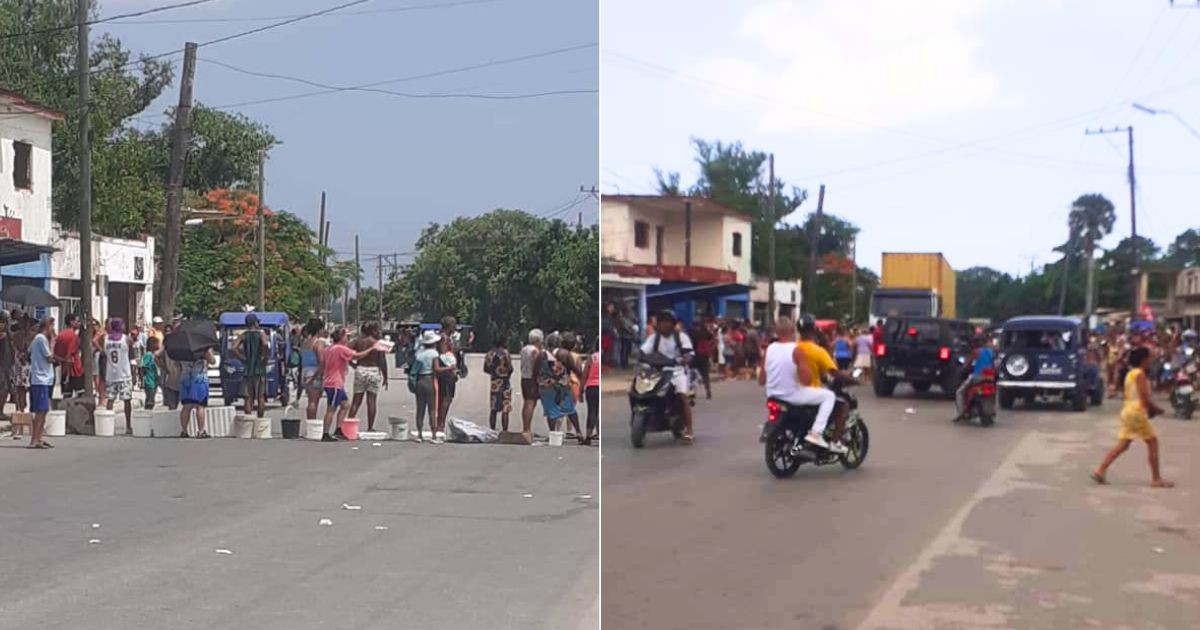
Residents of the Mantilla neighborhood in the Arroyo Naranjo municipality of Havana, blocked the Calzada de Managua this Sunday to demand drinking water after more than two months without regular supply, with temperatures exceeding 30°C.
The protest was shared through the community group "Somos Mantilla (Official Group)" on Facebook by Radimir Galán Rodríguez; and regarding its causes, the professor and former neighbor of the area Gretel Lobelle: "88°F temperature. It's been more than two months since water has come into Mantilla. A small tank of well water costs 2500 pesos; a truckload, 40 thousand.", she wrote.
Lobelle starkly described the survival mechanisms adopted by the residents of the neighborhood: "Many ask me how people manage to get by, with water thieves, meters and meters of hoses from areas where water actually arrives, and people loading up from wells that have existed for a lifetime. People have already gotten used to surviving by storing water in whatever they can find."
It is a neighborhood with decades of accumulated deficiencies. "It is a peripheral neighborhood, home to humble people, that deep community I have experienced firsthand," said Lobelle, who also recalled that Mantilla had access to aqueduct water and a drainage system in the year 2000, infrastructure that has since deteriorated without replacement.
The protest this Sunday did not come out of nowhere. On June 7, Mantilla had already gone seven consecutive days without water and residents rushed desperately to fill any container when a water truck arrived. Earlier, on April 2, a resident had reported a leak on Progreso street that mixed water with accumulated garbage, due to the inaction of the state company Aguas de La Habana. And on March 12, the neighborhood had already witnessed pot banging and street blockades in the context of prolonged blackouts.
Following the blockade this Sunday on the Calzada de Managua, authorities are said to have sent two or three water trucks to the neighborhood. However, residents emphasize that this doesn't address the underlying issue. Lobelle was skeptical yet understanding of those who took to the streets: "It’s likely they’ll just provide a little water. A protest isn’t something that really moves the leaders, but at least that group of people is expressing themselves as human beings, and for a moment, they stop feeling like animals just trying to survive."
The situation in Mantilla is a reflection of a water crisis affecting the entire capital. Over 376,000 residents of Havana lack regular access to drinking water, and nationwide about 2.7 million Cubans suffer from shortages, while several millions experience intermittent supply. The 87% of the supply system relies on the electric grid, which means that power outages of up to 22 hours a day directly disable water pumps across the island.
In the informal market, private water trucks and illegal pumps are reaching prohibitive prices: trucks carrying between 8,000 and 10,000 liters are sold for between 18,000 and 26,000 Cuban pesos in Havana, and the illegal pumps known as "water thieves" can cost up to 36,000 pesos. In Mantilla, according to Lobelle, a truck can reach up to 40,000 pesos, a figure that exceeds even these averages and highlights the severity of the crisis in this neighborhood.
Since March 2026, more than twelve municipalities in Havana have staged similar protests involving road blockades, pot-banging, and barricades: El Cerro, Guanabacoa, Regla, Marianao, Playa, Luyanó, Diez de Octubre, Alamar, Boyeros, San Miguel del Padrón, and Centro Habana, among others. The organization Cubalex documented at least 14 arrests linked to these mobilizations. The regime's response has consistently been the timely dispatch of water trucks under social pressure, without addressing the structural causes of a collapsing water system.
Filed under: