
Related videos:
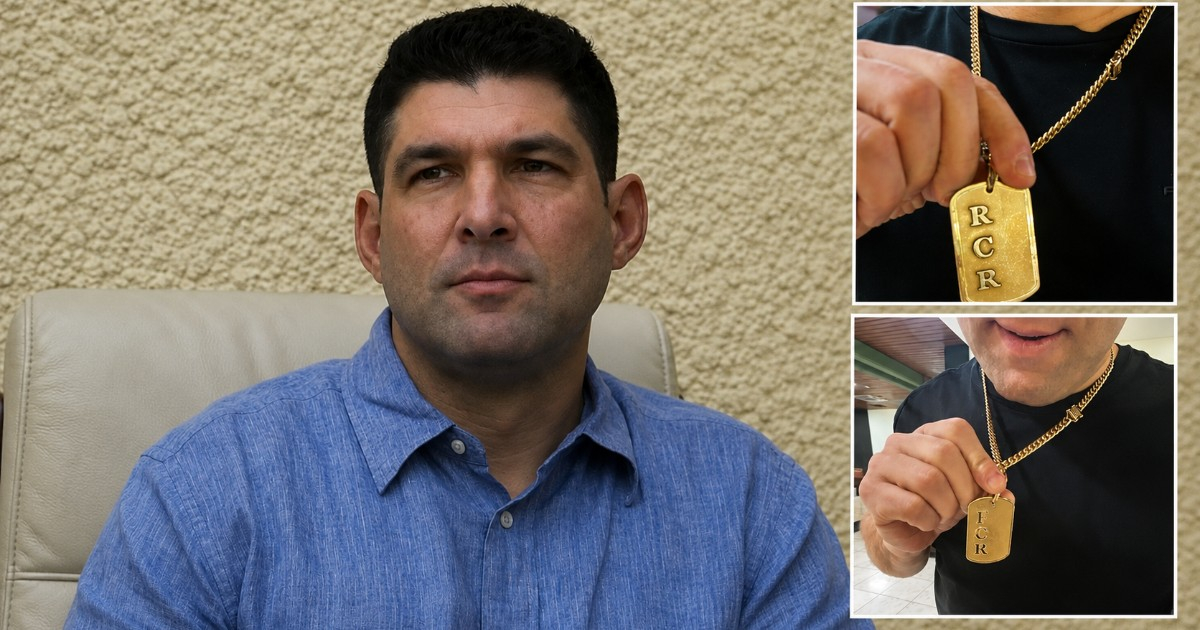
Dressed in light blue jeans, a black Hugo Boss t-shirt, and Hermès sneakers, Raúl Guillermo Rodríguez Castro took out a gold chain with a medallion engraved with the initials "FCR" and "RCR" —Fidel Castro Ruz and Raúl Castro Ruz— and held it in front of the in Havana. "If there's one thing I believe in, it's in these two men," declared the 42-year-old grandson of Raúl Castro, known as El Cangrejo, in his first interview with a U.S. media outlet.
The meeting took place in the same office that his grandfather occupied at the Havana Convention Center, the seat of the Cuban parliament. Rodríguez Castro does not hold an official government position, but he is a colonel in the Ministry of the Interior and has been the head of Raul Castro's General Directorate of Personal Security since 2016. Every morning, he keeps the classified reports he reads from 5 a.m. in a Salvatore Ferragamo leather briefcase.
The gesture of the medallion encapsulates his stance in the world: an ideological heir to a revolution that he defends unreservedly, albeit with a lifestyle radically different from that of his predecessors.
In the interview, El Cangrejo offered to negotiate directly with Trump regarding the future of Cuba: “I can negotiate with anyone appointed by the U.S. If given the opportunity, of course I would negotiate with Trump.” At the same time, he outlined his ideological boundaries: “I have never been interested in politics. It has never been a calling of mine. But if the revolution needs me at any point, I will do it.”
His public emergence occurs under extreme pressure. Trump's Executive Order 14380, signed in January 2026, imposed secondary tariffs on those supplying oil to Cuba, collapsing energy imports by between 80% and 90%. The result: blackouts of up to 25 hours daily across more than 55% of the territory and a projected GDP contraction of -6.5% for 2026, while Cubans survive on salaries ranging from 10 to 15 dollars a month.
That contrast does not seem to escape him. “It hurts me that many people cannot live like I do”, he admitted. “It weighs on me how people struggle. And I work every day to change that situation.” However, according to a joint journalistic investigation, he made at least 23 trips on a private jet to Panama between 2024 and the end of 2025 for luxury purchases.
Frank Mora, professor of international relations at Florida International University, defines him unambiguously: "He is the favorite grandson. Raúl Castro trusted his father, and he is the grandson he loved the most." His father was the late General Luis Alberto Rodríguez López-Calleja, who led GAESA —the military conglomerate that controls a substantial part of the Cuban economy— until his death in 2022.
The nickname has a physical origin: he was born with six fingers on his right hand and underwent three surgeries before the age of eight. As a teenager, he attended state meetings, including the debates between Fidel and Raúl Castro, which earned him a second nickname: Raulito.
Regarding political prisoners, Rodríguez Castro stated that Cuba is willing to release them "under appropriate conditions," although he added evasively: "The truth is not absolute."
Ricardo Herrero, executive director of the Cuba Study Group, provides a critical analysis of his rise: "This administration has helped create Raulito. It has achieved consensus among the various factions of the Cuban state in favor of market opening. But that is not enough for those surrounding Rubio, who want to see a political change, not just an economic one."
Filed under: