
Related videos:
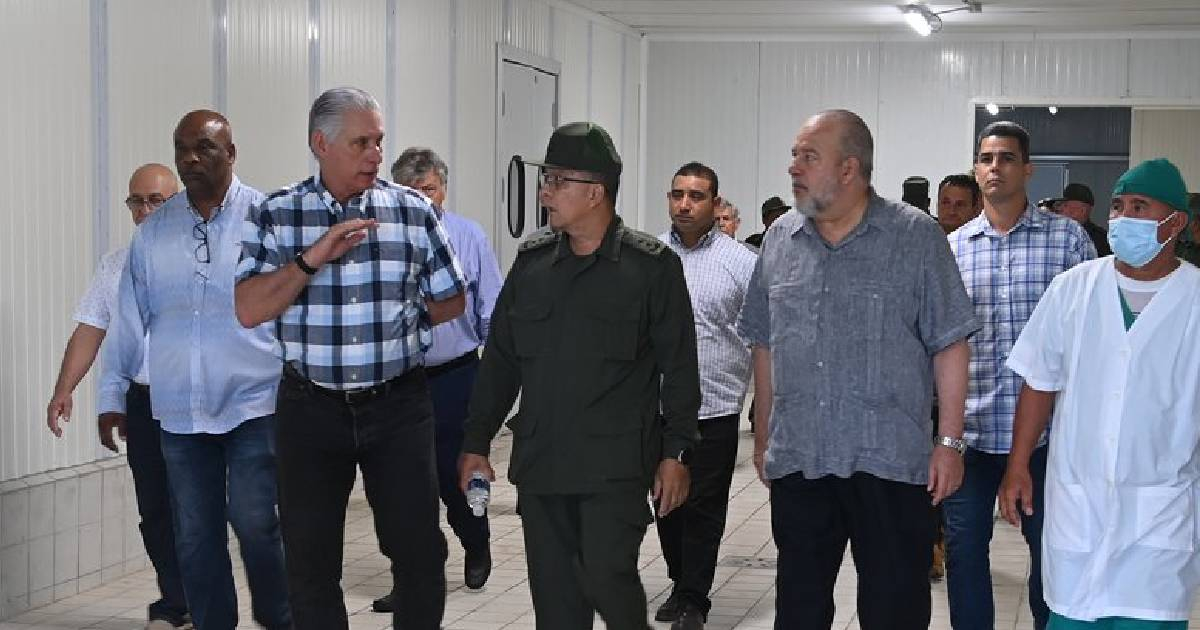
While millions of Cubans have been without electricity for days following the third total collapse of the National Electric System (SEN) in 2026, Miguel Díaz-Canel and Prime Minister Manuel Marrero Cruz visited industrial workshops in Havana on Wednesday to, according to the official site of the Presidency, "verify innovative energy and construction solutions".
The tour included the Minister of the Armed Forces, General Álvaro López Miera, and several members of the Council of Ministers. They visited a production workshop for expanded polystyrene panels with welded mesh—a system that, as explained, saves between 20% and 30% of cement and over 50% of steel compared to traditional construction—and an assembly line for solar panels that has manufactured more than 3,200 units so far this year.
The regime stated that, with the arrival of new investors and equipment, that factory could reach a production of 120 panels daily in two shifts. Díaz-Canel, according to the official statement, "highlighted these modern, agile, and functional solutions, and called for the generalization of these experiences to other regions and entities of the nation."
The contrast with the reality experienced by the population is hard to ignore. The total blackout last Monday —the seventh in 18 months— left approximately 9.6 million people without electricity following the unexpected shutdown of Unit No. 6 at the Nuevitas thermoelectric plant in Camagüey, which triggered a cascading disconnection.
By Wednesday, the restoration was only partial: in Havana, around 262,369 customers had been reconnected, just over 30% of the service. In Matanzas, the outages accumulated 87 consecutive hours; in Granma, up to 72 hours. Early on that same Wednesday, pot-banging protests were reported in Alamar and La Hata, in Guanabacoa.
The magnitude of the collapse is evident from the numbers from the system itself: the generation deficit reached 2,206 MW on July 3, just two megawatts below the historical record set on June 25.
At least 11 of the country's 16 thermoelectric units were out of service, and 106 distributed generation plants remained idle due to a lack of fuel, with 890 MW unavailable. The actual availability of the National Electric System ranged from 935 to 944 MW against a demand of between 3,100 and 3,150 MW.
The official site attributed the crisis to the "intensification of the U.S. government's embargo and the oil blockade, which has exceeded six months." Cuba produces only about 40,000 barrels of oil per day when it needs between 90,000 and 110,000.
However, the crisis has structural roots that far precede the most recent sanctions: an aging thermoelectric park, decades of lack of investment and maintenance, and an energy dependence that the government itself had warned in December 2025 would make 2026 a "difficult" year.
In that context, the production of 3,200 solar panels in six months —the figure presented by the regime as progress— is marginal compared to the actual needs of the country.
A report published in April 2026 estimated that an investment of 8 billion dollars in renewable energy could meet up to 93.4% of Cuba's electricity demand, a figure the regime is far from being able to mobilize.
Marrero Cruz summarized the official stance with a phrase that sounds like a distant promise to those who have been without electricity for days: "The solution to the energy problem lies in eliminating dependence on fossil fuels, replacing it with clean energy."
Filed under: