
Related videos:
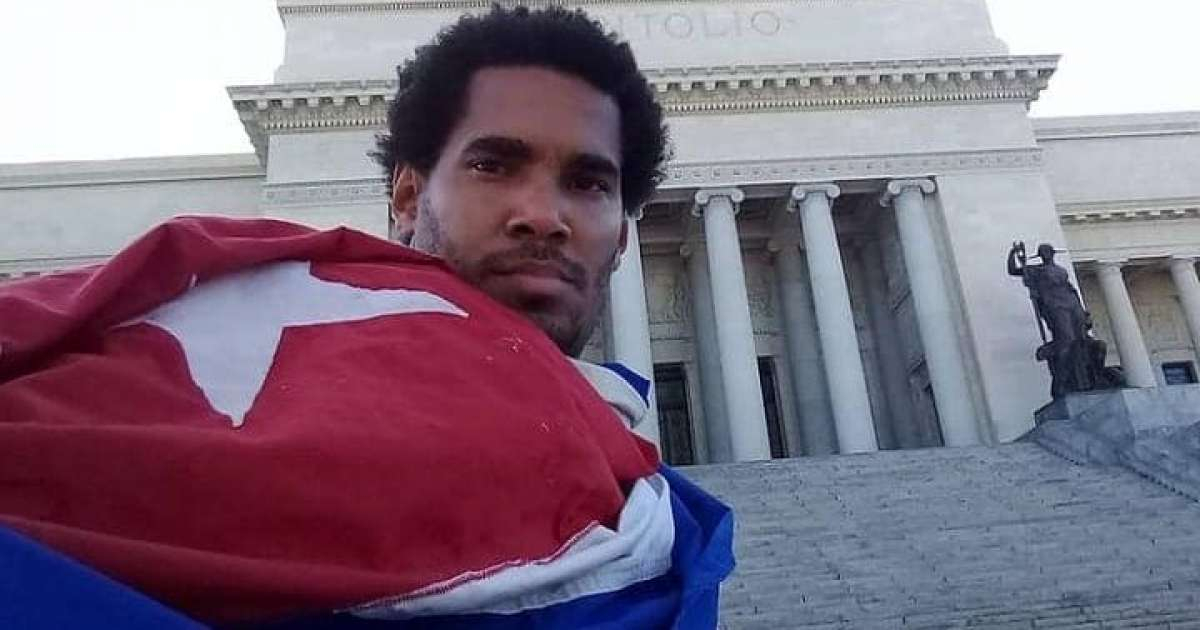
The Cuban State Security called activist Anamely Ramos this Thursday, with Luis Manuel Otero Alcántara on the other end of the line, to inquire about the status of the humanitarian parole process that her circle is managing towards the United States, as the activist herself revealed on Facebook.
The call came from an unknown number and was on speakerphone, indicating that the agents were monitoring the conversation in real time.
"I just spoke with Luis Manuel. He called me from a State Security cell phone, unknown number, and the call was on speaker. They wanted to know how the requested parole process is going," wrote Ramos.
The call this Thursday confirms that the regime is actively interested in expediting the artist's departure from the country.
Yanelys Núñez, in charge of the work of Otero Alcántara, stated a few weeks ago that she did not rule out forced exile as a destination for the artist once he completed his sentence for participating in the protests of July 11: "It's a possibility, because they don't want Luis on the streets, especially in a Havana that is completely mobilized by its citizens."
The process that manages the artist's environment is apparently an individual humanitarian parole through Form I-131 submitted to the U.S. Citizenship and Immigration Services (USCIS), the only option available since the Trump administration canceled the collective CHNV program for Cubans in March 2025.
"For several weeks, we have been managing a specific parole so that Luis has an escape route, because we know that there is no other possibility for Luis Manuel within Cuba," Núñez explained.
Ramos stated that in the call this Thursday, Otero Alcántara was unable to disclose his location and that he possibly did not know it precisely himself.
This is the first sign of life from the artist since he was released from the prison in Guanajay on Tuesday, July 7 during a heavy operation, two days before the official expiration of his five-year sentence.
Since his transfer, nobody from his close circle has been able to see or talk to him. This Wednesday, agents promised the family they would take him to his home in Cerro, but that never happened, and Ramos was emphatic: “Right now, Luis Manuel is missing. He is not free. He is not released. He is in the hands of State Security.”
Ramos urged those following the case to avoid speculation: "We continue to ask that you do not jump to conclusions, as such speculation does not help maintain accurate information and calm. Luis needs not only our solidarity but also our responsibility."
This Thursday, the five-year sentence imposed on Otero Alcántara officially expires, as confirmed by the Supreme People's Court in April 2026 after rejecting a habeas corpus appeal filed by Cubalex. The regime did not grant him any reductions for good behavior and also excluded him from the presidential pardon of that same month, as well as from the one in January 2025.
The relocation from Guanajay took place in the context of a severe social crisis: blackouts lasting up to 87 consecutive hours in Havana, shortages of water and gas, and nighttime protests with pots and pans. On the same day, the United States Ambassador to the UN, Mike Waltz, displayed the artist's photograph during an extraordinary session of the General Assembly and stated that "his crime was being an artist."
Filed under: