
Related videos:
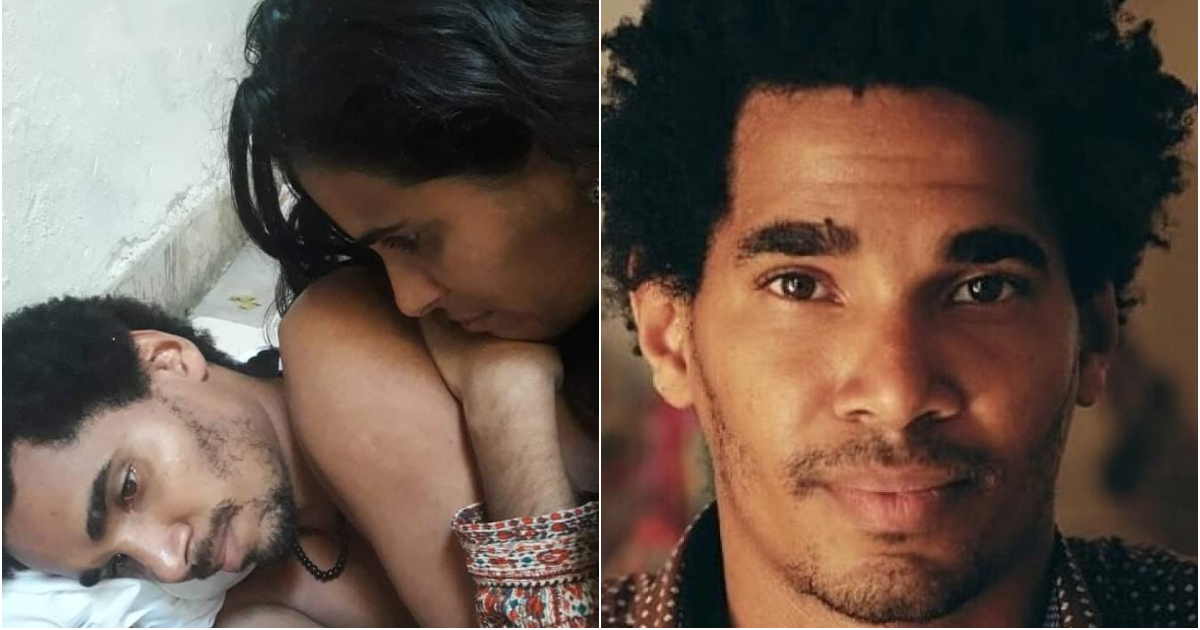
The activist and curator Anamely Ramos alerted this Tuesday that the artist and political prisoner Luis Manuel Otero Alcántara is missing after being taken out of the maximum-security prison in Guanajay by a State Security operation, just two days before the official end of his sentence.
Ramos confirmed it in a Facebook post from Washington D.C., where he traveled this Tuesday and will stay for three days.
"Luis Manuel is currently missing. He is not free. He is not released. He is in the hands of State Security somewhere in Havana," wrote the activist, the primary public spokesperson for the artist during his five years of incarceration.
According to the young woman, neither Otero Alcántara's family nor his close friends have received any official communication about his whereabouts.
"If we know he was taken from Guanajay, it is due to the solidarity of other prisoners," he emphasized, highlighting that the regime has not provided any explanation regarding the transfer.
The five-year sentence imposed on Otero Alcántara will expire on July 9, a date confirmed by the Supreme People's Tribunal in April 2026 after rejecting a writ of habeas corpus filed by the organization Cubalex.
Human rights organizations and families fear that the regime will fabricate new charges or keep him in an undisclosed location to prevent his effective release.
The artist, co-founder of the San Isidro Movement, was arrested on July 11, 2021 while trying to join the historic protests of 11J and was sentenced in June 2022 for "offending national symbols," "disrespect," and "public disorder." Amnesty International recognizes him as a prisoner of conscience and demands his immediate release without conditions, surveillance, or restrictions.
The transfer from Guanajay occurs in a context of maximum alarm. On July 5, the Cultural Rights Observatory of Cuba issued an alert regarding the deteriorating health of the artist. Months earlier, between March 30 and April 6, 2026, Otero Alcántara undertook an eight-day hunger strike after receiving death threats from agents of Department 21 of State Security within the prison itself.
Since June 12, Cubalex and the Luis Manuel Otero Alcántara Studio had launched a public countdown toward July 9, demanding a release "unconditionally, without surveillance, without exile, and without new fabricated charges."
Ramos urged to maintain as much pressure as possible and announced that the most up-to-date information would be published on the artist's official page. At the same time, he made an appeal to humanity in the face of collective anguish: "Our political prisoners are human beings. They are not a number, a piece of gossip, or even just a news item. Behind them are many loved ones, much distress, and a lot of uncertainty."
"Tomorrow we will explain more things on their page, but all the pressure that is applied is important. Hopefully by tomorrow we will have many more things to clarify. No one wants it more than we do," concluded Ramos.
Amid the uncertainty, writer and researcher Mónica Baró also urged to avoid confrontations between activists and social media users over the dissemination of the news.
In a Facebook post, he recalled the artist's unifying character and criticized the possibility that his potential release could become a source of division.
"Luis Manuel never established hierarchies or boundaries in his dealings with people," wrote Baró, who argued that any Cuban can care about their fate or take joy in the possibility of seeing it free.
He also called for acting with generosity in the face of the lack of official information, reminding that Cuba is under a regime characterized by opacity and that the recent blackouts have hindered even communication with family members inside the island.
"Luis Manuel is, first and foremost, a public figure; second, he built his identity precisely with a unifying spirit, with his 'we are connected.' So, it seems to me that there's little sense in trying to disconnect people from him, to silence them, offend us, or fight once again while we have a Crab who surely sat down today to review reports of political repression wearing Hermes shoes and a Rolex watch in an air-conditioned office," he recalled.
Baró emphasized that, regardless of how this episode concludes, Otero Alcántara will need the support of society after five years in prison.
"The last thing we need is to exclude ourselves and pass judgment on one another," he expressed, insisting that the common goal must remain the defense of human rights, the end of the dictatorship, and the unconditional release of all political prisoners in Cuba.
"And yes, we need to be careful with the information, but let’s also treat each other with generosity. We are facing a regime with no informational transparency and high levels of opacity. We’ve been in the dark for two days, both in Cuba and for those of us with family there, and we haven’t been able to hear from them. It’s understandable that inaccuracies arise amidst all this. I haven’t seen anyone talking on social media about Luis Manuel in the past few hours who wouldn’t be happy about his freedom. We are so desperate for good news that sometimes we jump to conclusions. But please, let’s not turn the potential release of Luis Manuel into a dispute over who has more or fewer rights to feel, say, or do."
Filed under: