
Related videos:
The Cuban Electric Union (UNE) issued an informative note on its official channels late Thursday to explain the worsening of power outages in several municipalities of Havana.
According to the statement, the situation is due to two combined factors: an incomplete repair of a malfunction at the Substation Apolo, and widespread limitations in electricity generation at the national level.
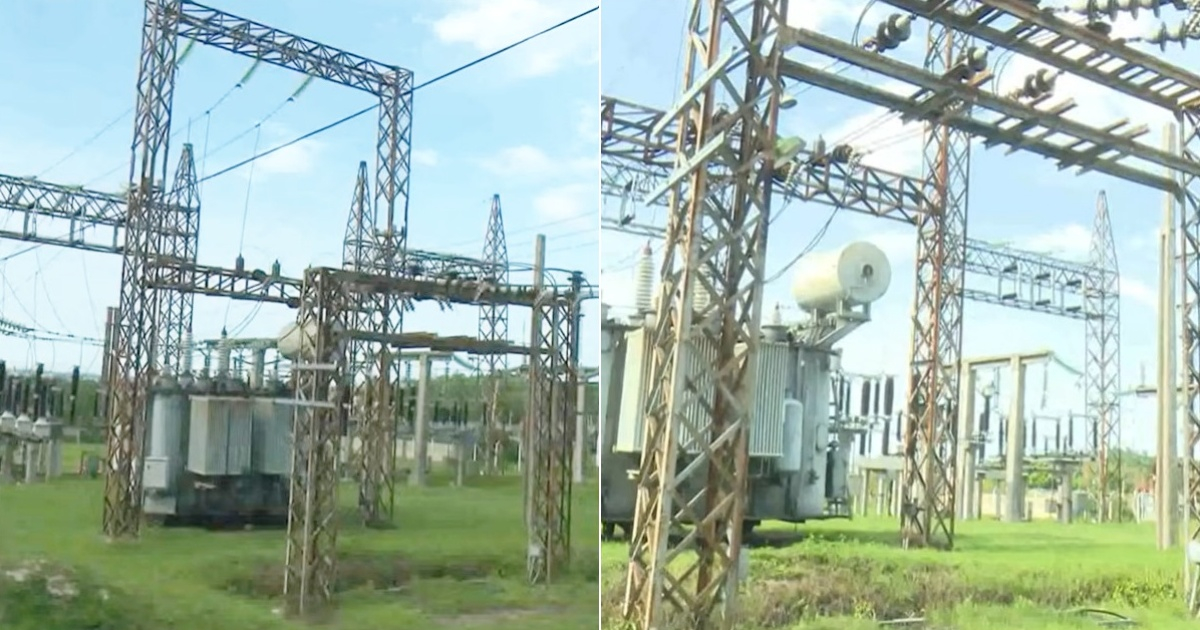
The breakdown at the Apolo Substation
The problem with that installation dates back to June 3, when the connection bar for the outlet switches failed, leaving all associated circuits out of service.
Specialists from the Electric Company of Havana, along with brigades from GEYSEL and the ECIE, managed to restore the supply during the night and early hours of June 5th, but the recovery was partial: one of the two transformers remained out of operation.
Given that limitation, the UNE established a rotation scheme: “6-hour cycles without service for 3 hours with service across all circuits included in this area.”
Why did that scheme stop working?
Not even that rotation—which is already quite severe—has been able to maintain itself consistently.
The UNE recognized it straightforwardly:
"We regret to inform you that the strict implementation of this rotation has been interrupted over the past few days due to limitations in the availability of electricity generation at the national level, which has affected the stability of the planned scheme."
In practice, the national electrical system does not generate enough electricity to even sustain the scheduled blackouts.
In its statement, UNE assured that its teams are working “intensively on completing the transformer capacity to solve the issue as quickly as possible”, and offered formal apologies to those affected.
The state-owned company did not provide an estimate of when a complete solution to the problem is expected.
The Cuban News Agency (ACN) reported that on Thursday, two additional thermoelectric units went offline: Unit 4 of the Carlos Manuel de Céspedes Thermoelectric Power Plant due to a voltage regulator failure; and Unit 2 of the Ernesto Guevara de la Serna Thermoelectric Power Plant due to a leak in the economizer.
As a direct consequence, at 5:45 PM on Thursday (local time) the Electric Company of Havana interrupted the 110 kV service in Playa, La Lisa, Boyeros, Plaza de la Revolución, and Centro Habana.
The worst moment of the electricity crisis in decades
All of this occurs in the context of an unprecedented collapse of the Cuban energy system.
This Thursday, Cuba recorded a historic deficit of 2,341 megawatts, with an availability of just 935 MW against a demand of 3,100 MW.
Last Sunday, the country experienced its third national blackout of 2026 -the seventh total collapse of the National Electric Power System in 18 months- triggered by the shutdown of Unit 6 at the Nuevitas thermoelectric plant in Camagüey, an event that further destabilized the rotation scheme in the Apolo area.
In this context, the Electric Company of Havana announced in recent hours the abandonment of the block outage management system to adopt one based on circuits, a change that was meant to be gradual but the crisis forced to expedite.
Residents of Havana reported power outages lasting up to 30 consecutive hours in neighborhoods such as Versalles in La Lisa and Zamora in Marianao.
The response on social media to the new explanations from the UNE was overwhelming.
"Your apologies don't solve anything at all", wrote a user in the Unión Eléctrica post.
On Thursday, Miguel Díaz-Canel toured the municipalities of Havana and requested to "better organize the scheduling of the outages" due to the blackouts, without announcing any specific measures to increase electricity generation in the country.
As of the close of this report, UNE has not published the forecast for power outages for this Friday, July 10, in Cuba.
Filed under: