
Related videos:
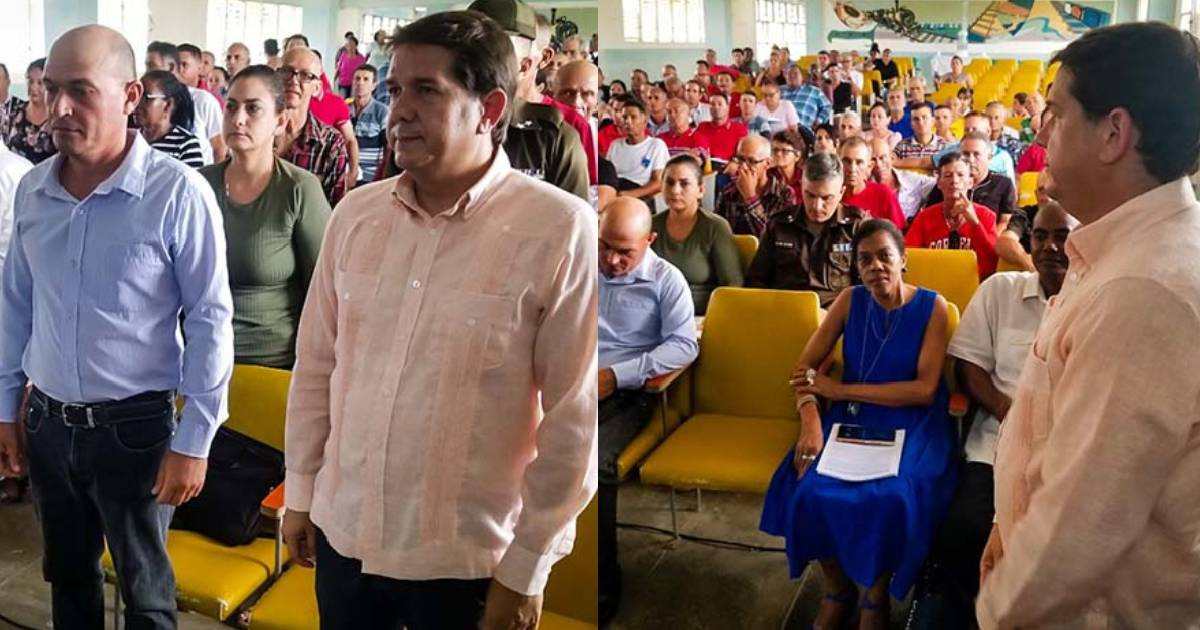
The Cuban regime elected journalist Jorge Legañoa Alonso, president of the state agency Prensa Latina and originally from Camagüey, as a deputy for the municipality of Rafael Freyre in Holguín, thus fulfilling the quota of 40 representatives that corresponds to that province in the National Assembly of People's Power.
According to the report from the Cuban News Agency, the process was carried out in accordance with Agreement 608-X of the State Council, signed by the president of that entity Juan Esteban Lazo Hernández on June 22 and published in the Official Gazette.
According to Maite Pupo Romero, head of the department of attention to local organs of the National Assembly, the vacancy had been "unfilled for a long period," a situation that "concerned the delegates themselves, who demanded its coverage."
The choice of Legañoa clearly illustrates the logic of the Cuban political system; a 43-year-old man from Camagüey, without historical roots in Holguín, represents a municipality in Holguín due to a proposal that the regime itself has labeled as having "national ascendancy," a euphemism that describes a top-down designation.
Upon accepting the position, he declared that representing the nearly 50,000 inhabitants of Rafael Freyre "constitutes a great challenge and, at the same time, an enormous pride," and promised to be "one of the voices of the people of Freyre in the Cuban Parliament," the source emphasized.
The next general election is scheduled for 2028.
The new deputy is one of the most active figures in official propaganda. The regime rewarded him with the presidency of Prensa Latina in October 2025 after he led a smear campaign against the opposition figure José Daniel Ferrer, founder of the Patriotic Union of Cuba (Unpacu), who had just been released from prison and deported to the United States.
In that intervention, Legañoa described Ferrer as "violent," "criminal," and "mercenary."
In June of this year, Legañoa defended the ruler Miguel Díaz-Canel on the state television program Mesa Redonda, following the sanctions imposed by the U.S. Department of the Treasury on the Cuban leader, which he described as a "medal" and "recognition of resistance."
"It is a recognition of resilience, of not wanting to bend, of not yielding, of not allowing oneself to be pressured, of defending the principles and values of the revolution," he then stated.
In March, Legañoa publicly denied the existence of negotiations between Cuba and the United States, which he referred to as a "manipulation maneuver," only to be forced days later to ask Díaz-Canel himself about those same contacts, after the leader officially acknowledged them.
Legañoa graduated in Journalism from the University of Havana in 2007 and has held positions at the Institute of Information and Social Communication, the Central Committee of the Communist Party of Cuba, and the Union of Journalists of Cuba.
Prensa Latina, which it currently directs, was founded in 1959 and operates as an international platform for the regime's propaganda from 39 offices around the world.
The most well-known precedent of this vacancy-filling mechanism between general elections was the election of General Luis Alberto Rodríguez López-Calleja (1960-2022) as a deputy for Remedios, in Villa Clara, in October 2021, also through an extraordinary session of the municipal assembly.
Filed under: