
Related videos:
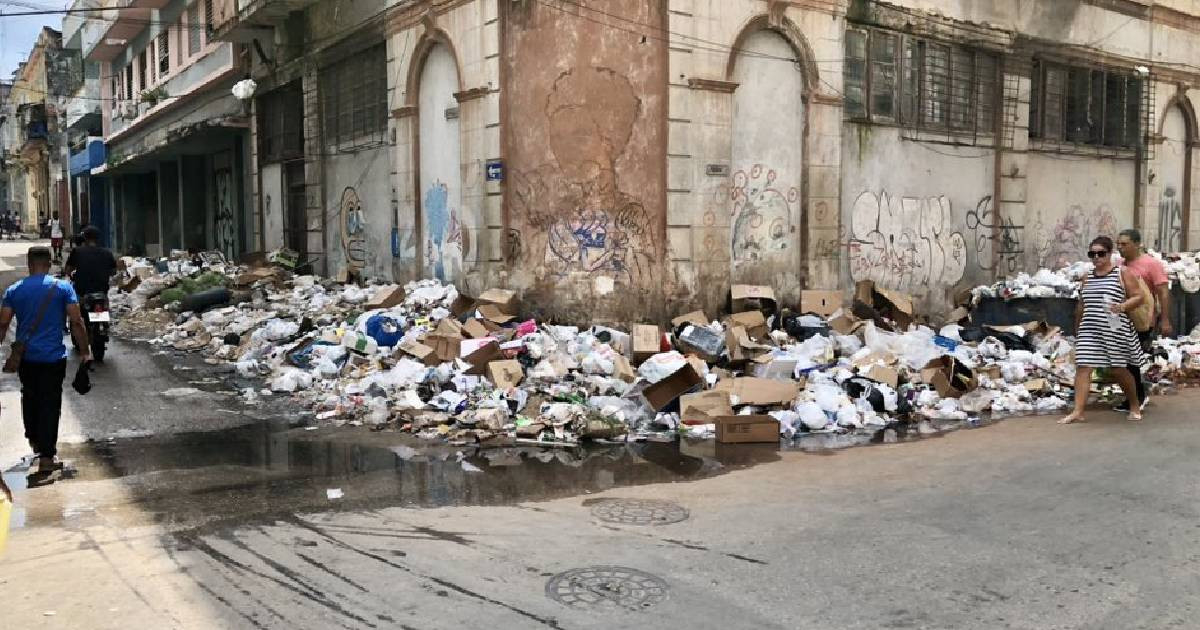
The July rains are revealing one of the most extreme aspects of the health deterioration in Havana. In neighborhoods where drinking water does not arrive for five or even ten days, numerous residents are forced to defecate in plastic bags that they then throw into makeshift dumps or even from buildings onto public streets, reported this Saturday the historian Julio César González Pagés.
The phenomenon mainly affects municipalities such as Old Havana, Centro Habana, and Cerro. González Pagés describes that, with the rainfall, the accumulated waste reappears on the streets, and many of the bags burst as vehicles pass by, while the stench invades homes accompanied by thousands of flies.
"Havana, amidst garbage and feces, faces the summer with little water, hygiene, and medicine, bringing back the worst of its colonial era," summarized the researcher in a Facebook post.
The historian also established a troubling parallel with the past of the capital. He recalled that in 1735, the Captain General Juan F. Güemes (1681-1766) ordered for the first time the systematic cleaning of Havana's streets due to the accumulation of feces and waste in front of homes.
Those enormous dumps also posed a constant fire risk, a problem that, almost three centuries later, is once again part of the urban landscape.
This danger is not just historical. On June 19, a fire caused by
The situation is a result of accumulated deterioration over decades. The sewage system in Havana, built between 1908 and 1914 for a city of about 600,000 inhabitants, currently serves nearly two million people without having undergone a comprehensive modernization.
This is compounded by the collapse of waste collection. Since February 2026, only 44 of the 106 collection trucks in the capital remain operational due to a shortage of diesel and mechanical deterioration.
As a result, every day up to 23,814 cubic meters of garbage remain uncollected from the 24,000 to 30,000 cubic meters of waste generated by the city.
Furthermore, Havana has only 10,000 containers, when it would need between 20,000 and 30,000 to meet the demand.
The system's incapacity reached the point where, in June, young members of the Military Service were mobilized to collect trash with shovels and bags at various locations in the capital.
Months earlier, the Government itself had acknowledged that it does not have sufficient resources to keep the city clean or to improve the wages of the workers in Communal Services.
Specialists have warned that the accumulation of garbage and feces poses a direct threat to public health. The Food Monitor Program alerted that flies, cockroaches, rats, and other vectors can carry pathogenic microorganisms to the food consumed by the population.
A biologist consulted by the organization warned that current conditions favor the emergence of an epidemic of gastroenteritis at any time.
The sanitary deterioration already has visible consequences. Cuba ended 2025 with at least 81,909 reported cases of dengue and chikungunya, resulting in 65 officially recognized fatalities, while in 2026, the outbreak remains active with over 2,800 cases reported across 134 municipalities.
In the midst of this situation, images of food being sold in the streets alongside mountains of trash and the testimony of residents who claim to have "hit rock bottom" reflect a city where the lack of water, the accumulation of waste, and the deterioration of basic services have returned large areas of Havana to sanitary conditions that seemed to have been overcome centuries ago.
Filed under: