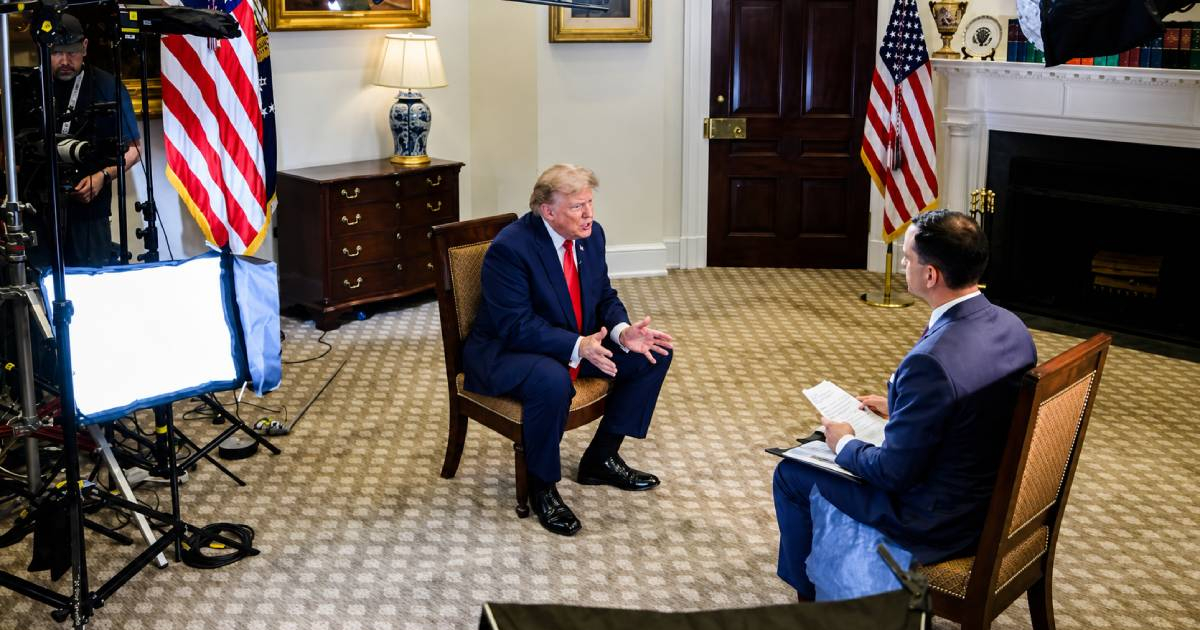
President Donald Trump issued a direct warning to the leaders of the Iranian regime during an interview broadcast on the official White House account on X.
"Better make a deal. No one will be left for you," said the president on Tuesday night during a conversation with Fox News correspondent Trey Yingst, recorded in a formal room at the White House.
The threatening tone contrasts with the hint that Trump himself gave in the same interview: that Iran "is negotiating now" and that there is a "good possibility" of reaching an agreement.
The warning came after the United States completed its third consecutive night of bombings against Iran, with Central Command (CENTCOM) targeting over 300 Iranian military sites in less than a week, including missile and drone facilities, naval capabilities of the Islamic Revolutionary Guard Corps (IRGC), ammunition depots, and communication networks.
The catalyst for this new wave was the IRGC's attack on the container ship GFS Galaxy, flying the Cypriot flag, on July 12 in the Strait of Hormuz. Ten of its eleven Indian crew members were rescued; one remains missing.
The day before, Trump warned that he would hit Iran "very hard" and described the regime as "bad people who have systematically broken all agreements."
On that same day, he reestablished the naval blockade against Iran and imposed a 20% tax on traffic through the Strait of Hormuz, a measure that Tehran described as "piracy."
The background of the conflict dates back to the collapse of the Islamabad Memorandum, signed on June 17 and 18 with the mediation of Pakistan, Qatar, Saudi Arabia, and Turkey.
That agreement established a ceasefire of 60 days, the reopening of the Strait, and the start of denuclearization negotiations, in exchange for the unfreezing of Iranian assets worth between 12,000 and 25,000 million dollars and access to a reconstruction fund of 300,000 million.
The pact collapsed when Iran attacked three commercial ships in the Strait on July 6 and 7. Trump declared the truce "over" on July 8 during the NATO summit in Ankara.
The CIA director, John Ratcliffe, had previously warned that Iran would likely not fulfill its nuclear commitments. The central dispute was the duration of the uranium enrichment ban: Washington demanded 20 years, while Tehran offered between five and 15.
In addition to the military pressure, there is an additional dimension: on July 10, Israel alerted Washington about a supposed Iranian plan to eliminate Trump, although Israeli sources clarified that it was about general discussions and not an active plot.
CENTCOM specified in a statement that the bombings "will continue to impose a high cost on Iranian forces and degrade their ability to attack innocent civilians and commercial shipping in the Strait of Hormuz," a route that accounts for approximately 20% of global crude oil trade.
Related videos:
Filed under: