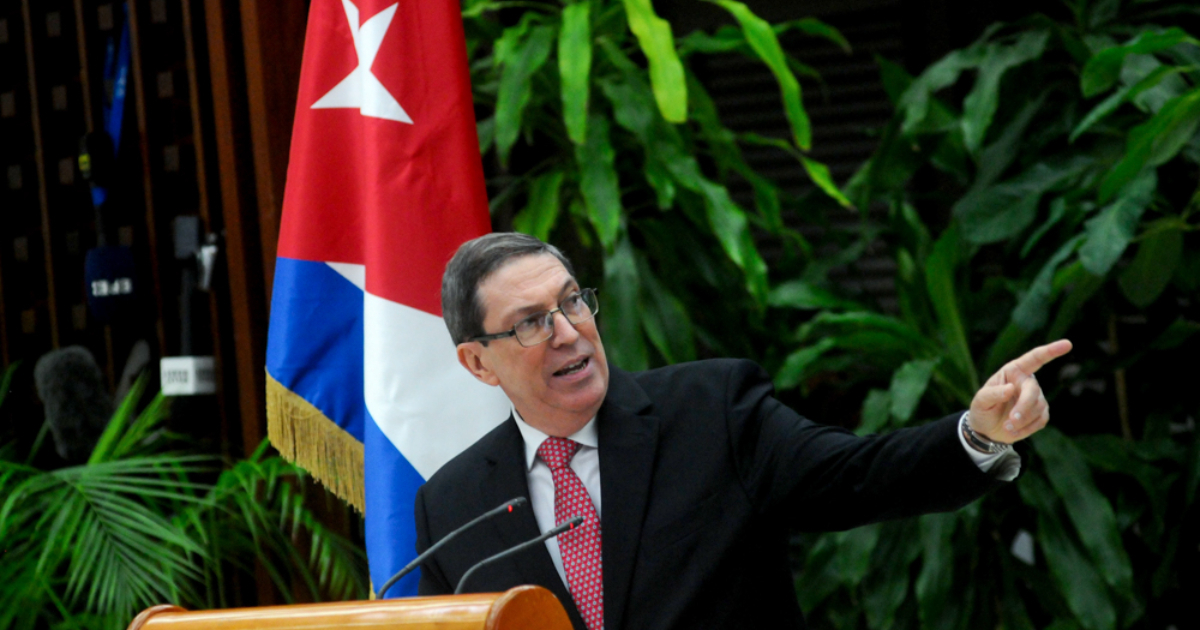
Cuban Foreign Minister Bruno Rodríguez Parrilla on Wednesday held the United States government responsible for the total collapse of the National Electric System that occurred on Tuesday, when the island was left without electricity following the shutdown of Unit 1 at the Felton thermoelectric plant in Holguín.
According to the chancellor, posting on his account on the social media platform X, the system failure "occurs in a context of maximum suffocation of our economy and our electric power sector by the U.S. government."
Rodríguez Parrilla pointed directly at Secretary of State Marco Rubio, asserting that U.S. leaders "do not care about the suffering of thousands of families, the hundreds of hospitals without electricity, the loss of food due to lack of refrigeration."
The Minister of Energy and Mines, Vicente de la O Levy, agreed with this assessment before the press, stating that the interruption — the third in the last eight days — "is fundamentally due to an electrical system severely affected by the blockade and, in particular, by the executive order of President Donald Trump aimed at prohibiting the entry of oil to Cuba."
Levy added that in the country "there is a complete absence of fuel" and that there is no access to spare parts for the thermoelectric plants or for the Energás units.
The state agency Prensa Latina reported that the system was restored on Wednesday at 07:00 local time, as announced by the Electric Union of Cuba.
Tuesday's collapse was the fifth total blackout of the year and the tenth in the last 24 months, in a context where daily outages average between twenty and twenty-four hours in many areas of the country.
At the time of the collapse, the system was operating with only 1,155 MW available against a demand of 3,150 MW, resulting in a deficit of between 1,990 and 2,020 MW.
The most recent turning point in the crisis occurred on January 29, 2026, when Trump signed Executive Order 14380, which imposed secondary tariffs on any country that supplies oil to Cuba, reducing Cuban energy imports by 80% to 90%.
On May 1, 2026, a second executive order directly sanctioned CUPET, the Cuban state oil company, blocking its assets and exposing foreign companies that operate with it to sanctions.
The humanitarian impact is severe: more than 100,000 patients —including 11,000 children— are awaiting postponed surgeries, while 2,888 people who rely on hemodialysis have supplies for only three days.
The Cuban regime has systematically rejected any responsibility for the crisis, attributing the collapse entirely to U.S. sanctions, without acknowledging the structural deterioration of a power plant built during the Soviet era that has lacked proper maintenance for decades, nor the impact of 67 years of centralized economic management.
The historical record for energy deficit was recorded just five days before the last blackout: on July 10, the system reached a shortfall of 2,341 MW, with only 935 MW available, impacting 73% of the population.
Related videos:
Filed under: