Cuba dropped 11 positions in the Global Peace Index 2026 (GPI) and is now ranked 109 out of 163 countries evaluated, according to the report published in June by the Institute for Economics and Peace (IEP), based in Sydney.
The decline is one of the steepest recorded by the island in the history of the index, placing it now in the “medium” peace category, far from the “high” levels it reached just a decade ago.
The factors that weighed most heavily in the Cuban decline, according to the report, are the political instability, restrictions on civil liberties, social discontent expressed through street protests, and an uptick in the perception of crime compared to historical records.
The decline is not sudden: Cuba's trajectory in the index has been in free fall for years.
In the mid-2010s, the island ranked between 84th and 91st, with a "high" peace rating.
Since then, it has continued to decline: ranked 99 in 2023, 98 in 2024, 102 in 2025, and now 109 in 2026.
That sustained deterioration coincides with the worsening of the economic and energy crisis.
In June 2026, Cuba recorded a historic high of 107 street protests, largely driven by power outages lasting up to 87 consecutive hours in Matanzas and a power generation deficit that left 70% of the country without electricity at the same time.
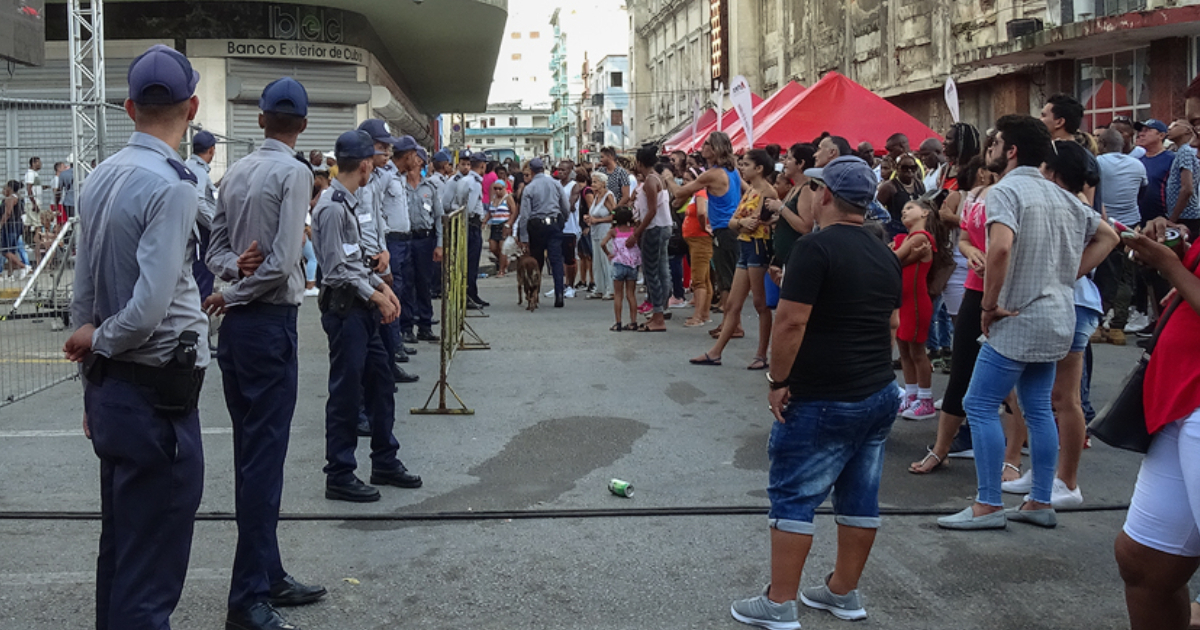
The regime has responded to the protests with police deployments and arrests, a dynamic that the index itself recognizes as an indicator of internal instability.
Cuba's position in other international indices for 2026 reinforces the picture: it ranks 160th out of 180 in press freedom according to Reporters Without Borders, and 175th out of 176 in economic freedom according to the Heritage Foundation, with a score of 25.2 out of 100 in the "repressed" category.
The Global Peace Index uses 23 qualitative and quantitative indicators grouped into three domains: societal security and protection, ongoing domestic and international conflicts, and the degree of militarization.
In the regional context, the IPG 2026 indicated that North and Central America experienced a significant deterioration: 10 of the 14 countries in the region worsened over the past year, and only four improved.
Haiti remains the least peaceful country in the region, ranked 142nd in the world.
On a global scale, the outlook is not encouraging either. The report concluded that "the world has become less peaceful for the fifteenth time in the last 18 years": 99 of the 163 evaluated countries reported a decline.
It is the twelfth consecutive year of global decline, and the world peace average fell by 0.7% in the last period.
The IEP also warned that the internationalization of conflicts has intensified: 103 countries participated to some degree in external conflicts over the past five years, compared to only 59 in 2008.
"This reflects a system in which third-party support for internal wars has become increasingly common," the report states.
Among the few positive data points, the index reported that deaths from terrorism have fallen to their lowest level since 2008.
Iceland remains the most peaceful country in the world for the 19th consecutive year, followed by New Zealand, Switzerland, Slovenia, and Ireland.
On the opposite end, Russia occupies last place for the first time, followed by Sudan, the Democratic Republic of the Congo, Ukraine, and Israel.
Related videos:
Filed under: