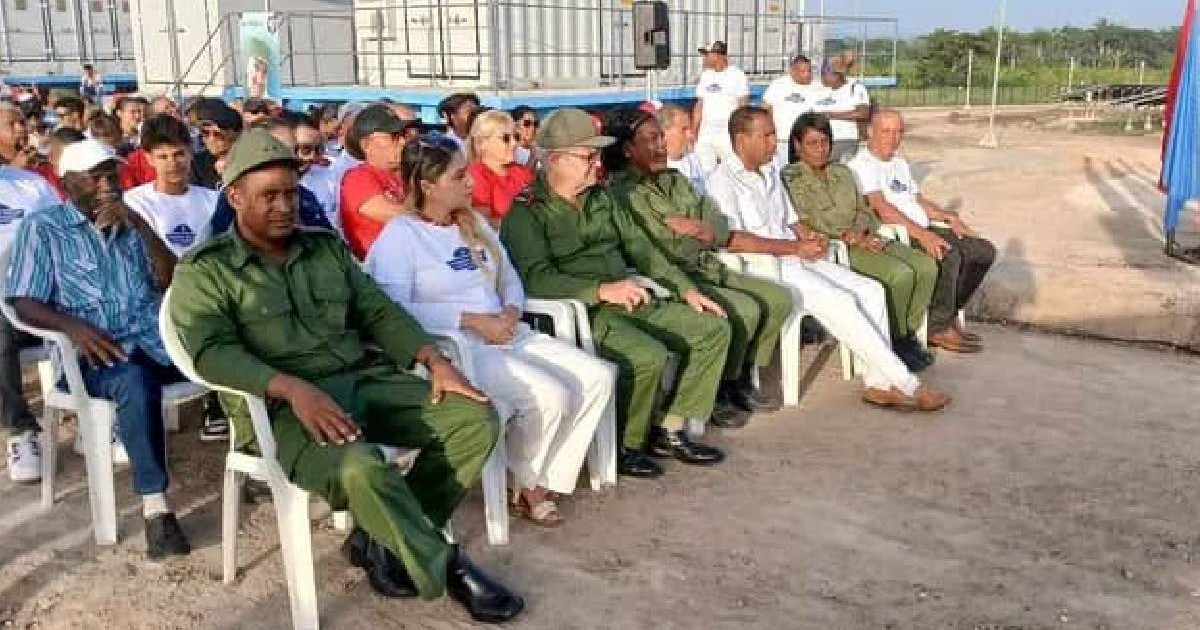
Cubans reacted with skepticism to the inauguration this Friday of the first photovoltaic solar park in Santiago de Cuba with the capacity to store energy, a feature that distinguishes it from the two previous parks built in the province and that, in theory, allows it to operate beyond daylight hours.
"And what does that translate to?" they asked, overwhelmed by the energy crisis on the island during the inauguration, which was presided over by Beatriz Johnson Urrutia, the first secretary of the Provincial Committee of the Communist Party in the province.
The government newspaper Sierra Maestra in its digital edition headlined the event as "Another Victory for the Santiago People"; it stated that this is a Chinese donation, in line with the investment and technology pattern that characterizes all the photovoltaic solar parks in Cuba built in recent years.
The images from the event show a weather monitoring station with equipment made in China —the control box is inscribed in Mandarin with "Environmental Monitoring Instrument for Photovoltaic Power Plant"— and rows of solar panels in the background.
The inauguration ceremony gathered civilian and military officials from the Revolutionary Armed Forces outdoors, following the usual protocol for high-profile political events in the province.
Villa Victoria is the third of the four solar parks planned for Santiago de Cuba. The first, Las Guásimas in Contramaestre, with 21.8 megawatts and over 45,000 panels, was synchronized to the national power grid in April 2025.
The second, Rafael Reyes in San Luis, also with 21.8 megawatts, began operations in January of this year. Neither of the two has a battery system, which limits their generation to daytime hours.
The fourth planned park, Anacaguita, also in Contramaestre, has not yet been inaugurated. The four parks together total around 80 megawatts of combined capacity.
The announcement, however, comes amid an energy crisis that shows no signs of letting up for the residents of Santiago. The province, with over a million inhabitants, has endured years of prolonged blackouts that the government has been unable to resolve despite successive claims of improvements.
In June, authorities promised to provide electricity to neighborhoods in Santiago that still lack stable service, and in October 2025, Johnson Urrutia had reported on the use of solar pumping to alleviate the water crisis affecting almost 400,000 people in the province.
The five-megawatt capacity of the new park is modest compared to the provincial electricity demand, and public skepticism regarding these announcements is palpable. The question that titles this article — "And what does that translate to?" — encapsulates the disconnection the population feels between the achievements claimed by the regime and the everyday reality of power outages and shortages.
The Cuban government aims for 24% of electricity generation to come from renewable sources by 2030, as part of a national plan for 55 solar parks. Thus far, none of the parks inaugurated in Santiago have eliminated the power outages experienced by the province.
Related videos:
Filed under: