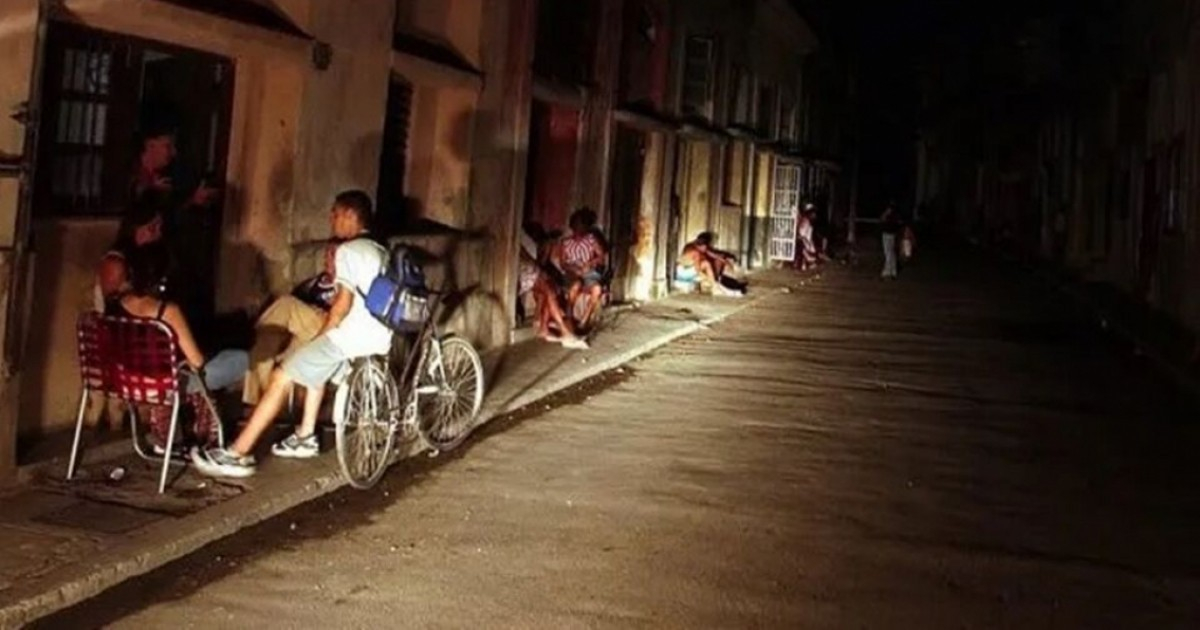
Cuba faces another day of widespread blackouts this Friday with no signs of relief, according to the report from the Electric Union (UNE), which confirmed that at 6:00 am the availability of the National Electric System (SEN) was only 940 MW against a demand of 2,710 MW, leaving 1,770 MW uncovered.
On Thursday, things did not improve: the service was interrupted for 24 hours, including in the early morning, and the maximum impact reached 2,321 MW at 9:30 PM, exceeding the forecast of 2,240 MW, as acknowledged by UNE itself.
By noon this Friday, a disruption of 1,600 MW is anticipated, but the nighttime outlook is even gloomier.
The state-owned company forecasts that during peak hours, demand will reach 3,200 MW, while availability will remain at 940 MW, resulting in a deficit of 2,260 MW and a projected shortfall of 2,290 MW— a figure close to the historic record of 2,341 MW set on July 10.
This means that millions of Cubans will spend another night without electricity, without water, and without any hope that the regime will offer a real solution.
The technical situation of the system is a compounded disaster.
Units 6 and 8 of the Mariel Power Plant, the Guiteras Power Plant in Matanzas, Block 2 of the Felton Power Plant in Holguín, and Block 3 of the Renté Power Plant in Santiago de Cuba are out of commission.
Four units of CTE Santa Cruz, Nuevitas, and Renté are under maintenance. Additional limitations in thermal generation amount to 307 MW more.
The 54 photovoltaic solar parks generated 4,641 MWh on Thursday, with a maximum power of 651 MW at noon.
This Friday marks a direct continuation of a crisis that has worsened exponentially in July: Cuba has experienced three complete collapses of the National Electric System in just eight days - on July 6, 10, and 14 - making it the tenth total blackout in approximately 24 months.
The latest total collapse, which occurred on Tuesday, July 14, at 11:05 am, was caused by the unexpected shutdown of unit 1 at the Felton thermoelectric plant, leading to a cascading disconnection of the entire network. The UNE declared the system "restored" on July 15 at 7:00 am, but dozens of Cubans across the country reported still being without electricity hours later.
The causes are structural, and the regime has ignored them for decades: the thermal power plants are over 40 years old without capital maintenance. Expert Jorge Piñón estimates that Cuba would need between 8 billion and 10 billion dollars in three to five years to resolve the crisis structurally.
On the other hand, Venezuela halted its oil shipments in November, Russian supply ran out last April, and Mexico suspended its shipments since January.
Meanwhile, the government's response has been notably insufficient. Miguel Díaz-Canel merely urged that the blackouts be "better organized" without announcing any measures to increase power generation.
Social tension escalates along with the blackouts. This past Friday, Cubalex reported the arrest of at least six people following a spontaneous protest in Loma del Chivo, Guantánamo, directly motivated by the prolonged power outages.
Related videos:
Filed under: