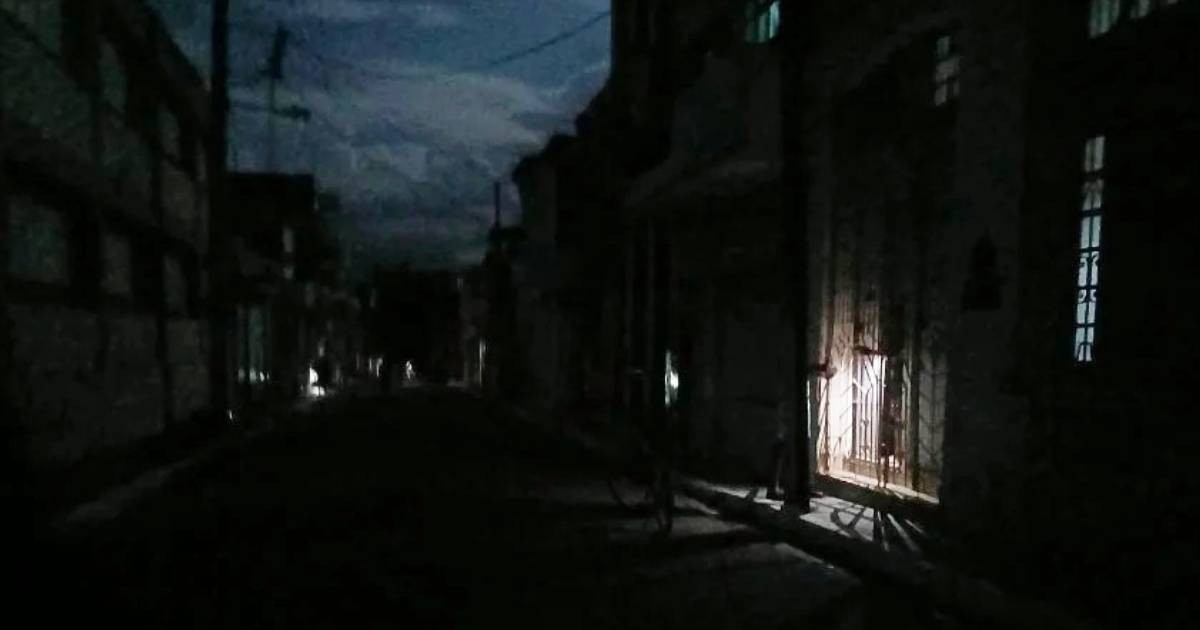
Cuba faces another day of massive blackouts this Thursday, just one day after the Electric Union (UNE) announced the purported restoration of the National Electric System (SEN) following the fifth total collapse of the year.
According to the official information note from UNE, the electricity service was disrupted for 24 hours on Wednesday - including the early morning - due to a lack of generation capacity.
The largest recorded impact on Wednesday was 2,126 MW at 8:30 PM, affecting all provinces of the country.
For this Thursday, the state agency forecasts an even greater impact: 2,240 MW during peak nighttime hours, with an availability of only 990 MW against a projected maximum demand of 3,200 MW, representing a deficit of 69% of the total demand.
At the time of publishing their morning update on social media, the actual impact had already reached 1,764 MW, with a demand of 2,858 MW. The forecast for midday was an impact of 1,650 MW.
The technical situation of the system is critical. The units that are out of service are 6 and 8 of the Máximo Gómez thermal power plant (Mariel), the Antonio Guiteras (Matanzas), unit 2 of Lidio Ramón Pérez (Felton), and unit 3 of Antonio Maceo (Renté).
Three other plants are under maintenance.
Additionally, 106 distributed generation plants are out of service due to lack of fuel, and the Regla and Melones barges, along with the Fuel plants of Mariel and Moa, are also inactive.
The 54 photovoltaic solar parks generated 3,822 MW/hour on Wednesday, with a peak capacity of 572 MW, but this energy does not compensate for the nighttime deficit when demand is higher.
The scene this Thursday is a direct continuation of a crisis that worsened on Tuesday, when the SEN collapsed at 11:05 am, following the unexpected shutdown of unit 1 of the Felton thermoelectric plant in Holguín, which caused a cascading disconnection of the entire electrical grid.
The next day, UNE announced at 7:00 am the "restoration" of the SEN with a brief message on Facebook: "Cuba at 07:00 hours, the National Electric System has been restored." However, dozens of Cubans across the country reported still being without electricity.
From Centro Habana, a user reported being without electricity for 40 hours. In Santiago de Cuba, it was reported that the power lasted only 15 minutes. A resident of Alamar complained of being without light since 4:00 AM on Tuesday and asked, "Do we not have the right to live without the worry of water shortages and spoiled food?"
This collapse is the tenth in approximately 24 months. In July, there have been three total blackouts in just eight days: on the 6th, the 10th, and the 14th. On the 8th, Cuba reached its highest historical generation deficit: 2,341 MW affected, with only 935 MW available against a demand of 3,100 MW.
The causes are structural. The thermoelectric plants, over 40 years old, operate without proper maintenance. Additionally, Venezuela interrupted oil shipments in November 2025, Russian oil was depleted in April, and Mexico suspended supplies since January.
Meanwhile, Díaz-Canel simply asked to "better organize" the blackouts, without announcing effective measures to increase generation.
The comedian Ulises Toirac summarized the public's frustration when addressing the Minister of Energy, Vicente de la O Levy: "The disaster we are living has been coming.", pointing out that six decades of poor economic decisions have made the collapse inevitable.
Experts like Jorge Piñón estimate that Cuba would need between 8 billion and 10 billion dollars within a timeframe of three to five years to address the energy crisis structurally, a figure that the regime is far from being able to mobilize.
Related videos:
Filed under: