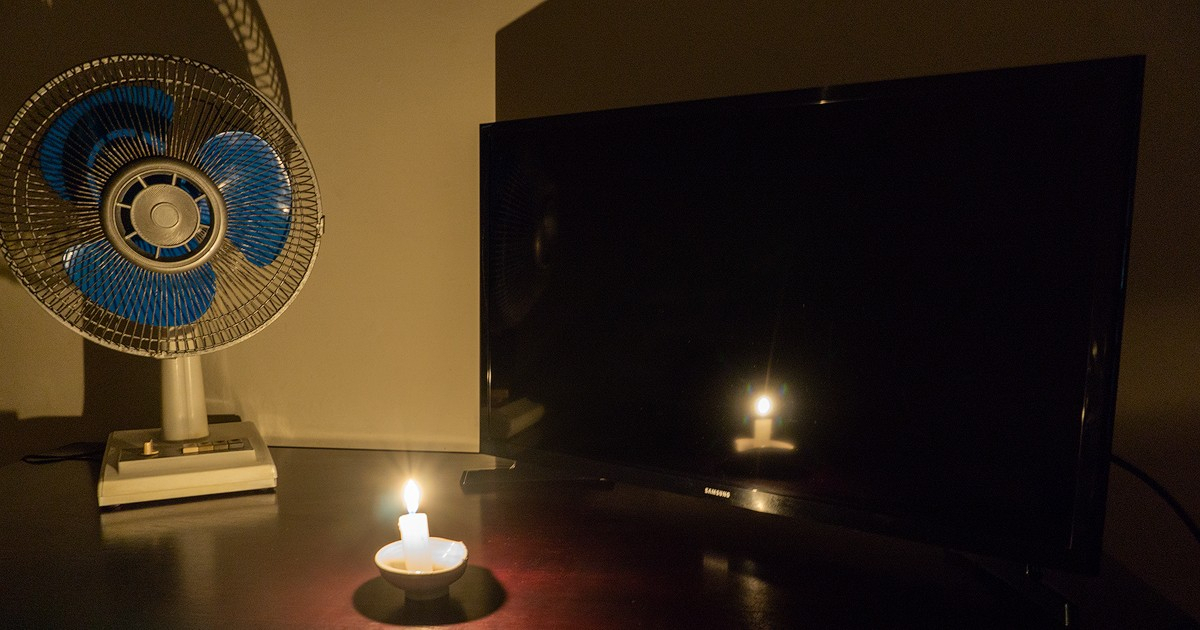
Cuba is experiencing another day of widespread blackouts. According to the official report from the Unión Eléctrica (UNE), at 06:00 hours this Sunday, the availability of the National Electric System (SEN) was only 1,108 MW compared to a demand of 2,807 MW, with 1,723 MW affected at that time.
Saturday was another exhausting day for Cubans: the outages lasted for 24 hours, including throughout the night, and the maximum impact reached 2,179 MW at 7:50 PM, as reported by UNE itself.
The outlook for this Sunday night is equally bleak
The state-owned company forecasts that, during peak demand hours, the availability will remain at 1,108 MW against a demand of 3,200 MW, resulting in a deficit of 2,062 MW and an estimated impact of the same magnitude.
The only planned addition is the unit 8 of the Mariel thermoelectric plant, which is in the start-up process and would contribute only 60 MW.
Several generating units remain out of service. Units 6 and 8 of the Mariel Thermal Power Plant, unit 2 of the Felton Thermal Power Plant, and unit 3 of the Renté Thermal Power Plant are currently malfunctioning.
Currently under maintenance are unit 3 of the Santa Cruz Thermoelectric Power Plant, unit 5 of the Nuevitas Thermoelectric Power Plant, and units 5 and 6 of the Renté Thermoelectric Power Plant. The limitations in thermal generation add up to 460 MW.
Solar energy provides some relief during the day, but it does not address the underlying problem. The 54 new photovoltaic solar parks generated 4,870 MWh on Saturday, with a peak output of 758 MW at noon.
However, that generation disappears at dusk, just when demand reaches its peak and the deficit skyrockets.
July 2026 has become the most destructive month for the Cuban electrical system in recent history. The SEN completely collapsed on five occasions during this year, totaling ten complete collapses in approximately 24 months.
Related videos:
Filed under: