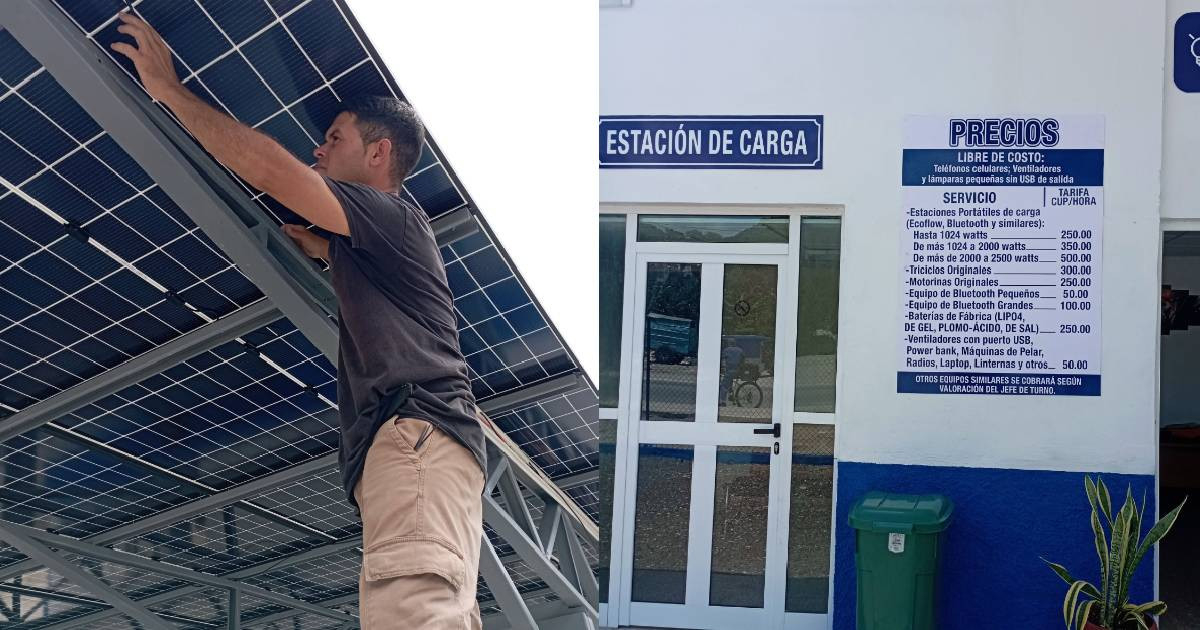
The publication of the official rates for the El Girasol solar charging station, the first "solar service station" opened in Holguín, continues to spark an intense debate on social media this Saturday, with some defending the prices and others deeming them excessive in relation to the average state salary.
The sign, mounted in acrylic on the wall of the facility located on the road to Gibara and Luz Street, sets rates from 50 CUP per hour for small Bluetooth equipment to 500 CUP per hour for portable stations of over 2,000 watts.
It is noteworthy that cell phones, rechargeable fans, and small lamps without USB output can be charged for free.
The original tricycles cost 300 CUP per hour, while the motorbikes cost 250 CUP per hour. Charging mobile phones, fans, and small lamps without USB is free.
Juan López, a commercial technician from the private Holguin-based small and medium-sized enterprise Frenas Conmigo S.U.R.L., which manages the installation, explained on his Facebook profile that he published the prices to "clarify doubts and misconceptions."
He also mentioned that he has unconfirmed news of two new charging stations belonging to other companies that would begin to be installed in the province.
The debate reflects the tension between market logic and the purchasing power of state workers, whose average salary is around 6,930 CUP per month, equivalent to about 230 CUP per day, making one hour of loading a large portable station equal to more than two days' wages.
"I have doubts whether it's a charging station powered by solar energy or nuclear energy, because with the pricing, it seems that the solar cost is higher than that of oil or uranium," a citizen joked. Another was more straightforward: "200 pesos per hour, which is what they don’t pay a worker."
Those who support the rates point to the scale of the investment. "That person spent thousands of dollars to set up that business. Charging what they charge, it will take at least five years to recover, not counting salaries or battery degradation," argued a user.
Others put the prices into perspective from a practical standpoint: "Considering that they charge you almost a thousand pesos per kilometer of travel, 2,500 for a load is not an exaggerated price," noted a commentator in reference to motorbikes and tricycles.
One technical point attracted some criticism: charging by the hour rather than by the energy consumed. "A modern unit with fast charging can be fully charged in just 45 minutes to an hour; a unit that lacks this feature takes five to eight times longer to charge the same amount of energy. That’s the flaw in that rate,” explained a user.
Despite the controversy, the demand is clear. A witness noted that "there are always a few people waiting in line to charge their devices" at the facility.
The absence of competition worsens the perception of high prices. A commentator warned that "only one [company] will control the two that are currently planned," dismissing the possibility that commercial rivalry could drive prices down in the short term.
The solar station El Girasol, operated by the private small and medium-sized enterprise Frenas Conmigo, was inaugurated on June 15 with 30 kilowatts in inverters and 60 in batteries, operates 12 hours a day, and creates 10 jobs.
Its emergence is a response to an unprecedented crisis: Holguín operates with only 70 MW against a demand of between 225 and 240 MW, experiencing power outages of up to 51 consecutive hours in some neighborhoods.
The phenomenon extends across the entire island. The first solar charging station in the country was inaugurated in Santa Clara in April, while Matanzas plans to install nine solar charging points, which was announced in May.
"I don’t see the prices as bad; what I see as bad is that misery is what is giving rise to these businesses. In Cuba, it is precisely misery that has created the greatest wealth," summarized a user, capturing in one phrase the paradox that defines this new energy market in Cuba.
Related videos:
Filed under: