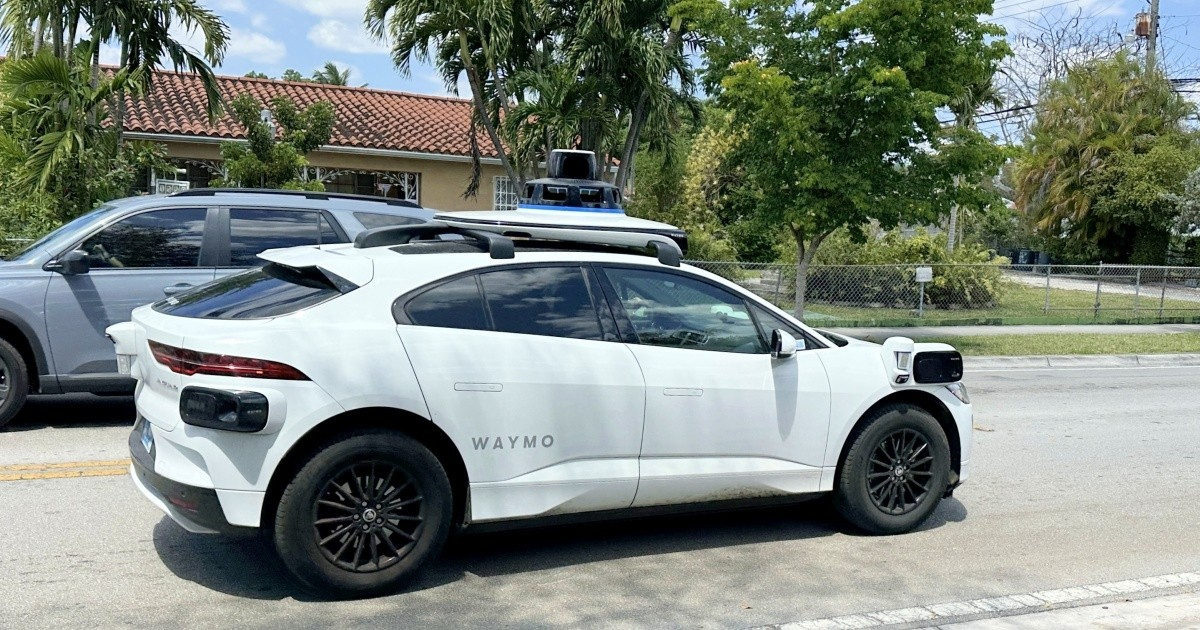
Waymo's robotaxis are now a common sight on the streets of Miami, and with their proliferation comes a practical question that more and more residents are asking: what should one do if one of these driverless vehicles is involved in an accident?
According to a report by El Nuevo Herald, the company has established a clear protocol for these cases, although the legal aspects can become significantly more complex than in a conventional accident.
The first thing is the most urgent: if there are injured people, call 911 immediately. Waymo warns that the vehicle may continue to drive after a collision to reach a safe place to stop, and the interior ceiling light will turn on if the system detects that an impact has occurred.
To exchange information with the company, there are four options: call 1-844-263-9885, write to insurance@waymo.com, complete an online form, or scan the QR code located on the front doors of the vehicle. The Waymo support team receives an automatic notification for any incident, and a representative will arrive at the scene to assess the situation.
"It is extremely important to take photos and videos after the collision to preserve evidence of the incident," said Ted Hollander, attorney at The Ticket Clinic. If the passenger is traveling within the robotaxi when the crash occurs, they should also obtain the information from the other driver involved: name and insurance information.
Waymo offers limited medical coverage for all passengers involved in a collision, regardless of who is at fault or whether they have additional insurance. The company clarifies that, once information has been exchanged, it is not necessary to wait for a representative unless indicated by the authorities present at the scene.
From a legal standpoint, accidents involving robotaxis introduce a different landscape compared to traditional collisions. "If, during the evidence-gathering process, it is discovered that the Waymo vehicle has a defect and that this defect contributed to the accident, the case could be reclassified as a matter of liability for a defective product," Hollander explained.
This becomes particularly relevant given the recent context: in May 2026, the National Highway Traffic Safety Administration (NHTSA) opened an investigation into Waymo following 13 incidents where robotaxis entered closed construction zones on highways. As a consequence, Waymo temporarily suspended highway rides in Miami and other cities on May 21, although urban routes continued to operate.
On June 18, the NHTSA announced the recall of 3,871 robotaxis to update their software via a remote update. Previously, in January 2025, a Waymo vehicle had entered the light rail tracks in Phoenix, causing trains in both directions to reverse.
Waymo arrived in Miami in January 2026 with limited operations and opened its service to the general public on April 15, covering about 100 square miles of Miami-Dade County, from Brickell and Wynwood to Coral Gables and Miami Beach. The company claims to have traveled over 127 million miles in fully autonomous mode and asserts that its vehicles experience ten times fewer accidents with serious injuries than human drivers, although these figures lack independent verification.
Related videos:
Filed under: