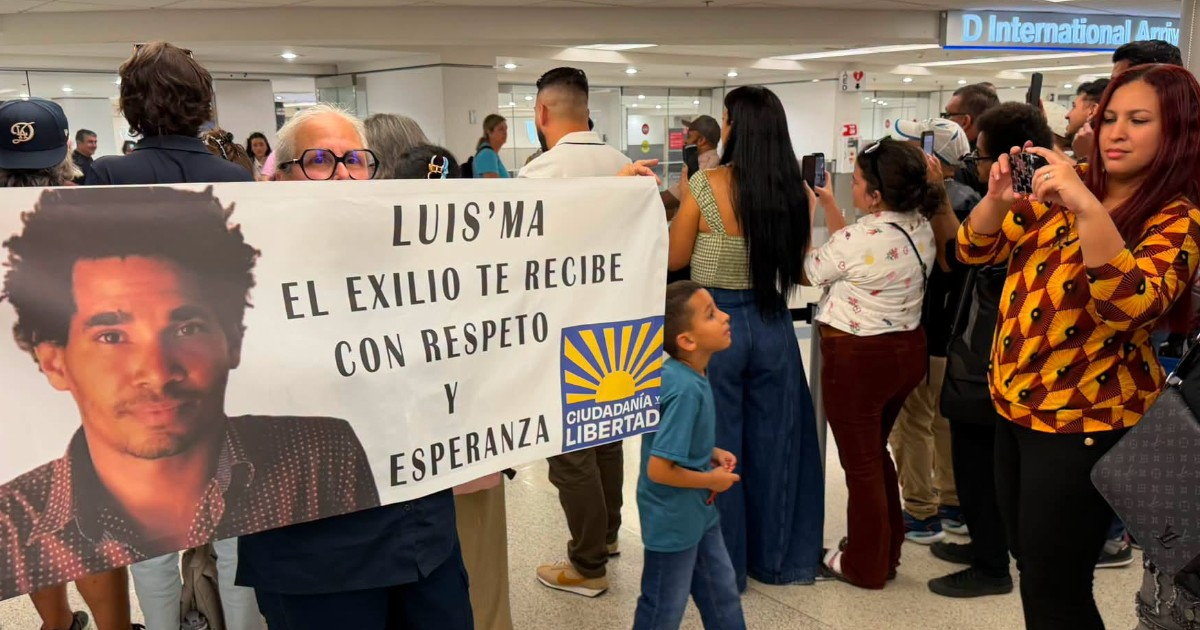
José Daniel Ferrer responded to the criticisms directed at Luis Manuel Otero Alcántara following his arrival in Miami on Saturday, doing so from a position that few can claim: that of someone who experienced the same forced exile and faced the same attacks.
Ferrer was present at Miami International Airport to welcome Otero Alcántara and later accompanied him at the gratitude event held at the Ermita de la Caridad del Cobre. In a video published on Facebook from the airport itself, the leader of the Patriotic Union of Cuba (UNPACU) described the artist as someone who arrives free after five years of captivity: "We are here at Miami Airport about to welcome our brother Luis Manuel Otero Alcántara who arrives in the Land of Freedom after more than five years of arbitrary captivity."
But it was his written message that directly responded to those who have questioned Otero for accepting exile or for arriving in apparently good physical condition. "Luis Manuel Otero Alcántara deserves respect. Those who criticize and defame him, if they have a day of brave history, like he has had many, let them tell it. Telling stories about brave acts is positive. Showing baseness, envy, and malice is very ugly," Ferrer wrote on X.
Criticism on social media—much of it from profiles linked to the government—suggested that Otero's departure was planned to obtain parole and permanent residency in the United States, and questioned his credibility based on his physical condition upon landing.
The parallelism with Ferrer's story is direct. The opponent was exiled to Miami in October 2025 along with his wife Nelva Ismarays Ortega Tamayo and their children, leaving directly from Mar Verde prison in Santiago de Cuba without going through normal procedures. He too accepted exile as the only way to leave prison, and he also faced the same smear campaign that is now being repeated against Otero.
Ferrer has accumulated approximately 11 years and five months of imprisonment in Cuba over three distinct periods, including eight years for the Black Spring of 2003 and more than three years after being detained during the protests on July 11, 2021. Amnesty International has repeatedly declared him a prisoner of conscience.
Otero Alcántara, co-founder of the San Isidro Movement, served his full five-year sentence in the maximum-security prison in Guanajay, where he staged more than ten hunger strikes and reported death threats from State Security agents. In January 2022, he had rejected exile with the phrase "I will die here"; four years later, the regime forcibly exiled him.
Otero himself acknowledged the complexity of his situation upon arrival: “It is important to recognize that I am expelled from Cuba”, he said at the Ermita de la Caridad. “That is not right.”
In the video from the airport, Ferrer summarized what the artist's journey represents: "More than five years kidnapped in a dark communist prison. For defending human rights, for defending free art, for wanting a free, democratic, just, and prosperous Cuba."
The exile of Otero Alcántara triggered a wave of reactions on social media, both in support and in criticism, in a debate that reflects the tensions within the Cuban community itself regarding every case of forced exile.
Related videos:
Filed under: