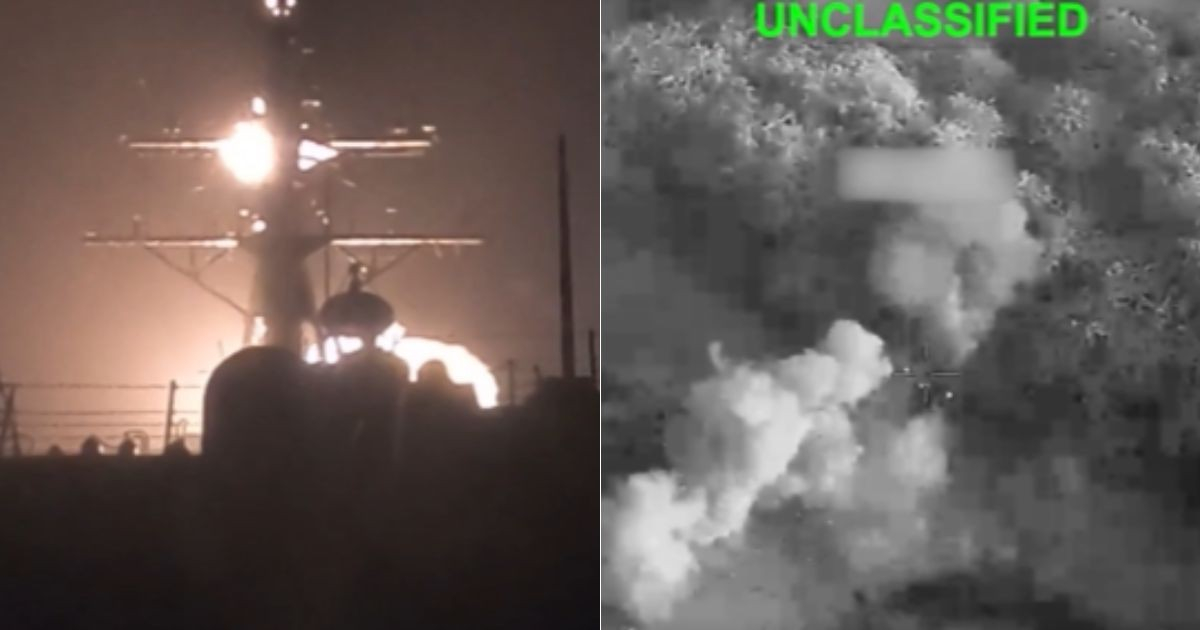
The United States Central Command (CENTCOM) completed the ninth consecutive night of bombings against Iran this Sunday, concluding what it referred to as a "weekend surge" in an official statement published on X from Tampa, Florida.
According to the statement, the attacks concluded at 10:00 p.m. Eastern Time on July 19, after approximately three hours of operations. The targets included Iranian military command centers, air defense facilities, coastal surveillance, maritime capabilities, missile and drone launch bases, and communication networks.
The stated objective of CENTCOM is "to further reduce Iran's ability to attack commercial ships and civilian sailors transiting through the Strait of Hormuz." The statement concludes with a warning message: "The U.S. Armed Forces are holding Iran accountable, acting on the orders of the commander in chief. CENTCOM forces remain on high alert, focused, lethal, and ready."
This new wave is part of the second phase of the conflict, which resumed on July 8 when President Donald Trump declared the ceasefire with Iran over during the NATO summit in Ankara, following Iranian attacks on three merchant vessels in the Strait of Hormuz on July 6 and 7. "The ceasefire with Iran is over," Trump declared at that time, also warning, "We are going to hit them very hard." Since then, the U.S. has targeted more than 300 Iranian military sites in consecutive nighttime strikes.
The conflict has claimed American lives. On Friday, July 17, Iran's Islamic Revolutionary Guard Corps attacked the Al Azraq airbase in Jordan with ballistic missiles and drones, resulting in the death of two soldiers and leaving a third missing. The total number of American military casualties in the conflict has risen to 16. Days earlier, on July 9, Iran had launched 10 ballistic missiles at that same base, of which Jordan intercepted eight with no reported casualties.
Iran, for its part, formally declared the agreement with Washington suspended on July 18 and frames its actions within the so-called "Operation Saeqeh" (Lightning), launched in retaliation for the American bombings. Tehran has also announced the closure of the Strait of Hormuz, although Washington insists that the maritime route remains open. On July 13, the U.S. used unidirectional maritime attack drones for the first time against Iranian targets, marking a new technological escalation in the conflict.
On Saturday, July 15, Trump issued a direct ultimatum to Iranian leaders in an interview with Fox News: “They better make a deal. They will have no one left,” although he noted that Iran “is negotiating now.” The current military deployment represents the largest U.S. air reinforcement in the region since the Gulf Wars, with up to 300 combat aircraft mobilized, including F-16 and F-35 fighters sent to the Middle East from bases in Germany and the United Kingdom.
This conflict has roots that date back to February 28, 2026, when Trump announced the “Epic Fury Operation,” a joint offensive with Israel that targeted thousands of Iranian sites, destroyed nuclear facilities in Natanz, Isfahan, and Fordow, and resulted in the death of Supreme Leader Ali Khamenei on March 1, 2026. After 38 days of fighting, the Islamabad Memorandum was signed between June 17 and 19, a 60-day ceasefire mediated by Pakistan, Qatar, Saudi Arabia, and Turkey, which Iran broke weeks later with attacks in the Strait of Hormuz.
Related videos:
Filed under: