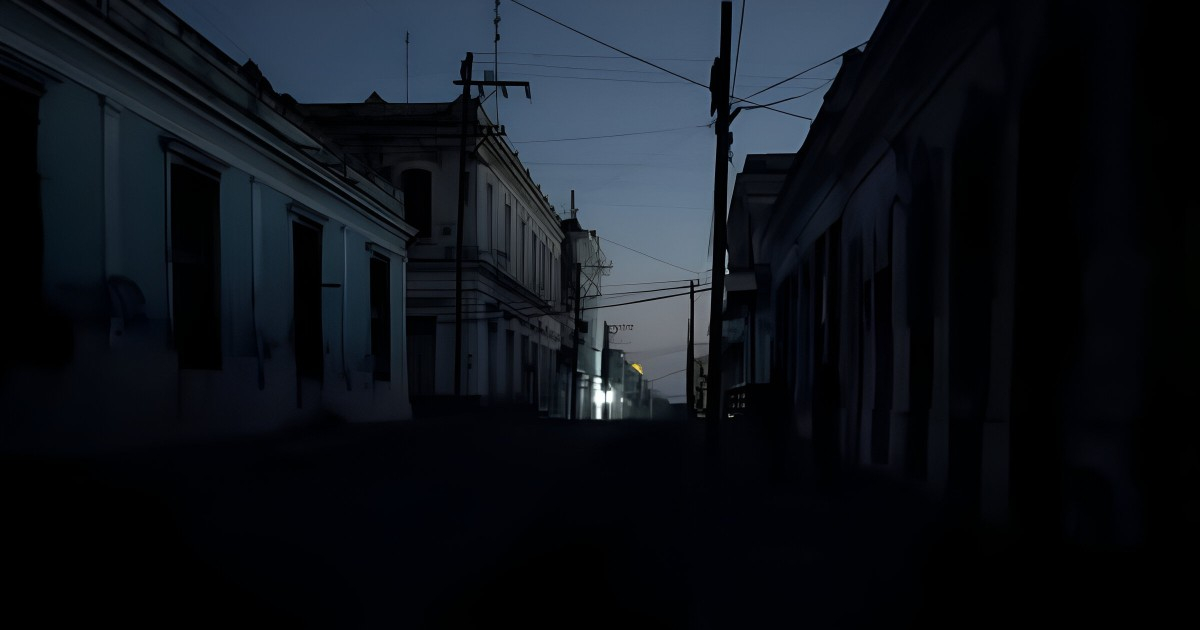
Residents of Calle 3, in the community of Veguita de Galo, south of Santiago de Cuba, have gone 26 consecutive days without electricity and report that the authorities have not provided an effective response to the problem. The complaint was published on July 19 by journalist Yosmany Mayeta Labrada on his Facebook page, who received the testimony directly from those affected.
Residents describe the situation as a "tremendous abuse" and point out that among the most affected are children, the elderly, and bedridden citizens, who are facing increasingly difficult conditions without access to electric service.
The Santiago de Cuba Electric Company attempted a partial solution by replacing a faulty transformer in the area, but the newly installed equipment exploded less than two hours after it started operating, leaving the entire community in the dark once again.
A neighbor who requested to remain anonymous for fear of reprisals summarized the official response with one phrase: "Every time we call, they tell us we have to wait."
The affected individuals claim to have reported the problem numerous times and went to the authorities of the Communist Party on Sunday, without receiving any attention or commitment to a solution.
Veguita de Galo is a peripheral neighborhood with around 19,000 inhabitants and a history of collective organization in response to service crises. In June and July 2026, residents of the area managed to halt the Electric Company’s operations up to three times which aimed to remove functioning transformers to relocate them to prioritized circuits, given the critical shortage of spare parts throughout the eastern region.
What happened in this Santiago community is not an isolated case, but rather part of the most severe energy collapse Cuba has experienced in decades. Since June 16, the Electric Company has reorganized power outages in Santiago into nine residential blocks, providing barely one or two hours of service each day. In July, 11 thermoelectric units were out of service nationwide, including the Antonio Maceo plant in Santiago itself.
The national energy deficit reached a historic record of 2,341 MW on July 8, leaving approximately 73% of the Cuban population without electricity. The National Electroenergy System suffered three total collapses in just eight days —on July 6, 10, and 14— marking the fifth total blackout of the year. Additionally, the cessation of Venezuelan oil supply since January 2026 has left Cuba without the necessary fuel to sustain its electricity generation.
Accumulated desperation has triggered a wave of protests across the country. On the same Sunday, residents of Consulado and Refugio in Centro Habana, staged a saucepan protest with fire in the street and verbally confronted the deployed police. Days earlier, similar protests shook Lawton and El Vedado. In June 2026, 107 street protests were recorded in Cuba, the highest monthly figure up to that point.
The organization Cubalex documented at least 38 detentions related to the protests in the previous months, while President Miguel Díaz-Canel simply called on July 8 to "better organize the blackouts", without announcing any structural measures to increase electricity generation.
Meanwhile, the residents of Veguita de Galo continue to wait for someone to respond to their call, receiving the same answer as always: that they must be patient.
Related videos:
Filed under: