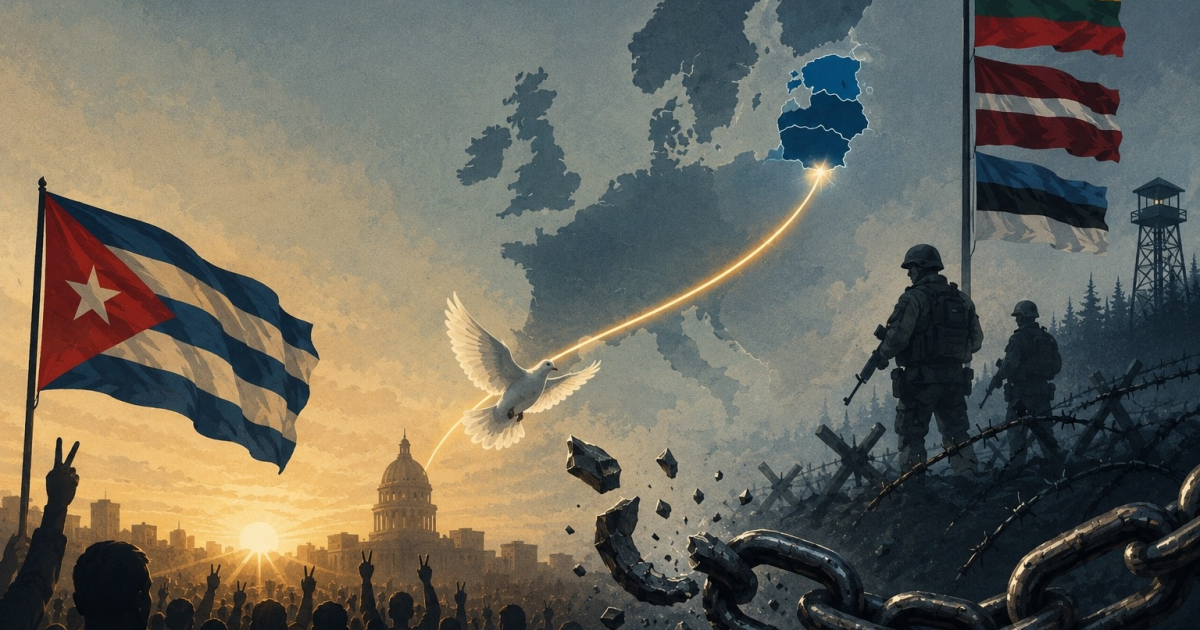
This Monday, Washington once again brings together defenders of democracy, former dissidents, policymakers, and representatives from nations that have directly experienced communist domination. The Captive Nations Summit 2026 is not a ceremony solely dedicated to remembering past tragedies. It is, above all, a warning about present dangers.
Among the nations whose experiences should be listened to with particular attention are Lithuania, Estonia, and Latvia. The three Baltic countries were occupied, annexed, and subjected for decades by the Soviet Union. They regained their independence because their peoples maintained their national identity, resisted Russification, and seized the historic moment when the communist empire began to crumble.
Today, they find themselves once again on the front line of Europe's defense. Vladimir Putin has not hidden his nostalgia for the Soviet imperial power nor his disdain for the sovereignty of the countries that Moscow considers part of its former sphere of influence. The invasion of Ukraine is not an isolated conflict or a mere territorial dispute. It is a war against the right of small and medium-sized nations to freely choose their political system, alliances, and future.
Russia maintains military initiative in several sectors of Ukraine but has not achieved a decisive victory. Its forces remain stalled, paying a huge price in lives, materials, and economic resources. Ukraine continues to resist, striking military installations, refineries, depots, and logistical centers within Russian territory. The Kremlin can sustain destruction and prolong suffering, but it has not managed to eliminate the Ukrainian state or break the national will of its people.
Putin relies on exhaustion. His calculation is that Russia can endure losses for a longer period of time and that Western democracies will eventually grow weary of financing Ukraine's defense. He hopes that the political divisions between the United States and Europe will achieve for him what his army has been unable to accomplish on the battlefield.
Internally, the Russian president continues to control the security apparatus, the media, institutions, and the main economic elites. Surveys still attribute a high approval rating to him, although these percentages must be assessed considering that this is a regime where criticizing the war can lead to imprisonment, loss of employment, persecution, and even death.
Russia is not on the brink of a rebellion, but it is showing increasing signs of exhaustion. The population increasingly desires negotiation; military spending is straining public finances; inflation is hitting households; labor is in short supply, and economic growth is weakening. Putin is under more pressure than before, yet he remains powerful, and precisely for that reason, he continues to be dangerous.
Could they attempt to invade Estonia, Latvia, or Lithuania?
An immediate conventional invasion does not seem to be the most likely scenario while most of Russia's military capacity is engaged in Ukraine. Attacking any of the Baltic republics would mean attacking NATO and risking direct war with the United States, the United Kingdom, Germany, France, Poland, Finland, Sweden, and the rest of the Alliance.
However, it would be a serious mistake to confuse the improbable with the impossible. Dictators do not always act with the rationality that democracies expect. Putin has already demonstrated in Ukraine that he can miscalculate a nation’s resistance, overestimate his army, and underestimate the international response.
The danger would increase if he were to become convinced that the United States is withdrawing from Europe, that NATO is divided, or that he can quickly occupy a small portion of territory before the Alliance decides to respond.
Before a full invasion, Moscow could resort to sabotage, cyberattacks, damage to underwater cables, disinformation campaigns, border provocations, or manipulations of Russian-speaking communities.
The defense of the Baltic cannot be symbolic.
Estonia has an allied combat group led by the United Kingdom. Latvia hosts a multinational brigade headed by Canada. Lithuania is receiving a permanent German brigade that is expected to reach approximately 5,000 troops. In addition, the three countries have welcomed U.S. forces, although their numbers have varied due to rotations and recent reductions.
The Baltic governments have publicly requested a continuous American presence. Lithuania has called for extended and uninterrupted U.S. units. Estonia has insisted that Washington's commitment must be visible and credible. Latvia has also expressed its willingness to sustain and facilitate the deployment of American forces.
They are right. The presence of American soldiers not only provides military capability. It directly places the commitment of the United States on the ground. A Russian attack would cease to be an abstract issue subject to prolonged diplomatic deliberations: it would immediately affect American and allied military personnel.
The smartest deterrence is to convince Putin that he cannot achieve a quick victory. Each Baltic country needs forces capable of fighting from the very first hours, not contingents that serve only as a flag or political gesture. The region requires air defense, missile systems, artillery, armored vehicles, drones, electronic warfare, stored ammunition, and secure routes for receiving reinforcements from Poland, Germany, Finland, and Sweden.
What significance does the security of the Baltic countries have for the freedom of Cuba?
The security of Estonia, Latvia, and Lithuania is deeply connected to the freedom of Cuba. The regime in Havana is not neutral in this confrontation. It has supported the Russian narrative, tightened political and military cooperation with Moscow, and has served for decades as an ally of authoritarian expansionism. Cuban diplomacy defends, at the United Nations, the interests of dictatorships that uphold their own repressive systems.
At the recent UN General Assembly, the Cuban regime requested an extraordinary debate on U.S. sanctions. The voting results were 136 in favor, nine against, and 30 abstentions. The Baltic countries were among those that did not support the Castro-communist dictatorship. They abstained, but should have voted against it, as did the Czech Republic.
That abstention had political significance. It amounted to a refusal to accept that Castroism controls the narrative, presenting itself as an innocent victim while imprisoning opponents, oppressing the Cuban people, and supporting Russian aggression against Ukraine.
Estonia had already publicly announced that it would modify its traditional behavior in the UN and propose a review of European policy towards Cuba. Its Foreign Minister explicitly linked the pressure on Havana with Cuba's support for the Russian war and the worsening of human rights violations.
Democratic Cubans must recognize that value. The Baltics understand that a dictatorship can use propaganda, diplomacy, and fear to present itself as legitimate. They also know that the freedom of a small nation often depends on the solidarity of other democracies.
Defending Ukraine protects Lithuania, Estonia, and Latvia. Supporting the Baltic countries strengthens all of Europe. And a strong Europe, aware of the Russian threat and less tolerant of the dictatorships allied with Moscow, is essential for the cause of Cuban freedom.
Western security is indivisible. The same imperial logic that denies Ukraine its right to exist supports the regime that denies Cubans the right to choose. The same propaganda that justifies the Russian invasion tries to portray the Cuban tyranny as a perpetual victim rather than the main perpetrator of oppression and national ruin.
Therefore, in this new Week of the Captive Nations, the message must be clear: there will be no secure Europe as long as Russia believes it can reconquer its neighbors. And there will be no freedom in Cuba if democracies accept that Havana continues to operate as a political and strategic outpost of Moscow in the Western Hemisphere.
The defense of the Baltic and the freedom of Cuba are part of the same battle: the battle for the right of peoples to live in democracy, without occupations and without dictatorships.
Related videos:
Filed under:
Opinion article: Las declaraciones y opiniones expresadas en este artículo son de exclusiva responsabilidad de su autor y no representan necesariamente el punto de vista de CiberCuba.