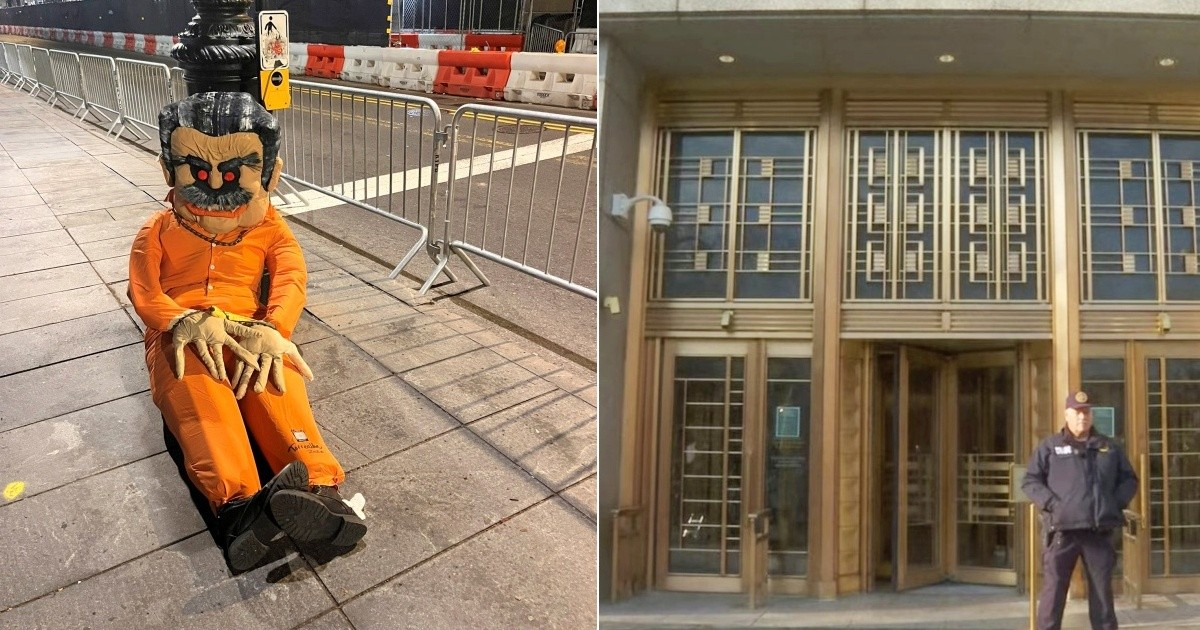
Nicolás Maduro and his wife, Cilia Flores, are appearing this Wednesday before the federal court in Manhattan in their third hearing since their capture in Caracas on January 3, 2026, when U.S. military forces detained them in a swift operation.
Since then, the couple has been confined in a federal prison in Brooklyn, awaiting trial on charges that include narcoterrorism conspiracy and cocaine importation, offenses that carry penalties of up to life in prison.
A procedural session without a scheduled trial date
The hearing scheduled for today is strictly procedural: the prosecution and defense will address the classification of evidence and the submission of pre-trial motions, for which there is still no defined schedule.
It is not expected that Judge Alvin Hellerstein, 92 years old, will set a date for the start of the trial at this time.
Today's session was originally scheduled for June 30, but the Prosecutor's Office requested a postponement for security reasons.
In the document presented to the court, the Government argued that the postponement was “strictly necessary to avoid scheduling issues and logistical concerns related to ensuring the safe transfer of the accused and maintaining public safety.”
During June and the first half of July, the resources of the New York Police Department (NYPD) were focused on the 2026 World Cup, which concluded on Sunday with Spain's victory.
Since the appearance requires the physical presence of both defendants in Manhattan, the NYPD must deploy extensive operations for their ground transportation from Brooklyn.
The charges and the defense strategy
Maduro faces four charges: conspiracy to commit narco-terrorism, conspiracy for the importation of cocaine, possession of machine guns and destructive devices, and conspiracy to possess those same weapons.
Cilia Flores faces charges related to drug trafficking and possession of weapons.
The former dictator pleaded not guilty in January 2026 and refers to himself as a "prisoner of war" before the court, while his defense team -led by attorney Barry Pollack- invokes head of state immunity and questions the legality of the capture.
In April 2026, Washington modified the sanctions on Venezuela to allow the Venezuelan government to fund the legal defense of both defendants, resolving a prior dispute in which the defense argued that the blockade of funds violated the constitutional right to choose a lawyer.
The 1922 Treaty: The Legal Bombshell That Could Change Everything
The element that draws the most attention among analysts is a 1922 bilateral extradition treaty between the United States and Venezuela, whose clause states that "all differences between the contracting parties concerning the interpretation or execution of this treaty shall be resolved through arbitration."
According to a column published by The New York Times on Tuesday, U.S. courts might "not have the authority to handle their case" if the Venezuelan government activates that clause claiming that the capture was illegal under international law.
The jurist David Sloss pointed out that "it would not be especially surprising if the dispute were temporarily withdrawn from the courts and referred to arbitration."
The same column warned that "the trial cannot legally proceed without this step," and that evading arbitration would make the operation "flagrantly illegitimate according to U.S. laws as well."
The 92-Year-Old Judge and the Diplomatic Context
Another point of concern is centered on Judge Hellerstein himself, who during the previous hearing - held on March 26 - exhibited a fatigued voice and small lapses that raised doubts about his ability to conduct a process of extreme complexity.
In that session, he/she rejected the dismissal of the case.
In parallel, the Trump administration requested on Tuesday that judicial immunity be recognized for the interim president of Venezuela, Delcy Rodríguez in a civil lawsuit filed in Florida, highlighting the complex diplomatic dynamics between Washington and Caracas as the trial progresses.
The Secretary of State, Marco Rubio, confirmed on Monday the beginning of transition talks in Venezuela for August 2026, which adds a major political dimension to a hearing that seemingly only addresses procedural matters.
Related videos:
Filed under: