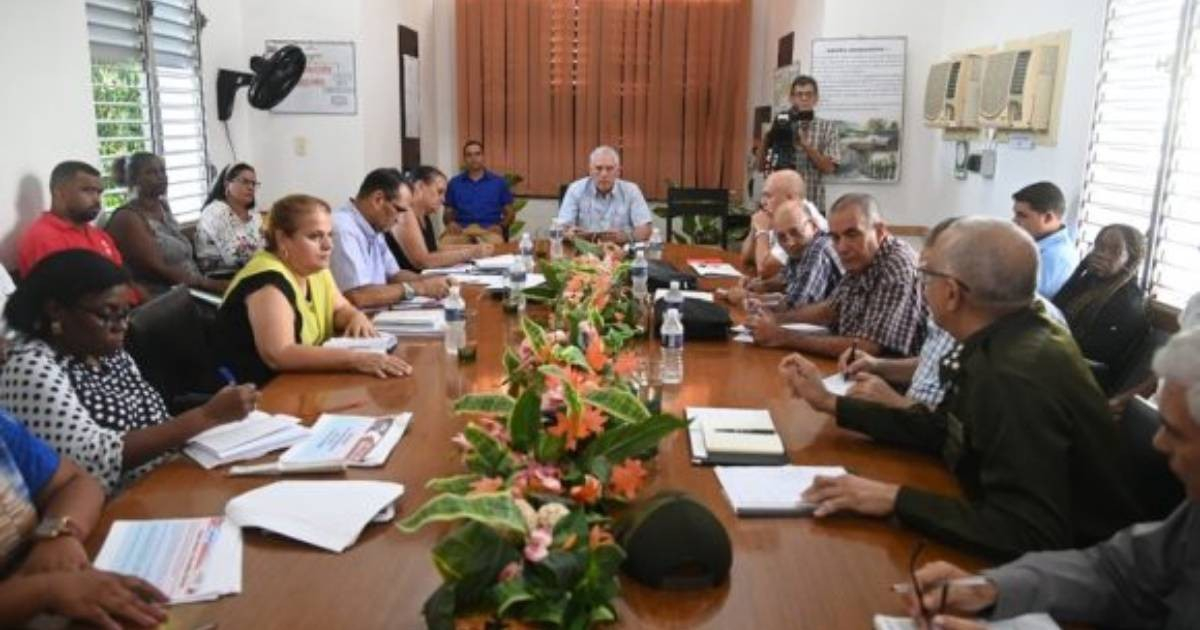
Cuban leader Miguel Díaz-Canel Bermúdez visited the Municipal Defense Councils of San Miguel del Padrón and Diez de Octubre in Havana, where he emphasized the need to place "the most capable individuals" in charge of the Defense Zones, which are key structures of the regime's territorial organization system to address situations deemed exceptional.
The visit comes at a particularly delicate moment for the country. Just a day prior, the National Electroenergetic System registered a record deficit of 2,341 megawatts, the largest reported electrical generation shortfall to date, while Cuba has experienced four nationwide collapses of the electrical system so far in 2026, the most recent occurring on July 10th.
According to Presidencia Cuba, Díaz-Canel was accompanied by Roberto Morales Ojeda, a member of the Political Bureau and Secretary of Organization of the Central Committee of the Communist Party of Cuba; the president of the Provincial Defense Council of Havana, Liván Izquierdo Alonso, and the capital's governor, Yanet Hernández Pérez.
During the tour of Diez de Octubre, a municipality with around 200,000 inhabitants and nine Defense Zones, the leader emphasized the importance of strengthening those structures.
"It is very important that a Defense Zone is well activated; and that the most capable people are at the forefront of such a structure," he stated.
The Defense Zones are the foundation of the Cuban defensive system and are responsible for coordinating the local response to scenarios that the regime deems exceptional, such as natural disasters, emergencies, or disruptions to internal order.
In San Miguel del Padrón, home to approximately 163,000 people, authorities presented a municipal energy map to monitor the status of the electricity service, whose crisis has led to increasing social unrest throughout the country.
In addition to the energy situation, the meetings addressed issues related to water supply, solid waste collection, support for vulnerable individuals, job disconnection, the development of renewable energy sources, food production, and pension payments.
The visit is part of the tour that Díaz-Canel began on June 30 through the 15 municipalities of Havana, as part of the so-called "Year of Preparation for Defense 2026." By July 17, he had already visited nine areas of the capital, including inspections of the preparations for the so-called "People's War" in the Cerro municipality.
However, the true purpose of these tours was revealed on July 17, when Canal Caribe accidentally displayed an official slide indicating that the visits are part of a plan to carry out “actions in the political, economic, social, and communicational spheres to prevent a social explosion”, in compliance with Directive No. 2 of the National Defense Council.
This document emerged in a context of growing social tension. Just three days later, on July 20, residents in the center of Havana staged pot-banging protests and demonstrations demanding electricity, which were joined by political slogans that went beyond mere opposition to blackouts.
At the end of his tour, Díaz-Canel announced that he will return soon to continue assessing the functioning of the municipalities.
"In a very short time, there will be a new opportunity to look closely at that small country, key to the Island, which is the municipality," he stated.
This new visit highlights the increasing prominence that the regime is giving to territorial defense structures in a context marked by the worsening energy crisis, the deterioration of basic services, and the rise in citizen discontent.
Related videos:
Filed under: