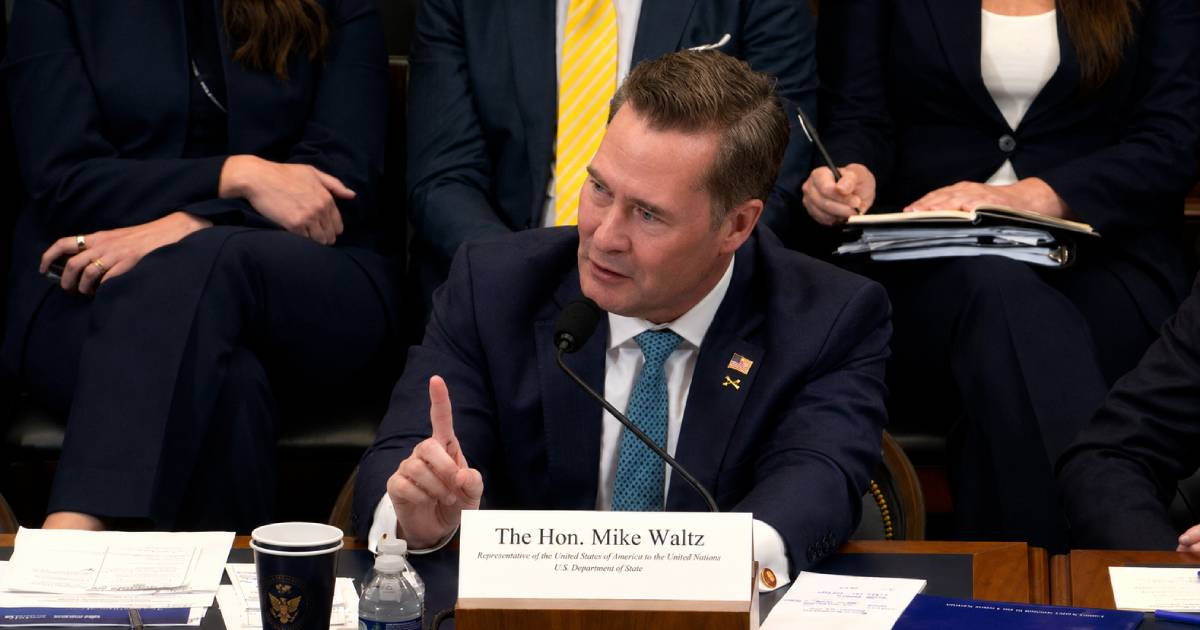
The U.S. Ambassador to the UN, Mike Waltz, refused on Wednesday to rule out potential military action against Cuba when directly questioned during a hearing of the House Foreign Affairs Committee.
"I'm not going to take options off the table for the President of the United States," Waltz responded to Democratic Representative Mark Pocan (Wisconsin), who asked him, "Are we going to have military action against Cuba? It seems that's what this report is preparing for."
The exchange, shared by CBS News, took place during a hearing focused on accountability and reform at the United Nations, although it quickly shifted towards U.S. policy regarding Cuba.
The State Department's report centered the debate
The question from Pocan came just two days after the Department of State published the report "Cuba: The Capital of 21st Century Communism", a document of nearly 100 pages that accuses the Cuban regime of engaging in espionage activities, subversion, and strategic cooperation with Russia, China, and Iran.
The Democratic congressman questioned both the content of the report and Washington's sanctions policy towards Havana.
Pocan, who was part of a delegation of legislators that visited Cuba from July 9 to 13, stated that during his stay, he observed prolonged power outages and hospitals forced to operate under extreme conditions.
"It is us who block that, not the Cuban government," he stated, arguing that U.S. restrictions hinder the entry of medical supplies to the island.
Waltz defended the sanctions
During the hearing, Waltz rejected the characterization of U.S. policy as a "blockade."
"A blockade is a ring of warships. A blockade is what we have now in Iran," he replied.
The ambassador also defended the sanctions as a tool to prevent the Cuban regime from continuing to expand "its revolution, its communism, and its anti-American revolution in the Western Hemisphere."
He also acknowledged that he has not read the full report from the State Department nor visited Cuba, although he claimed that, as a Floridian, he is aware of "the adversarial actions of the Cuban regime."
At another point in the exchange, he warned Pocan that he hoped his trips to the island would not be used "for the propaganda of the Cuban regime, which has oppressed and massacred people."
The debate is growing in Washington
Waltz's statements come in the context of increasing tension between Washington and Havana.
On July 12, the ambassador stated that China and Russia maintain intelligence facilities in Cuba located near U.S. military bases and asserted that the Trump administration "will not tolerate it any longer."
Meanwhile, in Congress, initiatives have also emerged to limit any potential military intervention. In May, representatives Nydia Velázquez and Gregory Meeks introduced the H. Con. Res. 106 War Powers Resolution, aimed at preventing military action against Cuba without prior authorization from Congress.
For his part, Pocan had previously described the State Department's report as "the most stupid, fantastic, and biased thing" he has read from a government agency, and argued that the document seeks to justify a more aggressive policy towards Havana.
The Cuban government also rejected the report. Foreign Minister Bruno Rodríguez described it as a "slanderous pamphlet", while Congresswomen Maxine Dexter and Delia Ramírez announced that they will promote legislative initiatives to prevent military intervention in Cuba without Congressional approval and to protect the Cuban population's access to medicines and humanitarian assistance.
Related videos:
Filed under: