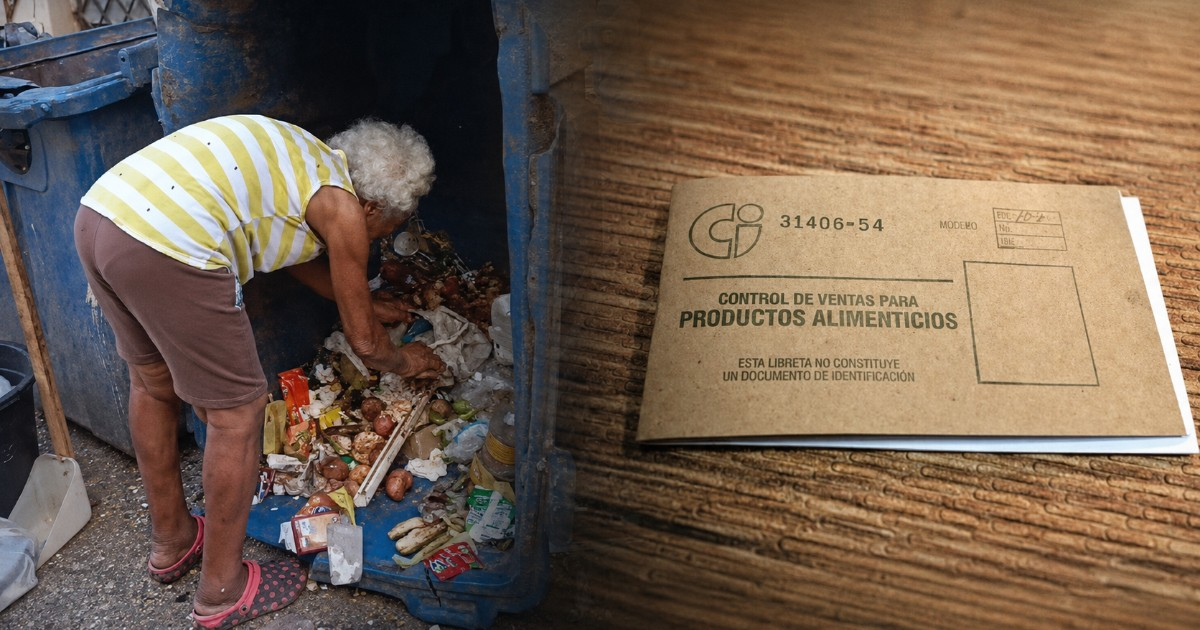
The Food Monitor Program (FMP), an independent organization dedicated to monitoring food (in)security in Cuba, published an analysis this Thursday stating that the 176 economic measures announced by the regime in June do not represent a structural reform, but rather the formalization of a historic break: the State is shifting the responsibility of survival onto citizens, but without restoring the political freedoms that have been restricted for decades.
The document, titled "Privatization of Survival: From Totalitarian Welfare State to Scarcity Management State," analyzes the food crisis from the perspective of the so-called social pact.
According to the FMP, since 1959 the regime has taken on the provision of basic goods in exchange for centralizing political power, limiting citizen autonomy, and controlling the means of production.
The legitimacy of the system, therefore, depended on its ability to ensure minimal living conditions. However, the organization believes that this agreement no longer exists.
The new economic measures, rather than addressing the root causes of the crisis, shift the risk from the State to the individual, forced to navigate a fragmented, inflationary market without any guarantees.
The analysis argues that this is not merely a weakened social contract, but rather one that has disintegrated since the moment the authorities ceased to guarantee regular and sufficient access to the essential nutrients for life.
The FMP outlines a genealogy of that deterioration. During the 1970s and 1980s, the apparent food security in Cuba did not rely on efficient internal production, but rather on resource transfers and subsidies from the Soviet Union and the Council for Mutual Economic Assistance.
This support allowed for the distribution of basic food at symbolic prices and disguised the country's low agricultural productivity.
Its disappearance during the Special Period of the 1990s marked the first significant visible break in the relationship between the state and the citizens.
Scarcity then ceased to be an exceptional situation and became a structural component of the system.
The subsequent opening to tourism and the growing dependence on remittances deepened inequalities and led to a differentiated food supply.
While an elite connected to the state, tourism, or foreign currency could access imported products, a large part of the population was limited to a diet primarily consisting of low-nutrient carbohydrates.
Access to proteins and micronutrients began to depend on money sent from abroad rather than citizen status.
The FMP also rejects the notion that the shortage can be explained solely by the U.S. embargo or by the crisis of traditional suppliers.
In his view, the deterioration reflects the government’s failure in the production, distribution, and management of food.
Although the official discourse insists on presenting food sovereignty as an expression of political resistance, Cuban agriculture continues to depend on the importation of fuels, fertilizers, machinery, and other supplies.
Centralization, bureaucracy, lack of incentives for producers, and the inability to respond to market needs have led to a sustained decline in productivity.
Cuba proclaims sovereignty, but it relies on imports and external assistance to prevent further nutritional deterioration.
The report pays special attention to what it calls the outsourcing of risk. Due to its inability to maintain subsidies and ensure distribution, the State encourages micro, small, and medium-sized enterprises (mipymes), private businesses, remittances, and individual efforts to meet needs that were previously officially covered.
When the private sector does not produce enough or sells at prohibitive prices, the Government stops responding through the provision of food and presents the issue as part of a market regularization.
Survival thus ceases to be a state responsibility and comes to depend on the economic capacity of each family.
This process has created a two-speed economy. On one hand, there remains a state sector that pays salaries in increasingly devalued Cuban pesos; on the other, a private and informal market is growing, with prices determined directly or indirectly by foreign currencies.
The result is that the value of work no longer depends on professional qualifications, productivity, or hours worked, but rather on the ability to earn dollars or other foreign currencies.
This distortion particularly harms state workers, retirees, and families without access to remittances.
The analysis also addresses the de facto dismantling of the supply booklet. According to the FMP, this process occurs through a reduction in the quantity and frequency of distributed products, the degradation of their quality, and the forced displacement of consumers to informal markets or small and medium-sized enterprises with prohibitive prices.
Food insecurity then ceases to be merely a distribution issue and becomes one of purchasing power.
Those who do not have foreign currency, savings, or relatives abroad are exposed to malnutrition and a gradual deterioration of their health.
To provide context for this situation, the 2025 Food Insecurity Survey from the FMP indicated that 96.91% of the respondents did not have adequate access to food.
33.9% of the surveyed households reported that at least one of their members had gone to bed hungry in the previous 30 days, compared to 24.6% recorded in 2024.
Additionally, 79.4% of participants stated that they allocate 80% or more of their income to purchasing food. Another report from the organization identified critical levels of food insecurity in Havana, Matanzas, Cienfuegos, Guantánamo, and Santiago de Cuba.
The FMP also warns that scarcity can work as a mechanism of social and political control.
When the state retains the ability to decide who receives certain products, at what time, and at what price, access to food becomes a form of institutionalized dependency.
The daily search for food also consumes the time, energy, and mental capacity of the population.
A person focused on addressing their immediate survival has fewer resources to organize, challenge those in power, or participate in protests.
In economic terms, the report describes inflation as a regressive tax that severely impacts those who do not hold assets in foreign currency.
The state salary continuously loses purchasing power, while basic foods like proteins, fats, and complex carbohydrates behave like luxury goods.
The citizen is left with no choice but to decide between feeding themselves, buying medications, paying for basic services, or addressing other household needs. Survival can no longer be achieved through the state salary, which undermines the old principle of working in exchange for a minimal safety net.
The FMP believes that the 176 measures are reactive responses aimed at managing scarcity, but they do not address low productivity, dependence on imports, the fiscal deficit, or the depreciation of the Cuban peso.
The organization outlines three possible scenarios: a deepening of the crisis if centralized planning continues; a transition towards a mixed economy with greater autonomy for producers; or a radical transformation driven by the pressure of a society unable to continue bearing the human cost of the system.
The document concludes that the social pact cannot be restored solely through fiscal adjustments, monetary controls, or subsidy cuts. It will be necessary to prioritize production, economic autonomy, and citizens' rights over ideology and centralized control.
The final paradox, according to the FMP, is that of "a system that seeks total control over the lives of its citizens but has lost the ability to keep them alive."
Related videos:
Filed under: