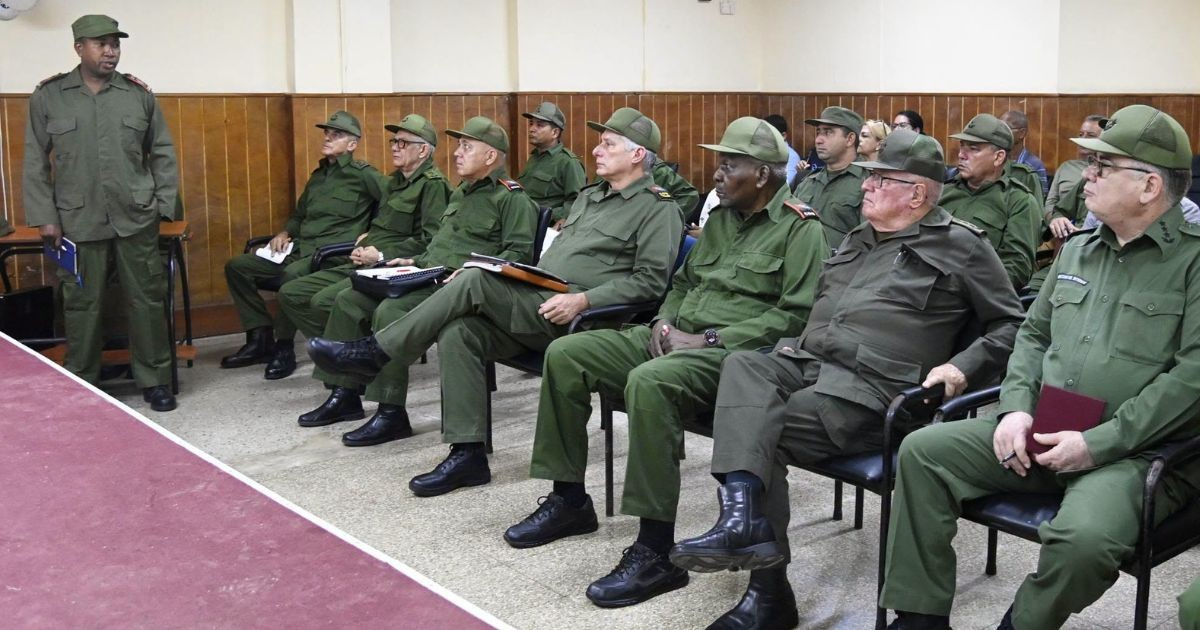
A few hours before the 73rd anniversary of the assault on the Moncada Barracks, one of the regime's key dates, the leader Miguel Díaz-Canel visited the "Libertad" Defense Zone in the municipality of Marianao, Havana, where he reaffirmed that the regime's priority is to strengthen territorial military structures.
Dressed in an olive green uniform and a cap from the National Defense Council, the leader addressed military and civilian personnel gathered at the facility to discuss two key areas that the regime presents as strategic: defensive mobilization and ongoing economic reforms.
In terms of defense, Díaz-Canel stated that "preparation for defense and enhancing combat readiness in the interest of the War of All the People is a fundamental task," invoking a supposed threat of U.S. aggression as justification.
He identified the completion of territorial defense structures, the protection of the population, and the updating of combat plans "in the real situation of the nation" as priorities.
This rhetoric is part of a sustained pattern throughout 2026: since January, the regime declared the "Year of Preparation for Defense" and imposed mandatory military training every Saturday, while Díaz-Canel has been touring the 15 municipalities of the capital inspecting defense zones since June 30.
In economic terms, Díaz-Canel informed that 80 transformations have been approved for implementation, a number that —as announced— will exceed one hundred next week.
He stated that measures aimed at unleashing productive forces, strengthening the business system, and granting greater autonomy to municipalities and enterprises have been prioritized, with the declared objective of improving the relationship between wages and prices.
These 80 measures are part of the package of 176 transformations approved by the National Assembly on June 18 and 19, 2026, presented by the regime as the largest block of structural reforms since the Special Period.
The package includes private banking, the removal of the cap of 100 workers for small and medium enterprises (SMEs), greater openness to foreign investment, and a gradual replacement of universal subsidies with targeted assistance.
Díaz-Canel also listed a series of advancements that the regime attributes to his administration in Marianao: the integration of renewable energy sources, the creation of new water reservoirs, the expansion of banking services for retirees, the renovation of Family Care Systems, and the recovery of facilities "in honor of July 26."
However, the real context is far from the picture painted by official propaganda. Cuba is undergoing one of its worst economic crises in decades in 2026, with blackouts exceeding 24 hours daily in several provinces, shortages of fuel and food, and a GDP decline of 5% in 2025 that has accumulated a contraction of 15% since 2020.
Analysts point out that Díaz-Canel's municipal tour also seeks to contain social discontent due to fears of a popular uprising.
Related videos:
Filed under: