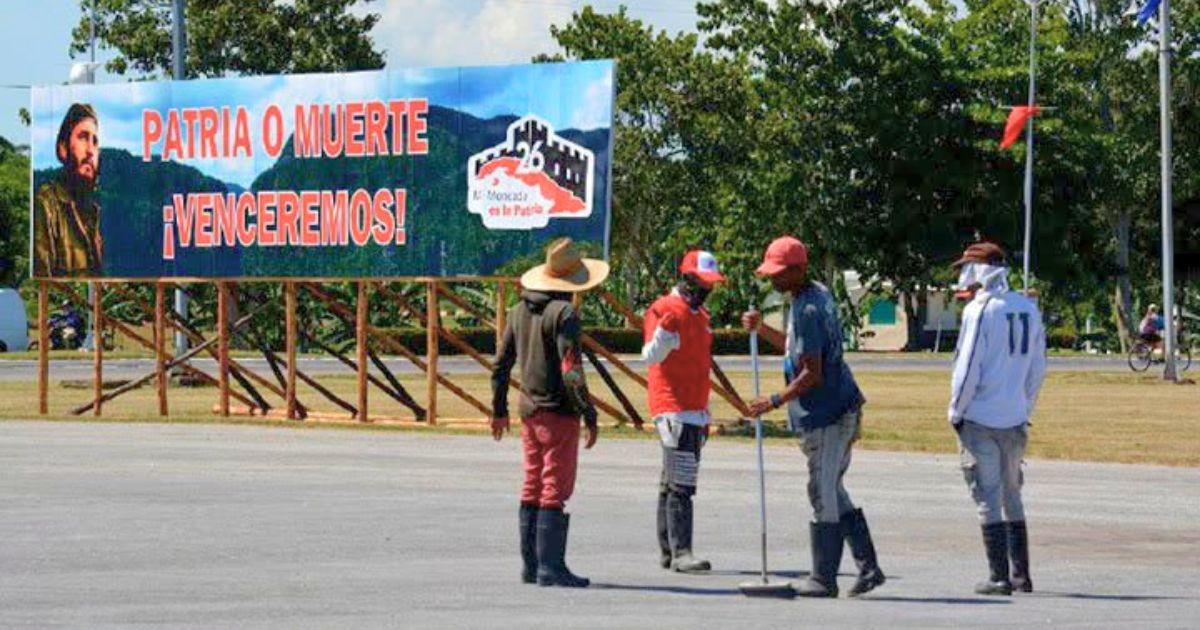
While part of Pinar del Río has gone over two years without regular access to potable water and blackouts can last up to 30 consecutive hours, the official Periódico Guerrillero celebrates that the square in the capital of Vueltabajo is already looking "adorned" for the National Central Act commemorating the 73rd anniversary of the assaults on the Moncada and Carlos Manuel de Céspedes barracks, which will take place this Sunday, July 26.
Hundreds of plastic chairs arranged in perfect rows, sound and lighting towers, Cuban flags and those of the 26th of July Movement, and a large banner with the slogan "Homeland or Death, We Will Overcome": the stage is immaculate. What is missing, of course, is the water.
The state media enthusiastically described how the "people of Vueltabajo, known for their spirit of rebellion and resilience, are preparing to experience a day of patriotic reaffirmation." A narrative that, in the current context of the province, sounds more like unintentional irony than praise.
Miguel Díaz-Canel, cited by the Guerrillero Newspaper itself, stated that this date "calls us to continue working to improve the quality of life of the population, promote food sovereignty, and maintain the achievements of our socialism." Words that the people of Pinar del Río, many of whom have been without running water for months, received with a mix of disbelief and frustration.
The reaction in the comments of the official post was immediate. An internet user summarized the collective sentiment with a phrase that went viral: "The country is falling apart, but we can't say anything; everything is just fine and dandy." Another was more direct and succinct: "Pinar del Río without water but with plenty of 26." A third posed the question that no one in the government seems willing to answer: "When will we have water?" There was even one person who, with genuine perplexity, simply asked: "What are they celebrating?"
The water crisis in the province is neither new nor minor. In Entronque de Herradura, a municipality in Consolación del Sur, residents reported in April 2026 over two years without regular access to drinking water. In Viñales, reports in May indicated over six months without supply, with power outages lasting up to 30 hours that render the water pumps inoperable. A water truck can cost up to 4,000 pesos, an amount beyond reach for most families.
Scarcity is not just an inconvenience: in June 2026, an increase in suspected cases of hepatitis A was reported in the province, directly linked to the lack of drinking water. Meanwhile, the regime mobilized a hundred workers to restore the Teatro Milanés in record time, with work starting on June 30 and a delivery deadline of July 20. For the political event, speed and resources appear out of nowhere; for water and electricity, the response is always the same: patience and resilience.
This is the fourth time that Pinar del Río hosts the central event of July 26, having previously done so in 1976, 2000, and 2017. This edition also features an additional element of propaganda: the regime frames it within the centenary of Fidel Castro's birth, under the slogan "My Moncada is the Homeland." The Ministry of Labor and Social Security confirmed a labor break on July 25, 26, and 27, which in practice means that workers will be mobilized to the event instead of resting.
The economic backdrop does not support the official narrative. The Cuban economy plunged by 5% in 2025 and has accumulated a decline of 15% since 2020, according to data cited by various sources, and CEPAL projects an additional slump of 6.5% for this year. But the square is ready, the chairs are arranged, and the flags are waving. That, apparently, is what matters.
As another internet user wrote with resigned irony upon seeing the pristine photos of the square: "What a beautiful square, hahaha, will I be able to arrive on time?" The question, of course, was not about the schedule of the event.
Related videos:
Filed under: