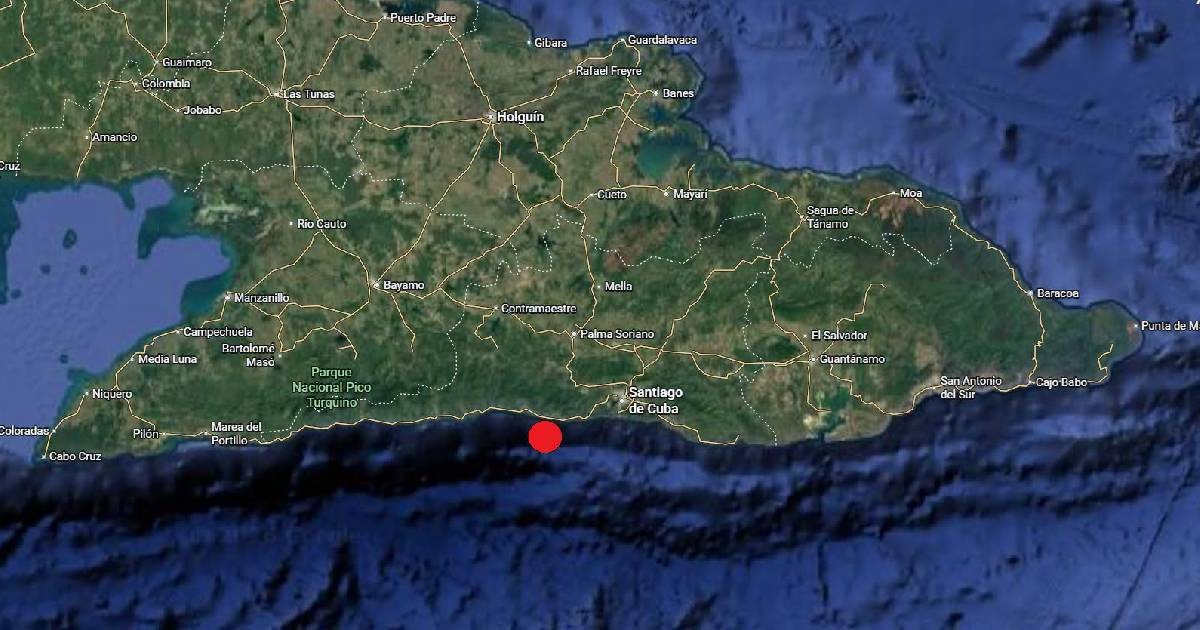
A magnitude 3.1 tremor shook the city of Santiago de Cuba on Thursday at 10:13 PM, according to the Cuban National Seismological Service.
The epicenter was located 26 km southwest of the city, in the Caribbean Sea, at a depth of 8.5 km.
The seismologist Enrique Diego Arango Arias published the report on his public Facebook profile, where he detailed the event's coordinates: 19.90 degrees north latitude and -76.06 degrees west longitude.
Until 10:25 PM —the closing time of the report— reports of perceptibility from various locations in the city had been received, with no reports of material damages or casualties.
Arango Arias specified that this is the "perceptible earthquake No. 9 of the year 2026," placing this event within a sustained sequence of seismic activity that has characterized eastern Cuba in recent months.
The year 2026 has been particularly active in the region. On March 17, the strongest earthquake of the year, with a magnitude of 6.0, was recorded, generating over 160 aftershocks and was felt in Santiago de Cuba, Guantánamo, and Granma.
Previously, on February 8, a 5.6 magnitude earthquake shook the southeast of Imías, and on March 6, another earthquake of magnitude 5.3 affected the southern area of that same region. On July 1, a new tremor of magnitude 3.9 was reported southeast of Imías, also felt in Santiago de Cuba.
Just weeks before the earthquake this Thursday, Arango Arias himself had raised concerns about unusual activity in Manzanillo, Granma.
"Very interesting seismic activity has been recorded since yesterday in Manzanillo, so we must stay alert," wrote the Cuban seismologist on June 29, when the National Center for Seismological Research (CENAIS) had counted 23 earthquakes between the 27th and 28th of that month in the eastern part of the country.
The eastern region of Cuba accounts for about 70% of the country's seismic activity, a result of its proximity to the Oriente fault, which marks the boundary between the Caribbean and North American tectonic plates. Santiago de Cuba is the province with the highest frequency of perceptible earthquakes in the country, experiencing between 10 and 15 per year, according to CENAIS.
This sequence began with particular intensity on November 10, 2024, when two earthquakes with magnitudes of 6.7 and 5.8 shook the Pilón-Uvero area in Santiago de Cuba, causing material damage and triggering thousands of aftershocks that lasted for weeks.
The earthquake this Thursday, with no damage reported, is the ninth noticeable event recorded in Cuba so far in 2026, in a year that has already seen several of the most significant tremors of the last decade on the island.
Related videos:
Filed under: