
Related videos:
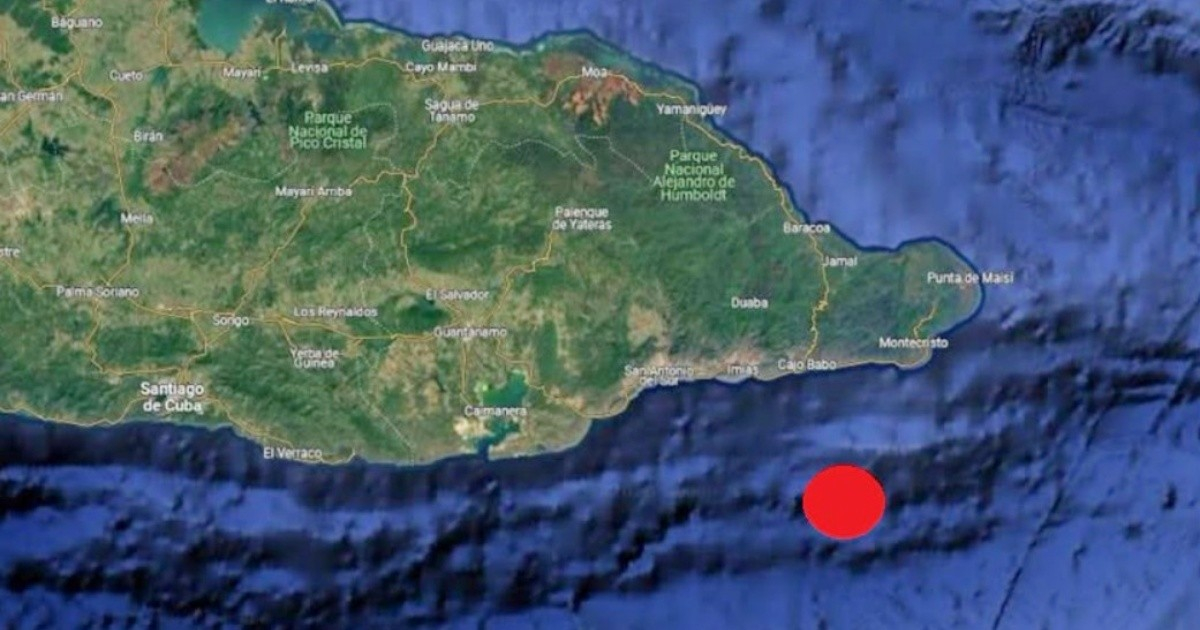
A magnitude 3.9 earthquake shook the easternmost part of Cuba on Tuesday morning, with its epicenter located 41 kilometers southeast of Imías, in the province of Guantánamo, making it the eighth discernible tremor recorded in the country so far in 2026.
The event was confirmed by Enrique Diego Arango Arias, Deputy Technical Director of the National Center for Seismological Research (CENAIS) and head of the National Seismological Service of Cuba, through a post on his Facebook account.
According to data from CENAIS, the earthquake occurred at 9:22 in the morning (local time) - 13:22:21 in coordinated universal time - with an epicenter located at 19.80 degrees north latitude and -74.42 degrees west longitude.
The earthquake occurred at a depth of 10 kilometers.
The specialist added that up to that moment reports of perceptibility had been received in Imías and in some areas of the province of Guantánamo, with no reports of material damage or casualties.
The eighth perceptible of the year
Arango Arias emphasized that this has been “the perceptible earthquake No. 8 of the year 2026”, a figure that reflects the exceptional seismic activity that has characterized Cuba during the first six months of the year, well above the usual historical records.
The daily seismic report from CENAIS corresponding to the period from June 29 to June 30 -prepared by on-duty specialists Ruddy Matos Rizo and Gilberto Sánchez Arce- had already recorded four earthquakes in the Imías area with magnitudes ranging from 2.1 to 2.7 in the hours prior.
Additionally, two events were recorded in Santiago-Baconao, two in Cauto-Guacanayabo, and one in Camagüey-Cubitas.
The earthquake this Tuesday comes just a day after Arango Arias himself warned about an "interesting seismic activity" in Manzanillo, Granma, recorded since Sunday, June 28, in the area of influence of the Cauto-Nipe fault.
An area with a history of intense seismic activity in 2026
Imías and the southeast of Guantánamo have been the epicenter of the most intense seismic activity this year in Cuba, all linked to the Eastern Fault, the country's main active tectonic structure, which serves as a transform boundary between the Gonâve microplate and the eastern tip of the island.
On February 8, a 5.6 magnitude earthquake caused cracks in 14 homes and in the Imías polyclinic.
On March 6, another earthquake measuring 5.3 shook the same area.
The most significant event was the 6.0 earthquake on March 17, with its epicenter also southeast of Imías, which generated over 900 aftershocks within 24 hours.
On June 9, a 3.8 magnitude earthquake 39 kilometers from Imías was identified by Arango Arias as a direct aftershock of the March earthquake.
Western Cuba has also not escaped this unusual activity: on June 8, a 6.2 magnitude earthquake in the Yucatán Channel, near Pinar del Río, was felt in Havana and southern Florida, being described by Arango Arias himself as an event that "we would never have expected" in that location.
A magnitude 5.3 shook the western region of Cuba on June 15 without causing damages.
In 2025, Cuba recorded 4,535 earthquakes throughout the year, of which only 15 were perceptible.
Filed under: