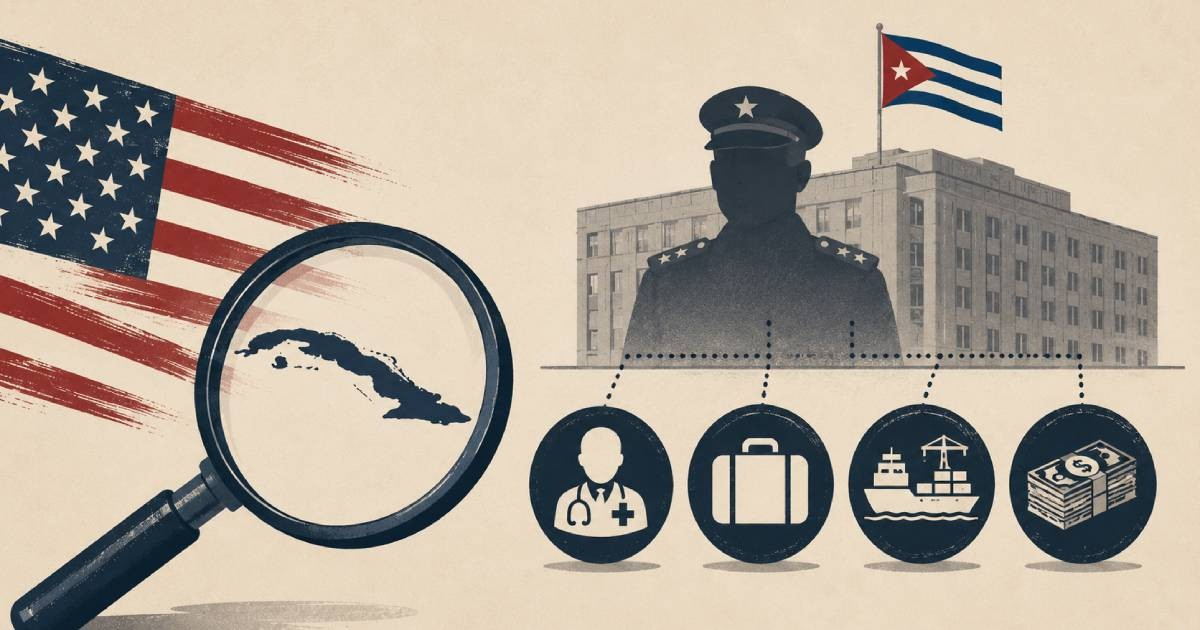
The United States struck again this Thursday at some of the main economic engines of the Cuban regime by announcing a new round of sanctions against nine entities and two high-ranking officials, in an offensive that directly targets three of the largest sources of foreign currency for Havana: the military conglomerate GAESA, the energy sector, and the medical services export program.
The measures, announced by the State Department under Executive Order 14404, signed by President Donald Trump on May 1, 2026, are part of Washington's strategy to limit the financial capacity of the regime and reduce the resources that, it claims, sustain its political, military, and repressive apparatus.
An important part of the new sanctions focuses on GAESA, the business conglomerate controlled by the Revolutionary Armed Forces and regarded by the United States as the main economic holding of the regime.
The State Department accuses GAESA of attempting to protect its assets through corporate reorganizations and the use of intermediary companies to evade existing sanctions.
As an example, Washington cited the transfer of administration of the Port of Mariel to Coral Marítima S.A., an operation carried out in mid-June that he described as an attempt to sidestep the restrictions imposed on the military conglomerate.
As a result, Terminal de Contenedores de Mariel S.A. and Coral Marítima S.A. were sanctioned, along with CEIBA Investments Limited, a firm based in Guernsey whose Panamanian subsidiary took control of an old joint venture of GAESA, and ORBIT S.A., a remittance processing company that the State Department believes is "almost certainly" controlled by that business group.
Pressure on the energy sector
Washington also expanded sanctions against the energy sector, another of the economic pillars of the Cuban state.
The list includes the Oil Research Center S.A. (CEINPET), the research arm of the already sanctioned Cuba-Petroleum Union (CUPET), as well as ENERSA S.A. and EINARBO S.A., companies responsible for importing gas, liquefied gas, and lubricants from Mexico and India.
With these designations, the United States continues to tighten its grip on an industry it considers strategic for the financial support of the regime.
Medical missions, another key source of income
The third line of action focuses on the program of international medical missions, described by the Department of State as Cuba's main source of foreign exchange income.
Washington sanctioned the Cuban Medical Services Marketing Company S.A. (CSMC), the Central Unit for Medical Cooperation (UCCM), and two of its main officials: the Minister of Public Health, José Ángel Portal Miranda, and the director of the UCCM, Gretza Sánchez Padrón.
According to the U.S. government, the regime retains between 50% and 95% of the salaries that recipient countries pay for the services of Cuban doctors, a scheme that affects tens of thousands of professionals deployed in more than 50 countries and that Washington views as a form of forced labor and human trafficking.
A strategy aimed at cutting off sources of funding
The new designations represent a further step in the Trump administration's strategy to economically pressure the Cuban regime.
Since May, the sanctions have targeted GAESA, CUPET, the International Financial Bank (BFI), mining companies, the Ministry of Tourism, the Rapid Response Brigades, the Territorial Troops Militias, and other entities deemed essential for the functioning of the state apparatus.
The measures announced this Thursday come just a few days after the release of the State Department report "Cuba: The Capital of 21st Century Communism," which identifies the economic and political structures that, according to Washington, allow the regime to remain in power.
In announcing the new sanctions, Secretary of State Marco Rubio warned that pressure will continue and issued a warning to foreign companies and financial institutions.
"Anyone who supports, sponsors, or provides services to these sanctioned actors risks being sanctioned. Foreign banks and other companies that provide services or hold funds for these entities must immediately suspend those activities," he stated.
Related videos:
Filed under: