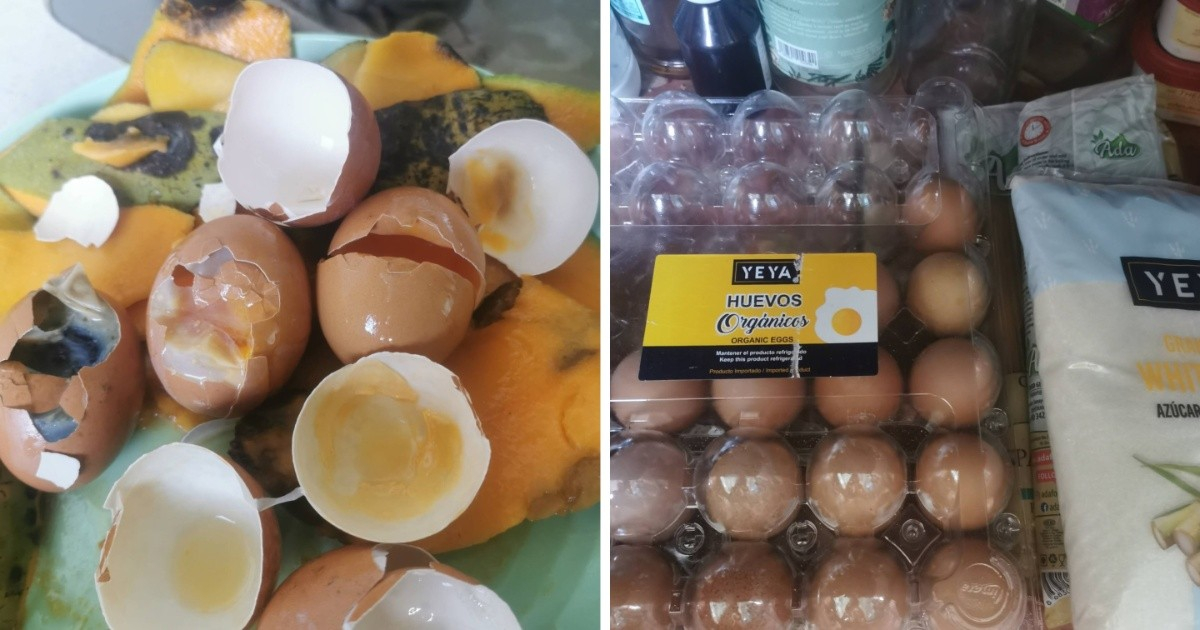
A Cuban identified as Sofia QRosabal posted a denunciation filled with anger and helplessness on Facebook this Thursday: the eggs that her husband sends her monthly from abroad through the agency Supermark23 arrived rotten at her home, and this is not the first time it has happened.
"I never thought one day I would reach this point of feeling so much anger and helplessness. This here is rotten eggs, that’s what apparently we Cuban families deserve," the woman wrote alongside images showing a carton of the YEYA brand — imported organic eggs — and remnants of decomposing shells.
Sofia reported that she had to discard six spoiled eggs and warned that the problem is not new: on previous occasions, she had sent photos to her partner to document it, but this time she decided to make it public.
What hurts the most is not just the waste, but the cost behind each unit. "As far as I can reason, when something spoils it's because it has been in warehouses for months waiting to be sold in foreign currency, while thousands of families struggle day by day, and buying 30 eggs costs them a month's salary; it's sad," he wrote.
His reasoning is supported by the numbers: the average monthly salary in Cuba in 2025 was 6,930 Cuban pesos, equivalent to between 11 and 17 dollars at the informal exchange rate, according to data from the National Office of Statistics and Information (ONEI).
A carton of 30 eggs in the informal market costs around 3,000 pesos, and in stores that operate in foreign currency, it can reach six dollars.
Sofia also recalled buying cartons in cafeterias for 3,300 pesos, with more than half of the eggs in poor condition, unable to complain to anyone because the owner of the establishment didn't know how long they had been stored in the small business where he bought them.
"I know what it’s like to not have even an egg to give to my children, and I will never forget that," she wrote.
"Now I think about that family that bought only two eggs at a price of 110 pesos each so that their child wouldn't have to eat rice alone, and when they got home, they were rotten."
The complaint points directly at the commercial chain: "The agency owners and small and medium-sized enterprises only want to sell; we pay, and no one cares what happens afterward."
The case is not isolated. In March of this year, a pregnant woman in Santiago de Cuba confronted a storekeeper for distributing rotten eggs through the ration book.
In June, neighbors collected rotten eggs from the street driven by hunger.
The background is a recent unprecedented food crisis: the supply booklet is practically in collapse and officials from the regime itself have admitted that they cannot guarantee oil, chicken, or yogurt for the standardized basket.
In Havana, children have been without meat or ground beef for over two months through the rationing system.
Cuba imports between 70% and 80% of its food, and due to the collapse of state distribution, millions of families rely on shipments from abroad paid for in dollars.
That those products arrive home rotten, as happened to Sofia, starkly summarizes the situation: "In Cuba, we are dying of hunger and a thousand other things; now... is it fair that products paid for in dollars are in this state? Who cares? They only need to sell; the rest is irrelevant to them."
Related videos:
Filed under: