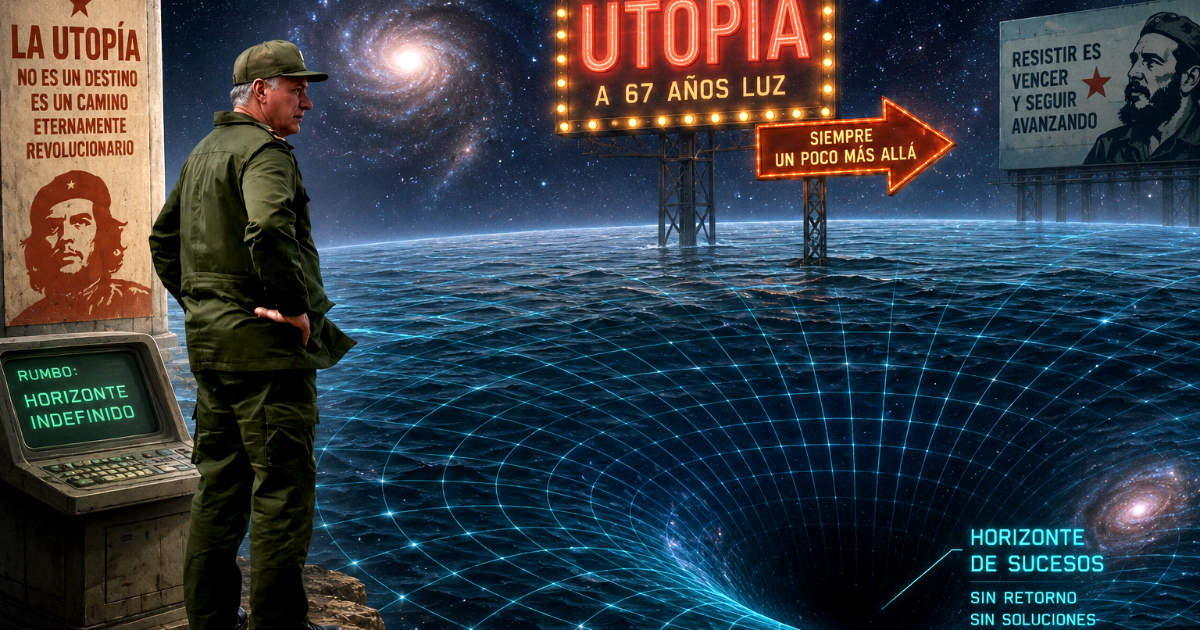
There are metaphors that illuminate. And there are others that end up consuming those who utter them.
When Miguel Díaz-Canel responded to a question about the resolution of the Cuban crisis by referring to the famous image of the utopia "that is on the horizon", he probably believed he was elevating the debate.
Four days later, Cubadebate had to publish a lengthy piece to explain what the ruler really meant. If a phrase requires a rescue operation of ideology, perhaps the problem was never with those who heard it.
The story, however, has an unexpected turn. Perhaps Díaz-Canel was not referring to the horizon of Eduardo Galeano, but to a much more fitting one for Cuba in 2026: the event horizon.
In astrophysics, the event horizon is the boundary surrounding a black hole. Once crossed, there is no turning back. Not even light can escape. Everything is trapped by such intense gravity that space and time cease to behave as we know them.
Doesn't that describe, with unsettling precision, the Cuban economy and reality?
Because in the universe of Doctor Díaz-Canel —Doctor of Technical Sciences, it’s worth remembering— physics also seems to have been altered.
Salaries lose value as inflation increases. Production vanishes without leaving an observable trace. Foreign investments exist, but can only be detected through complex theories, as they never appear in the telescope of reality. And time takes on extraordinary properties: solutions always belong to the future, while sacrifices only exist in the present.
Albert Einstein never got this far. Neither did Stephen Hawking.
A revolutionary educated at the Ñico López school is needed to develop a theory in which prosperity always travels at the speed of promise and never reaches the present.
Perhaps that is why Cubadebate came to the rescue of the appointee with an unprecedented scientific mission: to demonstrate that a black hole is, in fact, a lighthouse.
His article aims to convince us that utopia is not about reaching a destination, but about the journey itself. That "revolution" is not a final goal, but a continuous path. That if the horizon continues to recede after nearly seven decades, we should not interpret it as a failure of the model, but rather as a testament to its extraordinary vitality.
It's a fascinating theory. The problem with propaganda is that it sometimes ends up saying more than it intends.
"The same one that brought us here," Cubadebate proudly proclaimed in the headline of its defense. Here? The question contains the entire rebuttal.
Because the "here" of contemporary Cuba is not a socialist Arcadia, but a country of blackouts, scarcity, massive emigration, and reduced salaries amounting to just a few strong currencies a month. If this is the final destination of the revolutionary journey, the propagandist has just inadvertently drafted the most devastating summary of its outcomes.
Perhaps Díaz-Canel's true mistake was not misquoting Galeano —or hastily attributing the phrase to Lenin in a barely audible whisper— but choosing the wrong metaphor.
Because today's Cuba no longer seems to be moving towards a horizon.
It resembles much more a country trapped in an event horizon, where everything that enters—talent, savings, hope, or youth—ends up disappearing under the immense gravity of a system unable to escape itself.
And not even the light of the propaganda can escape from it.
Related videos:
Filed under:
Opinion article: Las declaraciones y opiniones expresadas en este artículo son de exclusiva responsabilidad de su autor y no representan necesariamente el punto de vista de CiberCuba.