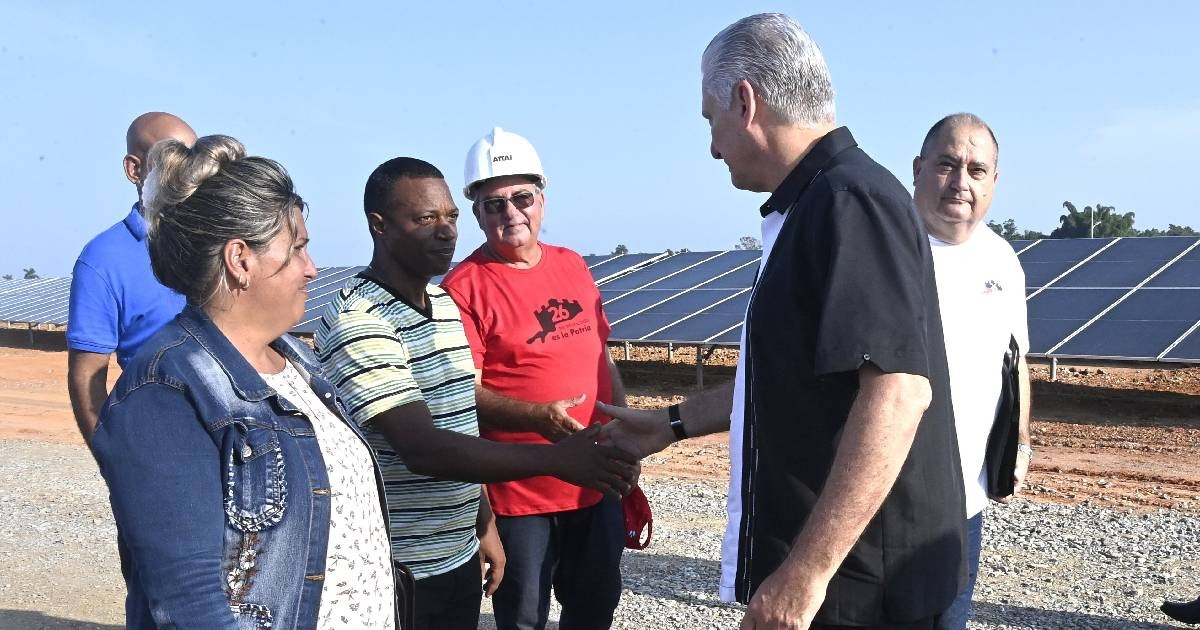
The Cuban Prime Minister Manuel Marrero Cruz stated this Saturday, on the eve of the 73rd anniversary of the assault on the Moncada Barracks, that during a tour of Pinar del Río alongside the leader Miguel Díaz-Canel, they found "a hardworking people who do not give up", attributing the province's difficulties to the U.S. embargo.
On his Twitter account, Marrero wrote: "Alongside President Díaz-Canel, we visited several economic and social centers in Pinar del Río, the host of the activities for July 26th. Under the impact of the most cruel of blockades, we witnessed a hardworking people who do not give up."
The visit included the Santiago Miguel Cabañas Perojo photovoltaic solar park, located in the municipality of Consolación del Sur, described by the government as the third park of its kind built in the province, with 21 MW of power, 42,588 solar panels, and covering an area of 32 hectares, which synchronized with the National Electroenergetic System in June 2026.
They also toured tobacco farms equipped with drip irrigation systems and photovoltaic panels, on a trip that the regime presents as a showcase of progress in the province chosen as the venue for the National Central Act on July 26.
Pinar del Río was designated to host this celebration by the Political Bureau of the Communist Party of Cuba, as announced on June 27, marking the fourth time that the western province has received this honor, following the editions of 1976, 2000, and 2017.
Meanwhile, Marrero participated in a meeting with international delegates from over 40 countries convened for the celebrations, where Díaz-Canel, Roberto Morales Ojeda, and Bruno Rodríguez Parrilla were also present.
In that forum, according to the state-run outlet Juventud Rebelde, Díaz-Canel declared, "We will always defend Cuba, in any scenario and under any context."
The official discourse, however, contrasts with the reality experienced in the province.
Pinar del Río has been dealing with an unresolved housing crisis since Hurricane Ian struck in September 2022: the cyclone damaged over 102,000 properties, and by April 2026, only 63% of those damages had been addressed, leaving more than 40,000 families still waiting for housing.
This is compounded by power outages lasting more than 20 hours a day that suffocate the population, and in March 2026, the province was left completely dark after a failure in a transmission line.
Critics also point out that the new solar park, lacking battery storage, does not address the nighttime power outages experienced by the residents of Pinar.
Marrero's statements generated mocking and indignant responses on social media, where Cubans pointed out the gulf between the official narrative of a people that "does not give up" and the everyday reality of shortages, blackouts, and unaddressed damages faced by those who actually live in the province.
Related videos:
Filed under: