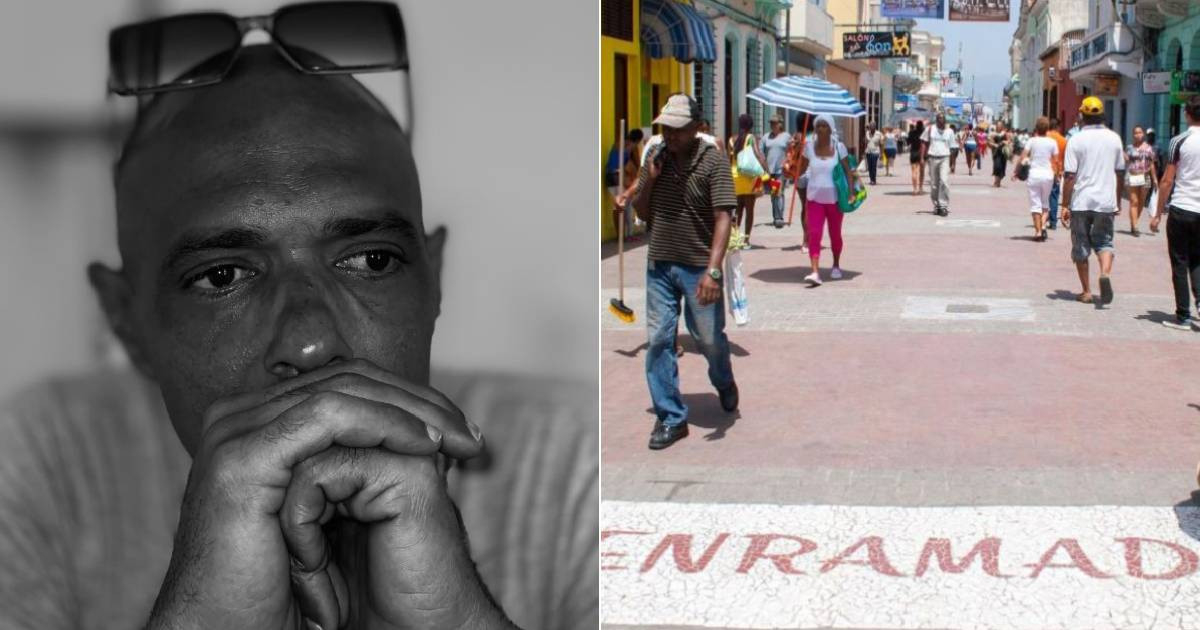
The writer and activist from Santiago Yasser Sosa Tamayo published a reflection on Facebook this Friday, in which he argues that the greatest harm caused by the Cuban crisis has not been the lack of electricity, but rather the normalization of the deterioration of living conditions and the loss of the collective capacity to be outraged.
"The most serious thing that happened to Cuba was not the blackouts. It was that one day we stopped asking ourselves if this was life," Sosa wrote in a text that was widely shared on social media and gathered hundreds of reactions.
The activist described how, gradually, Cubans adapted to increasingly deeper deprivations. In his account, he recalled that they first stopped making plans because they depended on the electrical service, then learned to cope with the scarcity of medicines, and later began to say goodbye to their children at the airports not knowing when they would see them again.
"That was the true blackout. Not the one in the cities. But the one of our ability to feel indignant," asserted the author.
The publication depicts scenes that it identifies as common in present-day Cuba, including a mother who organizes meals according to electricity availability, a grandfather who suppresses his pain because falling ill seems like a luxury, and a child growing up believing that studying in the dark is part of childhood.
One of the most shared passages was the one that describes families who no longer set an extra place at the table, but instead put a mobile phone there, to feel that their emigrated child is still having dinner with them.
The image generated numerous responses. "These lines reflect my daily life, all of them, including the phone on the table to remember that this place is for my son, who I certainly haven't overshadowed; he is still with me," commented a reader.
Other users summarized the sentiment provoked by the post. "True, we are dead while alive," wrote one internet user.
Another person stated that the current situation is even worse than what was experienced during the Special Period. "I can't sleep a single night with electricity, my food goes bad, and it hurts my life, my heart, and my soul," she expressed.
In his reflection, Sosa directly held the government responsible for turning precariousness into a condition accepted out of necessity.
"They convinced us to be grateful for what should always have been a right. A little bit of electricity. A little bit of water. A little bit of food. As if dignity could also be distributed by the hour," he stated.
The publication emerged during one of the most critical moments of the energy crisis. So far this month, the National Electric System has collapsed several times, while blackouts lasting over 24 continuous hours persist in numerous localities across the country.
It is not the first time that Sosa Tamayo has denounced the social deterioration of the island through concrete stories. In April, he recounted the case of a 14-year-old teenager who was selling polvorones in a park in Santiago de Cuba to help his mother.
In May, he found a 77-year-old grandmother who travels nearly 15 kilometers in the early morning pushing a wheelbarrow to sell okra and survive.
In September 2025, he found his former chemistry teacher sleeping in the hallway of a hair salon in Santiago, at the age of 79, without family or support.
For the activist, all these stories are part of the same phenomenon he addresses in his latest reflection, a "blackout" that not only affects the electrical system but also the dignity and the ability of a society to accept as normal a reality characterized by daily survival.
"A people can resist darkness. What they should never accept is to forget that they were born to live with dignity, not to get used to surviving," he concluded.
Related videos:
Filed under: