
Related videos:
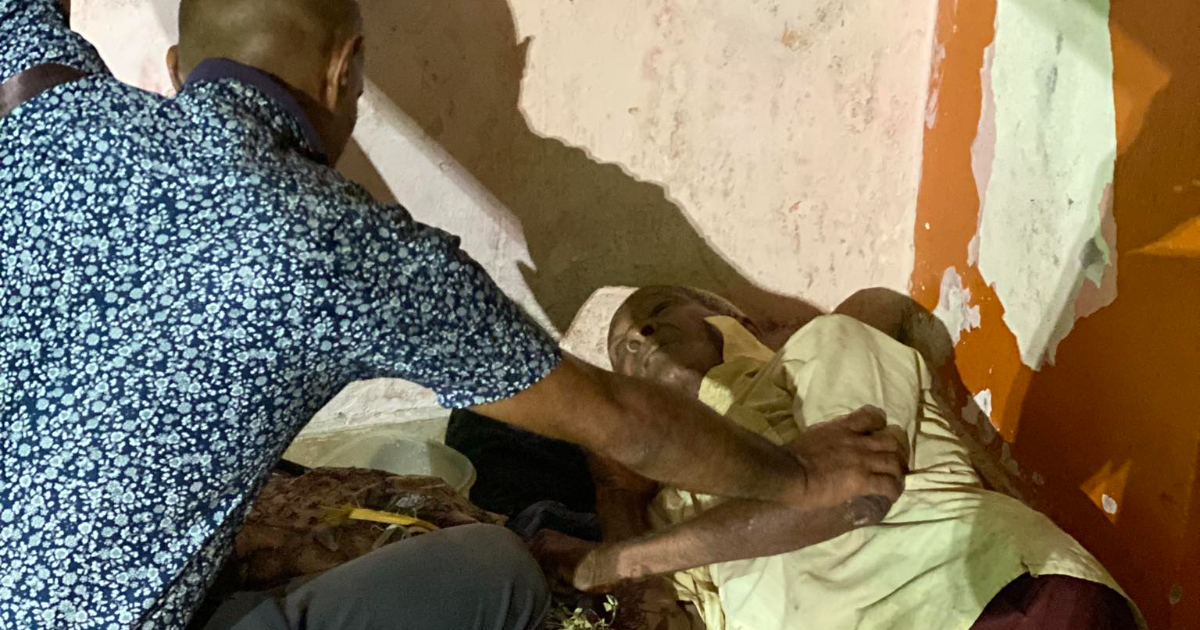
In Santiago de Cuba, a former student reunited with his old chemistry teacher under unimaginable circumstances: abandoned on the street, without family, and marked by loneliness.
The activist Yasser Sosa Tamayo recounted on Facebook that, after midnight, he found Manuel, 79 years old, asleep in the corridor of a hair salon, clutching his few belongings.
He was not a stranger: he had been her teacher in pre-university, the man who taught her that matter cannot be destroyed, only transformed.
According to what he said, the elderly man was expecting to receive his pension the next day, but he had been hungry for days.
Sosa, who has become one of the most prominent activists in the country, bought him food and watched him eat with urgency, like someone who is able to breathe again, in addition to giving him money so he wouldn't return to the street without any means of support.
The story also revealed Manuel's hard history: he lost his wife and son in an accident, and ever since, he has been wandering aimlessly, without a home or companionship.
“Loneliness is his only companion, a burden that no one else carries for him,” wrote the activist, who loudly questioned: “In what society does a teacher end up like this, forgotten in the street, while those who should protect him look the other way?”
"Words sometimes fall short, but we can make this story travel. Every reaction and every share is a gesture of humanity, an invisible hug to Manuel and all those whom life has left alone," the activist emphasized in the comments section.
He also emphasized: "Today we witnessed it... tomorrow it could be anyone. Let’s not allow silence to consume them. Make others feel by sharing this story," hinting that such stories, unfortunately becoming more common in Cuba, could belong to anyone in the future, in a country where the abandonment of the elderly is a painful reality.
The testimony sparked outrage among those who read it, as it reflected not only the vulnerability of an elderly person but also the crisis of a society where even educators, the builders of futures, end up being neglected.
The story of Professor Manuel, who was found homeless in Santiago de Cuba by one of his former students, is not an isolated case. Across the country, many retired teachers are facing old age under extreme conditions, without family or institutional support.
Cases like that of Mr. Manuel, a university professor who survives by selling recycled bags on a street corner, illustrate how educators who once shaped generations have been pushed to the margins by a system that has forgotten them.
This abandonment is reflected in the story of another retired teacher who collects cans to survive, an example of a reality that hits harder amid inflation and rising prices of essential goods.
Many cannot even afford a daily meal with their pensions. “What I need cannot be bought anywhere,” one of them said when recognized by a former student.
The situation worsens when it becomes known that the pension increase announced by the regime barely amounts to 4,000 Cuban pesos, an amount that is not enough to buy a carton of eggs or a bottle of oil.
Despite the official rhetoric, the reality is that elderly people live in critical conditions, and in many cases, they are only supported by charity or individual initiatives.
Testimonials like that of Juan Bautista, teacher and composer, who ended up selling drawings on the streets, or that of a retiree who spent her entire pension on a single product, demonstrate that working a lifetime in Cuba does not guarantee a dignified old age.
Meanwhile, public policies continue to ignore the magnitude of the problem, and state-run nursing homes operate at full capacity or in deplorable conditions.
Old age in Cuba, especially for those who served as educators and professionals in knowledge, has become a stage marked by neglect.
Stories like that of Maestro Manuel are merely a glimpse into a much broader and painful reality, where the dignity of the Cuban teacher has been left adrift.
Frequently Asked Questions about Elderly Abandonment in Cuba
What is the situation of the elderly in Cuba regarding pensions?
The situation of the elderly in Cuba is critical due to the insufficient pensions they receive. The recent increase in the minimum pension to 1,528 Cuban pesos (less than 5 dollars at the informal exchange rate) is widely regarded as inadequate to cover basic necessities, in a context of high inflation and shortages. This situation forces many elderly individuals to seek alternative means of livelihood, such as selling goods on the street or relying on the charity of others.
What does the case of Professor Manuel reflect about institutional neglect in Cuba?
The case of Professor Manuel reflects the systematic abandonment experienced by retired professionals in Cuba. After dedicating his life to education, Manuel finds himself in poverty, without family or institutional support. This highlights the lack of effective social protection for the elderly on the island, a problem that affects thousands of retirees who face extreme economic difficulties and lack a solid support network.
How has the Cuban population reacted to the abandonment of the elderly?
The Cuban citizenry has demonstrated solidarity and mobilization in the face of the abandonment of the elderly. Through social media, activists and citizens have organized initiatives to assist older individuals in vulnerable situations. Examples include support for elderly people arrested for street vending and assistance for artists neglected by the system, showcasing the crucial role of civil society in addressing the shortcomings of the State.
What does the Cuban government say about the situation of the elderly?
The Cuban government has announced increases in pensions and acknowledges the existence of more than 310,000 people in vulnerable situations. However, the measures implemented are deemed insufficient by citizens and experts, who criticize that the lack of productive support will heighten inflation and will not improve the quality of life for retirees. Furthermore, there is a clear disconnect between official statements and the harsh reality faced by the elderly in Cuba.
Filed under: