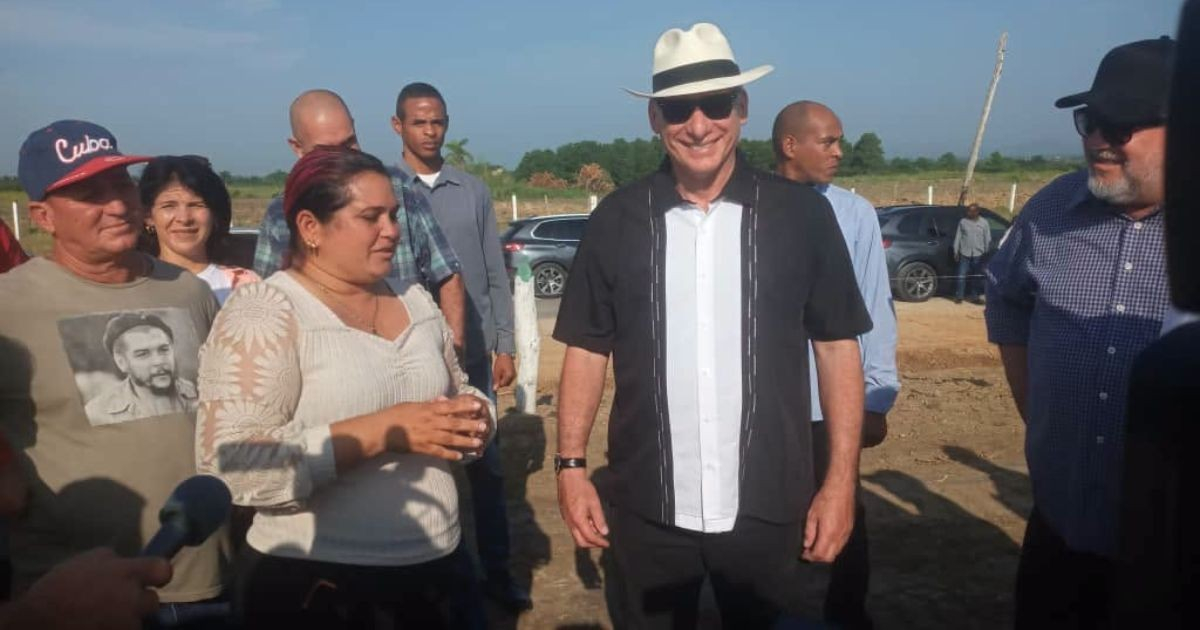
Cuban writer Armando Añel published this Sunday a satirical interview featuring Miguel Díaz-Canel, a piece of political humor that imagines the Cuban leader responding to questions from RT journalist Oliver Zamora about his striking outfit in Pinar del Río: a white Panama hat, dark sunglasses, and a black shirt with white details.
The trigger was Díaz-Canel's actual appearance on Saturday in that western province, where he traveled as part of the events leading up to the 73rd anniversary of the assault on the Moncada and Carlos Manuel de Céspedes barracks. His look, which many on social media described as "a 1930s gangster," triggered a flood of mockery and memes that compared the leader to The Godfather, characters from the Cuban animated series Vampires in Havana, and a mix between Compay Segundo and a mafia boss.
An activist commented on social media that "the person advising him hates him deeply, and suggesting those 30s gangster-style outfits is their way of expressing their disgust," and added that "he needs a good Cuban cigar."
Añel constructs in his text a Díaz-Canel who speaks in a dialect of high-flying revolutionary pseudophilosophy. When the fictional Zamora asks him if the attire was a message for Washington, the imagined leader responds with poise: "Not exactly. The recipient is apparent. The truly important messages never arrive where they seem to arrive. If they come too directly, they cease to be strategic and become utopian."
Regarding the dark glasses, Díaz-Canel from Añel provides an unmatched explanation of tactical depth: "So that it wouldn't be known if I was looking. A leader who looks can be observed. But a leader who seems not to look forces the other to think." Geopolitics, the character concludes, "starts with the pupil."
The Panama hat also falls under dialectical analysis. "A Panama hat is not from Panama but from Ecuador," reasons the fictional ruler. "Identity is a very relative matter. Now the Gulf of Mexico is supposedly the Gulf of America... and yet, it has always been that way. Its identity hasn’t changed, only its chronology. Never put off until today what you can do tomorrow."
When Zamora asks him if he planned the memes generated by his look, the response is immediate: "In Cuba, we plan even spontaneity. Organized improvisation is one of the pillars of creative socialism."
The episode comes just days after Díaz-Canel became the subject of ridicule with his real interview on RT from July 20, in which he paraphrased Eduardo Galeano — who in turn paraphrased Argentine filmmaker Fernando Birri — using the metaphor of utopia and the horizon. This response was widely interpreted as an evasion of the crisis, generating parodies by comedian Ulises Toirac and actor Armando Tomey, among others.
The pattern repeats itself: in June, Díaz-Canel was the subject of memes for appearing disheveled on television; on July 16, his Levi's jeans during an industrial visit once again made him a trending topic. All of this is happening while Cuba is undergoing a severe energy crisis characterized by prolonged blackouts, shortages of food and medicines, and social unrest that contrasts sharply with the spectacle of official events. Pinar del Río, designated as the venue for the central event on July 26 for the fourth time in history, does not escape this reality.
The apocryphal interview with Añel concludes with a direct question: Do you prefer to be regarded as a philosopher or a mobster? The imagined Díaz-Canel remains silent, smiles, and responds: "I am a kind of dialectical synthesis between metaphor and threat. An explicit threat intimidates. An implicit threat causes concern. But an incomprehensible threat forces the enemy to think." And he adds, with one last smile, that the time the enemy spends thinking could be better used "in capturing Bruno Rodríguez in New York. Those people could come up with many ideas."
Related videos:
Filed under: