The Cuban playwright and activist Yunior García Aguilera published a column in 14ymedio this Saturday, where he dismantles the supposed achievements of the regime under Miguel Díaz-Canel and concludes that the Cuban dystopia serves to “call hope to resignation, resistance to misery, and continuity to sinking”.
The trigger was an interview that Díaz-Canel gave on July 20 to the Russian channel RT in Spanish, during which, when asked whether Cuba has a way out of the crisis, he cited a quote about utopia originally from the Argentine filmmaker Fernando Birri and popularized by the Uruguayan writer Eduardo Galeano.
The president's version was this: "The utopia is on the horizon… What is utopia for? To walk. I would say that hope is the same."
García Aguilera argues that Díaz-Canel "completely destroyed the sense of utopia" and that the incident was not just an intellectual stumble but a confession: the regime no longer promises to achieve anything concrete.
"The regime no longer promises to achieve anything. It only asks to walk backwards, like crabs; to resist and wait for nothing, like zombies," writes the playwright, who has been living in exile in Madrid since November 2021.
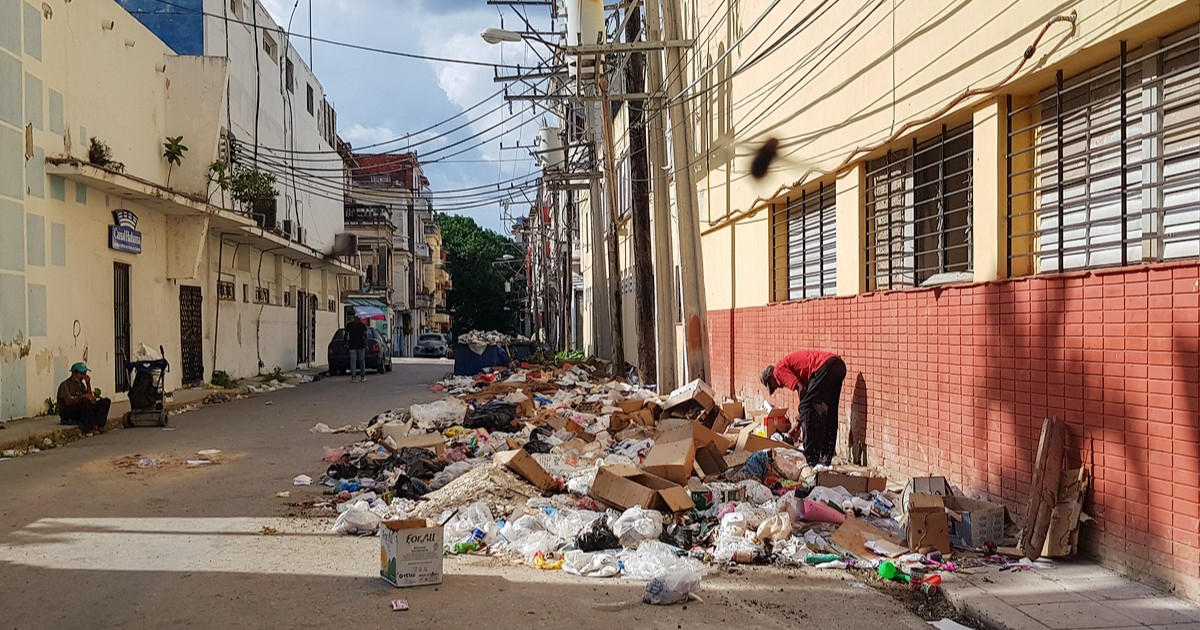
The column reviews Díaz-Canel's eight years in power as a catalog of regressions. Under his leadership, the Tarea Ordenamiento was implemented, presented as the grand solution to the accumulated economic distortions. The result was the erosion of salaries and pensions, an inflation rate that reached 77% in 2021, and the consolidation of a caste economy where some can buy in foreign currency while others are limited to gazing at store windows.
The national electrical system has repeatedly collapsed. In July 2025, almost 45% of Cuba is experiencing power outages of up to 20 hours a day. Tourism plummeted even before the new sanctions from the Trump administration, and foreign companies are also fleeing because they are fed up with a state that does not pay its debts and changes the rules at will.
The demographic outlook is equally bleak. García Aguilera notes that in 2025 Cuba recorded 134,354 deaths, the second highest number of deaths on record, surpassed only by 2021. Data from the National Statistics and Information Office released in July 2026 reveal that in that year Cuba recorded double the number of deaths than births: 136,214 deaths compared to only 68,064 births.
"Continuity has not managed to multiply the loaves and fishes, but it has multiplied the corpses," writes the playwright.
García Aguilera also recalls that when thousands of Cubans took to the streets on July 11, 2021, to demand freedom, food, and electricity, Díaz-Canel delivered his most revealing phrase: "The order to engage has been given." What followed were beatings, arrests, show trials, and disproportionate sentences.
For the playwright, that day made clear Díaz-Canel's true role: "Raúl Castro did not place him in the position for his boldness, but for his obedience. He needed someone willing to destroy an entire country rather than risk the elite."
The column is published on the anniversary of the assault on the Moncada Barracks and adds to a chorus of critical voices. The comedian Ulises Toirac mocked Díaz-Canel's metaphor with the remark "the light at the end of the tunnel... there is no tunnel", while the actor Luis Alberto García publicly questioned the regime over the lack of solutions to the blackouts and shortages.
"Díaz-Canel is the civilian fuse of a military machinery, the expendable face of a power that uses surnames without history to protect the important surnames," concludes García Aguilera, founder of the civic movement Archipiélago and promoter of the failed Civic March of November 15, 2021.
Related videos:
Filed under: