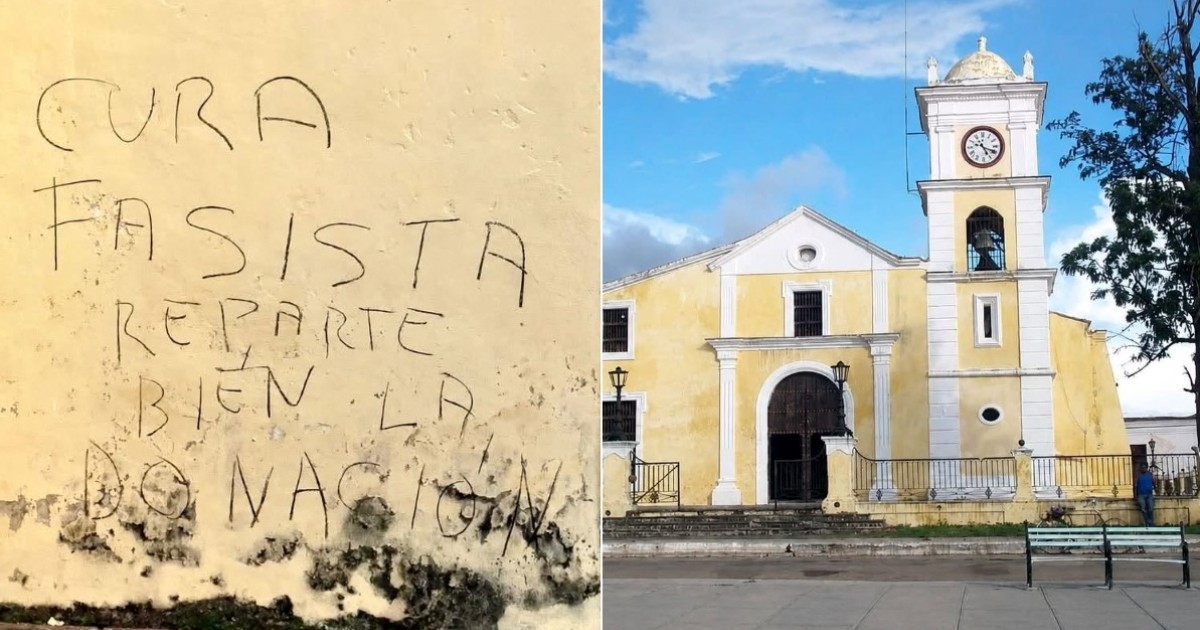
A graffiti misspelled: "CURING FASCIST DISTRIBUTES DONATION WELL," appeared painted on the wall of the church in Bejucal, Mayabeque, after the Catholic Church began distributing humanitarian aid from the United States government to vulnerable individuals.
The Father Jorge Luis Pérez Soto, from the Archdiocese of Havana, publicly responded on with an extensive text titled precisely "Fascist is spelled with c," in which he defended the charitable work of the Church and rejected accusations of misdistribution of donations.
The priest began by clarifying that there is a sea of needy people and that with limited resources, it's not possible to reach everyone in the same way.
"We have never imposed conditions on that assistance. Neither based on religious beliefs, nor political or social affiliations, nor on likes or dislikes. The only criterion is the actual need of the individuals," he emphasized.
He specified that the delivery will be gradual due to logistical constraints, and limited, because resources are insufficient to meet all the vast needs. What will not be lacking is responsibility, with seriousness and a commitment to truth and justice.
"60 million sounds large... sounds like a lot... but in the current situation in Cuba, where the highest percentage of the population lives in extreme need, it amounts to five loaves and two fish," he said.
Regarding the attempts to discredit the work, he was emphatic: "Let them ask those who have received the aid whether it is good or bad. (...) At least we know where these donations are going and we know that they are received free of charge."
He also reported that attempts at defamation do not only come from social media: "Even from the institutions of the country, we have seen attempts to belittle this act that, while it does not resolve the situation, provides relief to those who receive it."
Father Pérez Soto criticized that some evangelical ministers demand lists of beneficiaries to exclude those aligned with the regime, and he questioned why independent civic volunteers join smear campaigns when they themselves "know how complex it is to organize any type of humanitarian aid in Cuba."
He also warned about the risk of the donation being used for political purposes by the government: "May humanitarian aid not become a smokescreen used by the ciberclarias and others to distract from our serious and urgent problems as a nation that can no longer afford to be postponed in their resolution."
Finally, he emphasized that while humanitarian aid is a temporary relief, what Cuba needs are political, economic, and social changes that make a dignified life for its people possible.
"Let us not have to beg as if we were starving or a people incapable of working and sustaining ourselves," he expressed.
It is noteworthy that the provocation against the church occurs precisely in Bejucal, where Mike Hammer, head of the U.S. Embassy mission in Cuba, visited several families on Saturday to witness firsthand how the humanitarian aid sent by his government had arrived.
Hammer visited the homes of some beneficiaries: "We are here on behalf of the government of the United States, President Trump, and Secretary Marco Rubio, to see how the aid we are sending has arrived, if it will improve the situation, and to check on how things are going," he told them.
In addition to food, the included rechargeable lamps in the packages were particularly valued in light of the energy crisis affecting the Island. "Everyone is telling me that the little lamps work," Hammer noted.
The distributed modules in Bejucal contain basic food items—rice, beans, oil, sugar, pasta, sardines, and tuna—alongside hygiene and household products such as soap, toothpaste, toothbrushes, water purification tablets, a plastic bucket, a 20-liter container, and a rechargeable lamp.
The Catholic Church began distributing humanitarian aid on Wednesday, July 22, in the municipalities of Bejucal and Alquízar, a day after the first shipment—18 tons on a flight from Miami—landed at José Martí International Airport.
The U.S. government's aid program amounts to 100 million dollars: 60 million channeled through the Catholic Church and Caritas, and 40 million through independent non-governmental organizations, with the explicit condition that the resources do not pass through the Cuban state.
Caritas Cuba publicly acknowledged that the aid will not reach all Cubans in need, and that the selection criteria prioritize elderly individuals living alone, pregnant or nursing women, people with disabilities, and families with children under five years old.
The program aims to benefit between 100,000 and 200,000 households.
The incident fits into a documented pattern of harassment against the Catholic Church in Cuba.
Between January 2025 and June 2026, the organization CSW recorded 667 violations of religious freedom on the Island, including the confiscation of humanitarian aid distributed by churches and 94 warnings issued against religious leaders.
The Cuban Observatory of Human Rights reported 873 violations in 2025, and the United States Commission on International Religious Freedom included Cuba in its 2026 annual report as a country with serious and systematic violations.
Related videos:
Filed under: