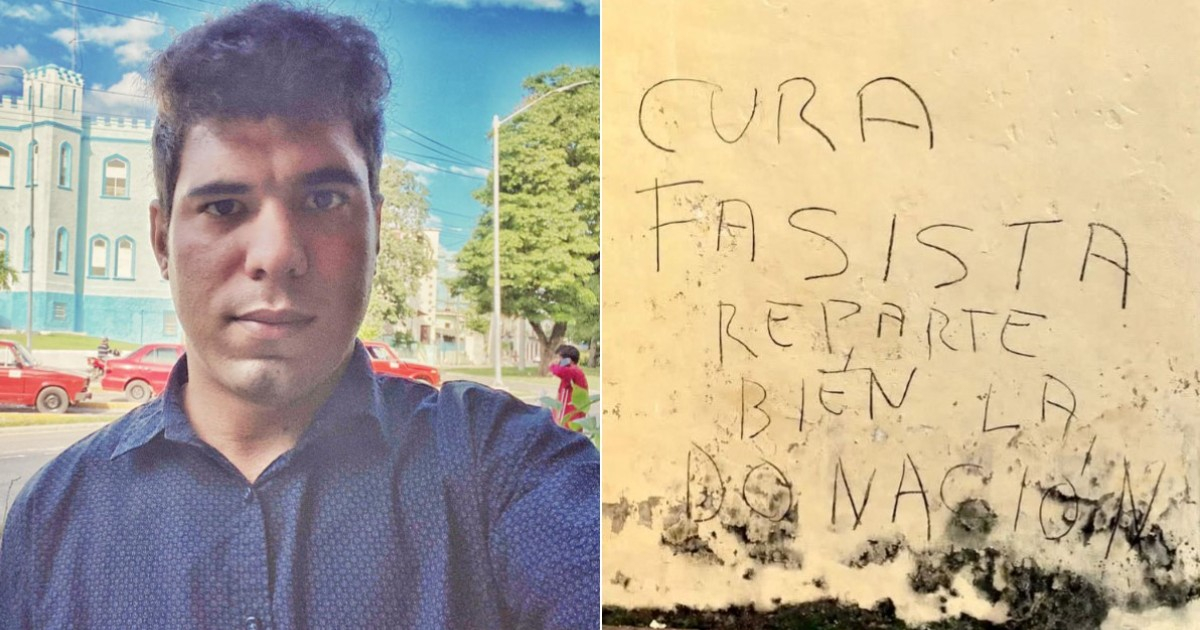
A graffiti painted on the facade of a Cuban church that accused the priest of not distributing donations properly prompted a strong response from independent journalist Adrián Martínez Cádiz, correspondent in Havana for the Catholic media EWTN, who published a reflection titled "The Wrong Wall" on Facebook.
The text painted on the exterior wall of the temple read: "FASCIST CURE PROPERLY DISTRIBUTES THE DONATION," with a spelling mistake included.
The incident occurred in the context of the distribution of humanitarian aid funded by the United States, whose delivery to families began on July 22 in Bejucal (Matabeque) and Alquízar (Artemisa).
Martínez Cádiz firmly rejected both the vandalism and the accusation against the priest, pointing out that the frustration of those who were not selected as beneficiaries was being misdirected towards the wrong actor.
"We've been living with the world turned upside down for so long that some dare to criticize those who provide assistance, while remaining silent before the power that left an entire country in need of that help," he wrote.
The correspondent explained that Cáritas Cuba applies objective vulnerability criteria established by the donor: elderly individuals living alone, pregnant women or nursing mothers, people with disabilities or bedridden, and families with young children at risk, identified through home visits.
"It is not questioned who goes to Mass," nor did the priests "create a list of friends and acquaintances," Martínez affirmed.
He also highlighted a key difference with the regime's mechanisms: "At least the modules are not sold in currency shops."
The social tension has a clear backdrop: Cáritas Cuba publicly acknowledged that the aid will not be enough for everyone, in a country of over 11 million inhabitants. The program aims to benefit between 100,000 and 120,000 families.
In response to those who direct their indignation towards the Church, Martínez Cádiz posed a question that many want to avoid: "Shouldn't we be much more scandalized that millions of Cubans depend on foreign donations to obtain rice, beans, soap, toothpaste, or a lamp to cope with power outages?"
And he emphasizes: "The Church did not create this misery (...) The responsibility lies with a system that, after more than six decades of dictatorship, has turned daily survival into a race for food, medicine, and electricity."
The journalist also recalled the history of the ecclesiastical organization: "Cáritas Cuba did not appear this week with the arrival of these modules. It has been working throughout the island for over three decades, often with minimal resources."
Martínez Cádiz, who was fined by the regime in 2022 for his social media posts, clarified that those who attack those who help while staying silent in the face of those who impoverish are not defending the people, but cowardly misidentifying the enemy.
And he closed his text with a phrase that summarizes the core of his argument: "Do not stain the wall of the church; write, if you dare, on the walls of the dictatorship that turned Cuba into a country of the needy."
The first shipment of humanitarian aid from the United States - 18 tons on a flight from Miami - landed last Tuesday at José Martí International Airport.
The total package amounts to 100 million dollars: 60 million managed by the Catholic Church -through Cáritas Cuba and Catholic Relief Services- and 40 million by independent non-governmental organizations, explicitly designed to exclude the Cuban regime from any intermediaries.
On Saturday, Mike Hammer, mission chief of the U.S. Embassy in Cuba, visited beneficiary families in Bejucal to verify the arrival of the modules.
Related videos:
Filed under: