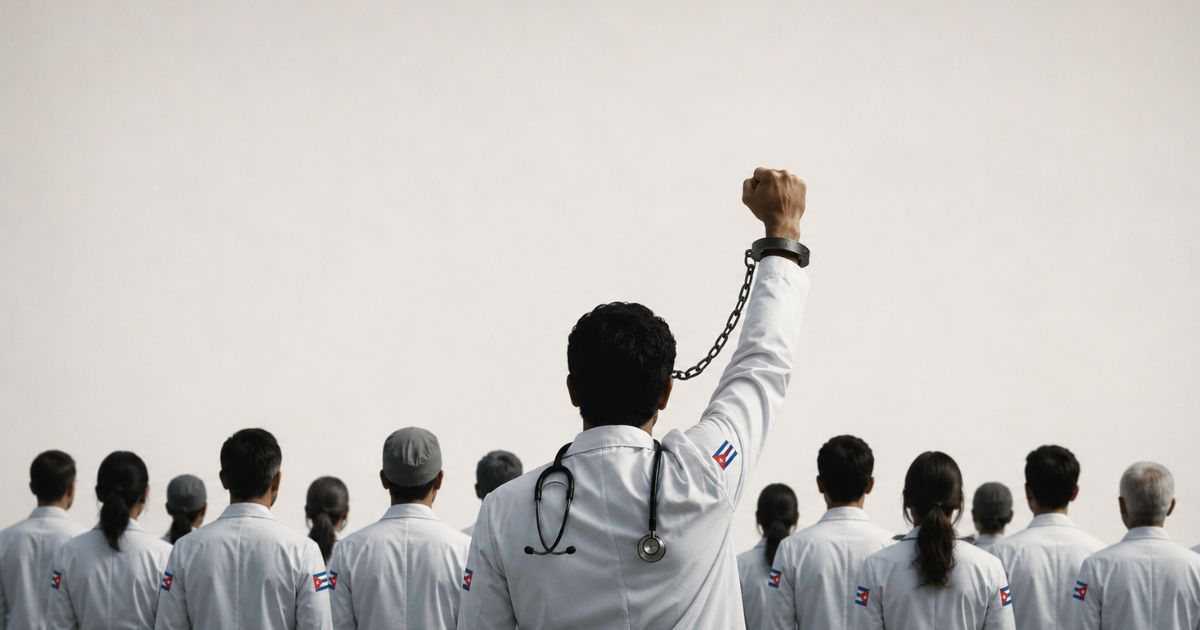
The Cuban regime reaffirmed on Tuesday the prohibition of private medical practice by publishing in the Decree 160 of 2026, a regulation that reserves the technical and professional activities of medical, social, and dental care for the National Health System, amid a deep health crisis.
The decree, approved by the Council of Ministers and signed by Prime Minister Manuel Marrero Cruz on July 22, will come into effect on August 4, seven days after its publication. The regulation repeals Decree 107 from August 2, 2024 and establishes differentiated regulations based on the type of non-state economic actor.
The text classifies the "technical and professional activities related to healthcare and social care, or connected to these health services, including dental services, within and outside the National Health System" as "an unauthorized activity for non-state economic actors, reserved for the National Health System and its provision of free services."
It is also prohibited for non-state economic actors to conduct medical and scientific research on human subjects.
However, the regulation stipulates that these can be conducted by authorized and certified entities that have an ethics committee for research, through their association with the biopharmaceutical industry.
On the other hand, the allows, with prior authorization or license, pharmaceutical, optical, care, and rehabilitation services, classified as "authorizable or conditional" activities.
The ban is not new: Decree 107 of 2024 already included clinical and assistance services among the 125 activities that micro, small, and medium-sized private enterprises, non-agricultural cooperatives, and self-employed workers were prohibited from engaging in.
What changes with Decree 160 is the regulatory framework, which is now more detailed and differentiated according to the type of economic actor. However, the core of the health prohibition remains intact.
The Public Health Law No. 165/2023, published in the Official Gazette on January 23, 2026, strengthened state control over healthcare professionals and did not open medical care to private practice. Decree 160 now reaffirms that state exclusivity.
The text of the decree itself states that the Council of Ministers must review its provisions at least every two years, at the proposal of the National Institute of Non-State Economic Actors.
This leaves open, at least in theory, the possibility of future changes in a system that, for now, still does not allow for a private alternative for the provision of professional medical and dental services.
The decision comes at one of the most critical moments for the Cuban healthcare system in decades.
Minister José Ángel Portal Miranda acknowledged before the National Assembly in July 2025 a “unprecedented structural crisis”, with only about 30% of the basic medicine supply covered.
The surgical waiting numbers illustrate the magnitude of the collapse: in March 2026, there were 96,387 patients awaiting surgery, including 11,193 children.
In July, Deputy Prime Minister Eduardo Martínez Díaz reported that this number stood at over 100,000 patients, including more than 10,000 minors awaiting surgery.
Infant mortality, one of the indicators that the regime showcased as a hallmark of the socialist model, had risen to 9.3 deaths per 1,000 live births, more than double the historical levels of between four and five.
In addition to the shortage of medications and the deterioration of infrastructure, there is the massive exodus of professionals.
In last May, more than 300 Cuban doctors residing in the United States were trapped in a migratory limbo that prevented them from working. To practice their profession, they also need to complete a complex and costly revalidation process that can take up to five years.
Related videos:
Filed under: