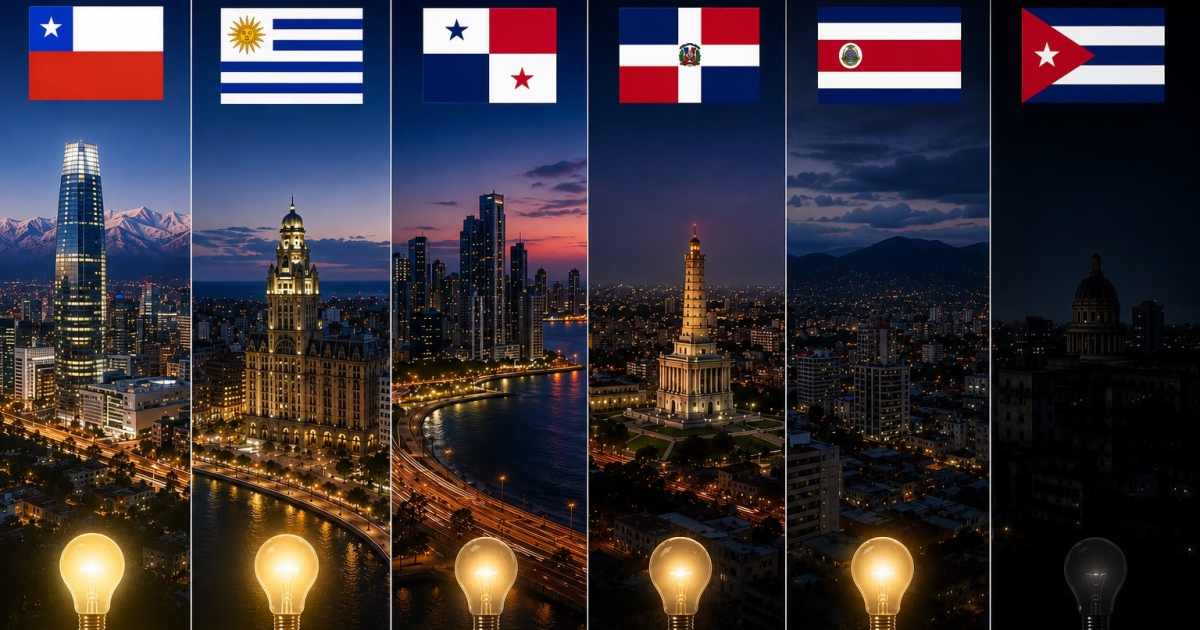
During much of the 20th century, Cuba was considered one of the most electrically developed countries in Latin America. By the 1950s, it had an electricity coverage that surpassed much of the region and a per capita energy generation that exceeded that of several Latin American nations that today boast modern and reliable electrical systems. Seventy years later, the reality is quite the opposite: the country is currently experiencing one of the worst energy crises in its history, with blackouts lasting up to twenty hours a day, total collapses of the National Electrical System (SEN), paralyzed industries, and an economy unable to sustain even minimal growth.
The problem did not arise overnight. It is the result of decades of insufficient investment, poor maintenance, an almost absolute dependence on fossil fuels, and an economic model that has been unable to modernize the country's energy infrastructure. The main thermoelectric plants in Cuba —Antonio Guiteras, Lidio Ramón Pérez (Felton), Máximo Gómez (Mariel), Carlos Manuel de Céspedes (Cienfuegos), Diez de Octubre (Nuevitas), Antonio Maceo (Renté), Ernesto Guevara (Santa Cruz), and the Energás unit in Varadero, along with other generation sources— operate with equipment that, in many cases, is over forty or fifty years old.
On paper, Cuba's installed capacity is sufficient to meet a significant portion of national demand. However, the reality is quite different. Constant breakdowns, prolonged maintenance, a lack of spare parts, and, above all, fuel shortages mean that a significant part of that capacity remains out of service. At various times in 2026, the effective availability of the system has fallen below 1,000 megawatts compared to demands exceeding 3,000 MW, causing historic deficits and nationwide blackouts.
This situation is compounded by the limited contribution of distributed generation and the new solar parks. Although in recent years dozens of photovoltaic installations have been inaugurated, their output remains insufficient to offset the deterioration of thermal power plants. Solar energy represents an important step toward a cleaner energy matrix, but it cannot alone sustain nighttime consumption or replace the base load generation required by a country of nearly ten million inhabitants.
Cuba's electricity demand typically ranges between 3,200 and 3,500 megawatts during peak consumption hours. On many occasions, the system barely manages to meet between 50 and 60% of that demand, and sometimes even less, forcing the implementation of extended scheduled outages and, at times, total blackouts when the national electrical system loses stability. The economic and social impact is devastating. Hospitals, schools, industries, businesses, and households experience interruptions in their daily activities, while small private enterprises face significant losses due to their inability to maintain refrigeration, production, or services.
The contrast with other Latin American countries is revealing. Uruguay, with a population of only three and a half million inhabitants, has built one of the most modern electrical systems on the continent. Almost 98% of its electricity comes from renewable sources—hydraulic, wind, biomass, and solar—and recently met a historic demand record without resorting to fossil fuels.
Costa Rica has maintained an electricity matrix based almost entirely on renewable sources for years. Although it faces challenges due to droughts associated with the El Niño phenomenon, it continues to ensure national supply through a combination of hydroelectricity, geothermal energy, wind, and solar power.
Panama, for its part, has significantly increased its generation capacity thanks to sustained investments in hydropower, natural gas, and renewable energies. Chile, which just two decades ago relied heavily on imported diesel, now leads the expansion of solar and wind energy in Latin America, thanks to clear regulations for private investment and long-term planning.
The Dominican Republic may perhaps serve as the most illustrative comparison for Cuba. With a similar population, it has consistently increased its installed capacity through private sector participation, new generation plants, expansion of transmission networks, and diversification of its energy matrix. In July 2026, the Dominican system responded with stability to a record demand exceeding 4,180 megawatts, something unimaginable today for Cuba.
After conducting research on electricity production per capita during peak hours in the aforementioned countries, we obtained the following data: Chile 661 Watts, Uruguay 556 W, Panama 467 W, Dominican Republic 384 W, Costa Rica 370 W, and Cuba only 122 W.
The fundamental difference between these countries and Cuba does not lie solely in the available natural resources. It primarily resides in the existence of regulatory frameworks that promote investment, allow for competition, diversify sources of generation, and ensure ongoing maintenance of infrastructure.
Is there a solution to the Cuban crisis? Yes, but it won't be quick or cheap. Experts in the sector estimate that the comprehensive recovery of the electrical system would require investments of several billion dollars to rehabilitate recoverable thermal power plants, build new combined cycle plants powered by natural gas, significantly expand solar and wind capacity, incorporate storage systems using batteries, modernize transmission and distribution networks, and reduce the enormous technical losses of the system.
However, money alone will not solve the problem. True transformation requires deep economic and institutional reforms that attract domestic and foreign investment, provide legal security to investors, decentralize electricity generation, create space for private producers, and establish a modern and competitive energy market.
History shows that Cuba was once one of the most advanced countries in Latin America in terms of electrification. The recent experiences of Uruguay, Costa Rica, Chile, Panama, and the Dominican Republic confirm that it is also possible to build modern, reliable, and sustainable electrical systems.
The question is not whether Cuba can emerge from darkness. It will, it must. But how long will the Castro-communist regime obstruct the necessary solution? And how long will the people allow themselves to be forced to live in the midst of a long dark night?
Related videos:
Filed under:
Opinion piece: Las declaraciones y opiniones expresadas en este artículo son de exclusiva responsabilidad de su autor y no representan necesariamente el punto de vista de CiberCuba.