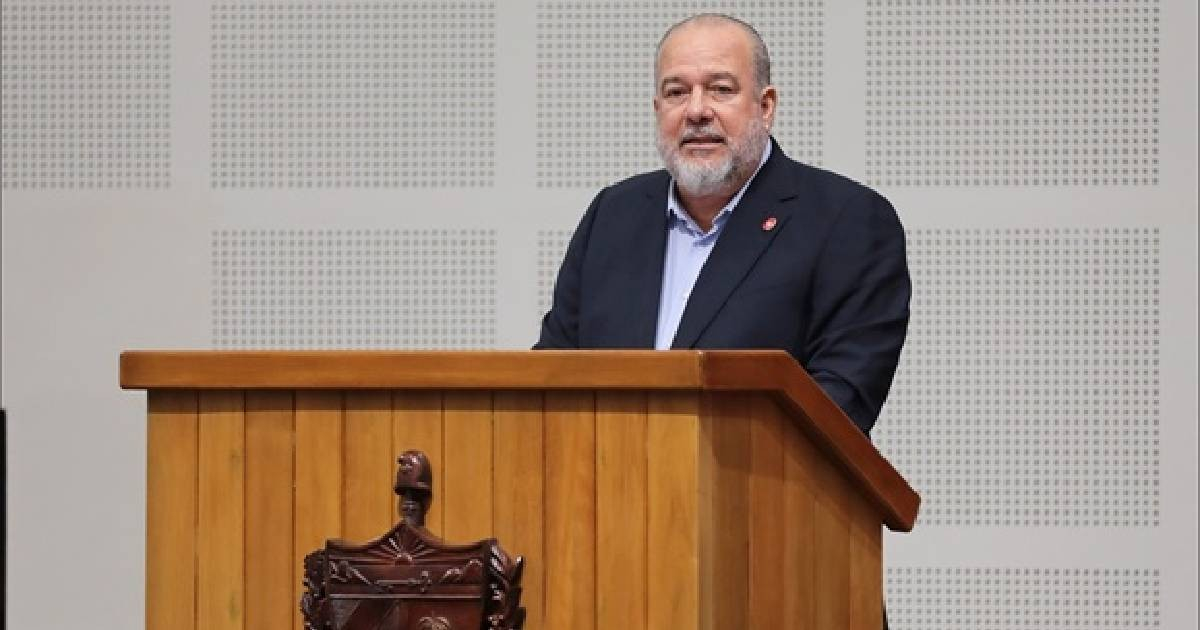
The Prime Minister Manuel Marrero Cruz announced this Wednesday before the National Assembly of People's Power that four ministries will eliminate more than 92,000 positions as part of a process to reorganize the Cuban state, according to the official source Cubadebate.
The cuts affect the ministries of Public Health, Education, Culture, and Sports, and are primarily focused, according to the regime, on vacant administrative positions. The rest of the state agencies will have to complete their own resizing process in September.
The announcement is part of the largest package of economic reforms that the regime has introduced in decades: 176 "transformations" approved in an extraordinary session of the National Assembly on June 18, endorsed by Raúl Castro and the Central Committee of the Communist Party.
Marrero reported that out of the 121 transformations scheduled for June and July, 110 had already been approved, accounting for 90.9% of the total planned, while another five were progressing partially.
The stated objective of the "rightsizing" is to separate state functions from business functions, reduce structures, and achieve more efficient government management. The regime did not specify how many of those 92,000 positions correspond to jobs currently filled and how many are positions that were already vacant.
This process is part of a broader plan, announced since April, which aims to reduce the number of ministries from 27 to between 20 and 21 through mergers and the creation of super ministries.
At the same time, Marrero presented other measures from the reform package. He highlighted the approval of a decree-law that grants greater autonomy to state enterprises to establish their own salary systems, define prices and rates, and make decisions regarding the employment relationship of their workers. Regarding this regulation, the prime minister asserted that it "constitutes the most significant transformation in terms of labor organization and salaries implemented in recent years."
It was also reported that Cuba has surpassed 15,000 authorized micro, small and medium enterprises (mipymes) and non-agricultural cooperatives, after approving all those that were pending authorization. Additionally, Decree 160, which eliminates 46 prohibitions and modifies another 36 for the non-state sector, came into effect this Tuesday.
In terms of territorial matters, the regime allocated excess revenues obtained in 2025 to 111 municipalities so that they could use them for their own local development strategies.
However, Marrero acknowledged before the deputies that "the prolonged blackouts continue to be one of the main problems facing the country," an admission that contrasted with the triumphalist tone of the rest of his speech. Cuba is experiencing the most severe energy crisis in its history, with electricity cuts lasting more than 20 consecutive hours in many regions and repeated total disconnections of the National Electrical System, in addition to widespread shortages of food and fuel.
The prime minister attributed part of the difficulties to the intensification of U.S. sanctions, which the regime claims have affected sectors such as energy, food production, tourism, and foreign trade, without acknowledging the responsibility of 67 years of centralized management in the Island's structural crisis.
According to official data, 1,464 MW of renewable energy sources have been installed, accounting for 13.8% of the national electricity generation, and 4,292 photovoltaic systems have been placed in essential facilities and homes.
The parliamentary session this Wednesday also had on its agenda the approval of the Labor Code, the Housing Law, and the Law on the Organization of the Central State Administration, among other key regulations to support the reforms.
Related videos:
Filed under: